


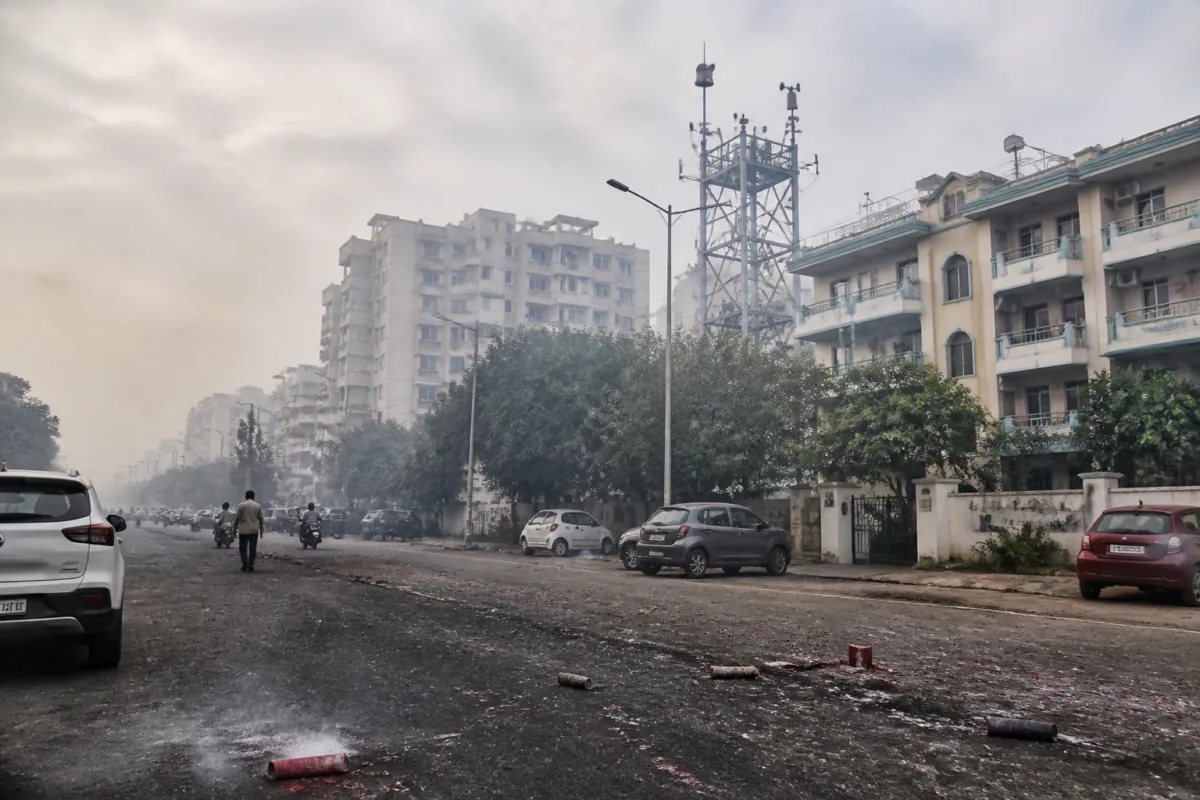
Visakhapatnam’s air quality deteriorated to the ‘poor’ category after Diwali celebrations, with the Air Quality Index rising from 229 on November 8 to 264 on November 9 and noise levels in residential areas reaching 111 decibels. Rajamahendravaram also recorded poor air quality, while most other monitored cities in Andhra Pradesh remained in the moderate category.
The Visakhapatnam readings were recorded at a Greater Visakhapatnam Municipal Corporation monitoring station, according to data cited in a report by Deccan Chronicle. Particulate matter, particularly PM2.5, emerged as a major pollutant after the festival fireworks.
Rajamahendravaram recorded an AQI of 220 at the monitoring station at Anam Kala Kendram. The readings placed both cities in the poor category, indicating a significant deterioration compared with locations where the AQI remained moderate.
The reported air-quality deterioration was accompanied by a sharp rise in noise levels during Diwali night. In Visakhapatnam, average noise levels in residential areas ranged from 62 to 75 decibels, against a prescribed standard of 45 decibels. The peak level recorded in the city was 111 decibels.
Vijayawada also recorded elevated noise levels, with residential-area averages ranging from 63 to 77 decibels and a peak of 112 decibels. The figures show that the festival-related disturbance extended beyond the cities where air quality entered the poor category.
Air quality remained in the moderate category in Amaravati, Anantapur, Eluru, Guntur, Kadapa, Kakinada, Kurnool, Machilipatnam, Nellore, Ongole, Srikakulam, Tirumala, Tirupati and Vijayawada, according to the report. The variation between cities highlights the importance of location-specific monitoring during periods of concentrated fireworks activity.
Andhra Pradesh Pollution Control Board officials said there was no significant variation in AQI and average noise levels recorded in different parts of the state during Diwali in 2025 and 2026. The statement provides the pollution-control authority’s assessment alongside the city-level monitoring readings reported from Visakhapatnam and Rajamahendravaram.
The immediate monitoring focus remains on the AQI readings, PM2.5 levels and noise measurements recorded across the affected locations after the celebrations. Further assessment by pollution-control and municipal authorities will determine how the readings change after the festival period.

