


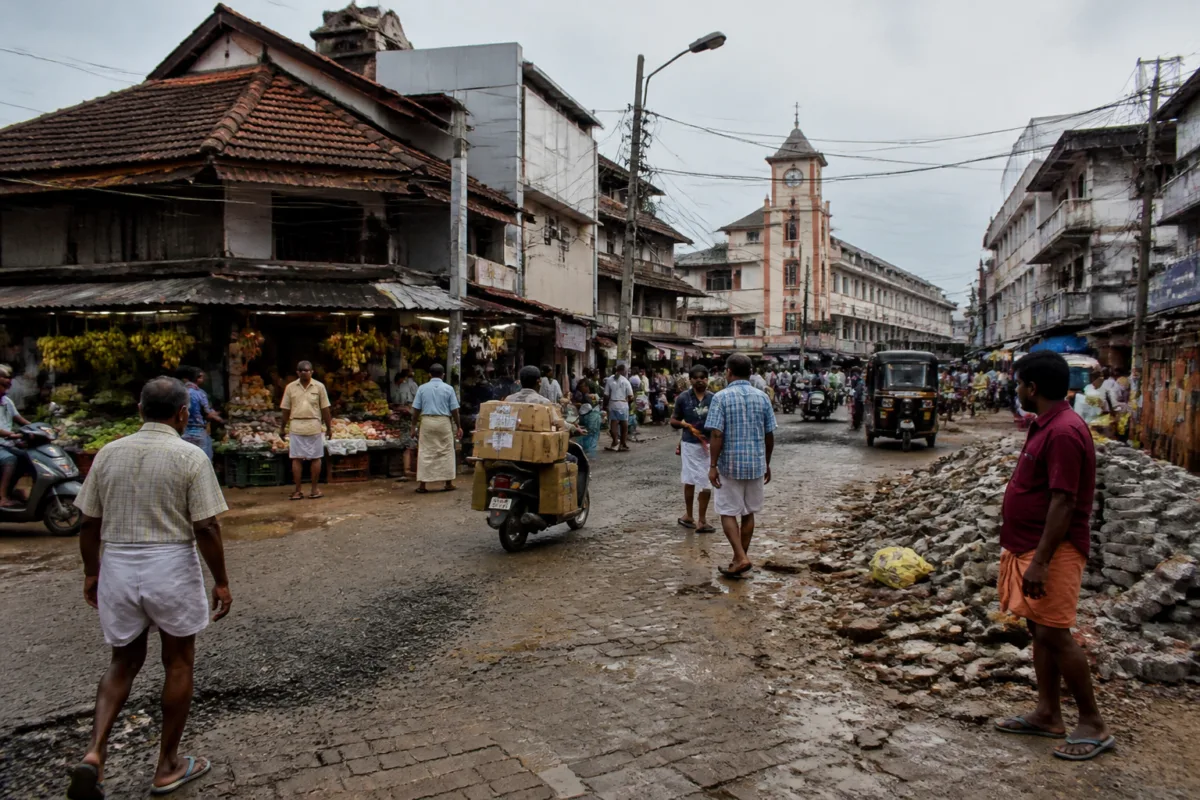
The uncertainty surrounding Thiruvananthapuram’s Chalai Heritage Street project is not only a story about delayed funding. It is also a demonstration of how multi-agency urban projects can lose momentum when the institution responsible for implementation and the civic body expected to support it no longer share an active roadmap.
The project was conceived to transform Chalai, a nearly 400-year-old commercial market, into a more pedestrian-friendly heritage and tourism destination. But the city corporation says it has no immediate proposal to take the project forward, while Smart City Thiruvananthapuram Ltd (SCTL), the implementing agency, maintains that the initiative remains active and is awaiting assistance from the Union government.
That difference is central to the project’s current status. For the corporation, the scheme is not presently on its agenda. For SCTL, the project has not been abandoned and could proceed if the proposed funding is approved. In practical terms, the redevelopment has reached a point where a project cannot move ahead through the implementing agency’s financial proposal alone, but there is also no clear evidence in the supplied material of an agreed municipal implementation plan.
According to the Times of India report, SCTL has prepared a proposal seeking around Rs 60 crore under the Centre’s Urban Challenge Fund. The proposal is awaiting clearance from the Union government. An SCTL official said, “The funding from the Union govt is getting delayed. If we receive fund, we will take up the project by associating with the civic body.” The statement makes funding a necessary condition for revival, but it also confirms that coordination with the corporation would still be required.
This is the institutional weakness exposed by the project: the agencies involved appear to be discussing the same scheme from different administrative positions. SCTL is looking at the project through the lens of funding and implementation. The corporation’s position, as stated by Mayor V V Rajesh, is that there is currently no proposal to take it forward. Without a jointly owned scope, timeline and responsibility structure, even an approval of the requested funds may not automatically resolve the project’s uncertainty.
Chalai’s redevelopment has already undergone several changes. When it was launched in 2018, the project was modelled on the redevelopment of SM Street in Kozhikode. Its original vision included heritage-style arches at entry points, tiled footpaths, umbrella-style covered walkways, underground utility cables, LED streetlights, Wi-Fi connectivity, heritage-themed wall art and landscaped seating spaces. The proposal was intended to combine commercial activity with a stronger public-realm and tourism identity.
That original design encountered two familiar constraints in Indian market-area redevelopment: funding limitations and resistance from existing traders. The source report states that traders raised objections over the design and the possibility of displacement. The project was subsequently modified, with greater emphasis on improving the eight feeder roads connecting the market, upgrading street infrastructure and improving access without evicting existing traders.
The change was significant. Instead of treating heritage redevelopment primarily as a visual transformation of the main market street, the revised approach attempted to address the surrounding movement network and the continuity of existing businesses. This is often the more difficult form of urban renewal because it requires construction in an active commercial area while preserving access, livelihoods and daily trading patterns.
SCTL has already spent nearly Rs 15 crore on improvements to the eight feeder roads, against an estimated cost of around Rs 30 crore for that component. That expenditure indicates that the project is not an entirely unstarted proposal. A portion of the planned access infrastructure has been taken up, but the main market street, heritage features and proposed parking facilities remain incomplete.
The incomplete status creates a fragmented urban outcome. Improvements to feeder roads can support access, but they do not by themselves deliver the pedestrian-oriented heritage district originally envisaged. The public experience of a market is shaped by the relationship between approach roads, walking surfaces, crossings, utilities, parking, loading activity, shopfronts and public amenities. If only selected components are completed, the project may remain difficult to read as a coherent redevelopment scheme.
The project’s history also shows how changing designs can become a symptom of unresolved institutional and financial priorities. The initial plan focused on a strong heritage identity and a defined public-realm design. Later revisions responded to funding constraints and trader concerns. The revised emphasis on feeder roads and non-displacement addressed some practical risks, but the source material does not establish whether the agencies agreed on a final design, a sanctioned cost for the remaining works or a firm delivery schedule.
This distinction matters because a revised urban project needs more than a modified concept. It needs an approved scope, a funding commitment, an implementation agency with a live mandate and a civic partner prepared to manage the operational consequences. Those consequences would include construction access, traffic management, pedestrian movement, utility work, parking arrangements and coordination with traders. The supplied report does not indicate that these responsibilities have been consolidated into a current implementation roadmap.
The proposed Urban Challenge Fund assistance adds another layer to the project’s administrative structure. The initiative was originally associated with the state government, the tourism department, the city corporation and the Smart City mission. Earlier discussions also involved the state public works and tourism departments, with assurances that resources from different agencies would be mobilised. The project therefore depends on a chain of decisions extending across municipal, state and Union-level institutions.
Multi-agency involvement can bring together funding, technical capacity and sectoral expertise. It can also make accountability difficult when a project slows down. A corporation may control local priorities and day-to-day public-space management, while a special-purpose company may be responsible for project preparation and implementation. State departments may influence tourism, roads or construction, and central funding may determine whether the next phase can be sanctioned. Unless one institution is clearly empowered to coordinate the full programme, responsibility can become distributed without being integrated.
Chalai’s case also raises a broader question about heritage-led redevelopment in functioning markets. A market that is nearly 400 years old is not simply a collection of buildings or façades. It is a working economic system with traders, customers, deliveries, parking demand and movement patterns. The decision to avoid eviction and focus on accessibility recognises that reality. However, it also makes implementation more complex than a conventional streetscape upgrade, because construction must be sequenced around ongoing commercial use.
The source material provides no evidence that the project has been formally cancelled. It does, however, establish that the corporation has no immediate plan to take it up, while SCTL is waiting for central funding clearance before proceeding. That places the project in an administrative gap rather than at a clearly defined implementation stage. The initiative remains politically and institutionally alive, but its next operational step is uncertain.
The numbers tell a similar story. Nearly Rs 15 crore has already been spent on the feeder roads, compared with an estimated Rs 30 crore for that component. Around Rs 60 crore is now being sought under the Urban Challenge Fund for revival. Yet the available information does not clarify whether the proposed amount covers all unfinished components, only a revised phase, or a new version of the project. It also does not establish the current total project cost or the timeline for the remaining works.
That absence of a clear financial and implementation baseline is important for public accountability. Residents, traders and visitors need to know what has been completed, what remains sanctioned, which agency owns each pending component and what conditions must be met before work can resume. Without that information, repeated assurances of revival can coexist with little visible progress on the main market street.
For Thiruvananthapuram, the larger urban issue is not whether every heritage proposal should be built exactly as first designed. Plans may reasonably change when funding, trader concerns or operational realities make the original proposal unsuitable. The more consequential question is whether those changes are being managed through a transparent, jointly approved framework that protects public investment and gives affected users a predictable process.
The Chalai project therefore remains a test of implementation rather than concept design. Its heritage ambition, pedestrian focus and non-displacement approach have all been articulated at different stages. The unresolved parts are institutional: who is currently leading, who is funding, who is approving, and who is responsible for coordinating the remaining work.
The immediate developments to watch are the Union government’s decision on the proposed Rs 60 crore assistance, the corporation’s position on associating with SCTL, and the publication of a clear plan for the unfinished market-street, heritage and parking components. Until those steps are defined, Chalai’s redevelopment will remain a partially executed project caught between an earlier vision and an uncertain administrative future.

