


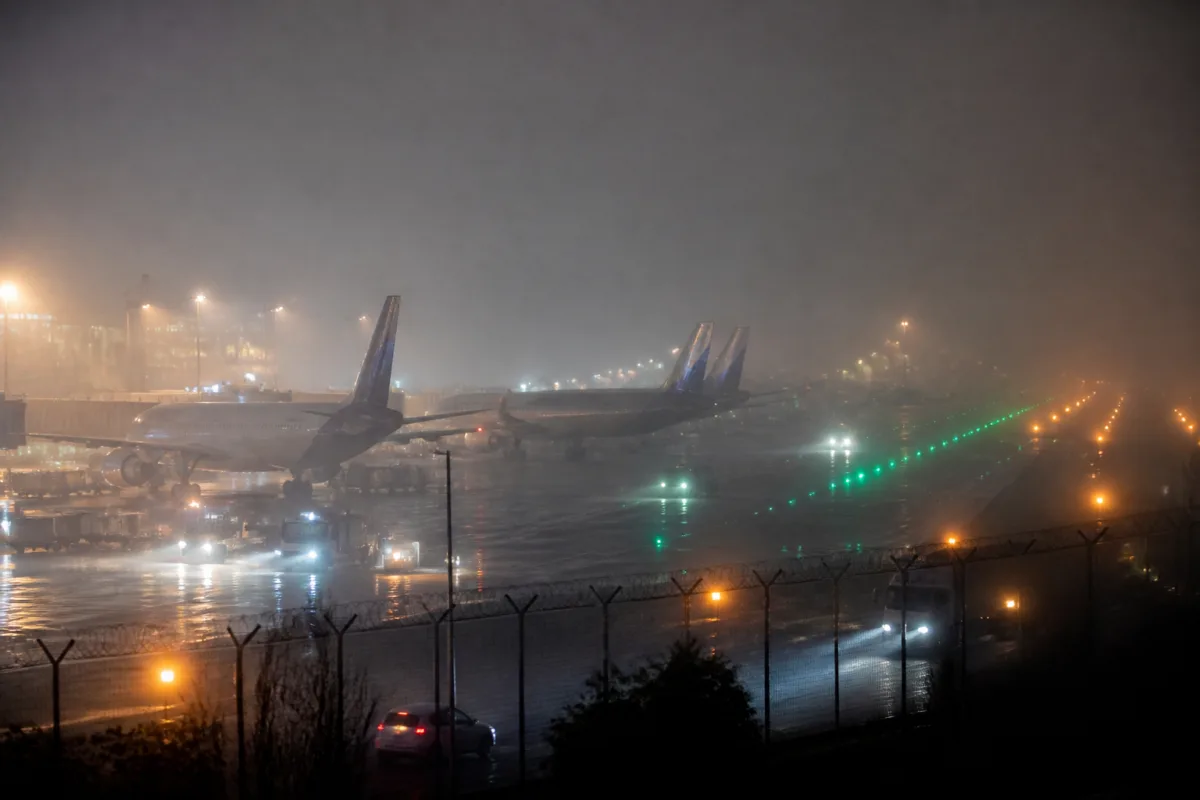
Delhi airport activated its first Low Visibility Procedure (LVP) of the winter season on Diwali night after smog sharply reduced visibility, delaying 44% of departing flights by an average of about 20 minutes, according to airport updates reported by Jagran.
The procedure was introduced at Indira Gandhi International Airport as falling temperatures, rising pollution and weak winds created conditions in which pollutants accumulated close to the ground. Delhi Airport issued a passenger advisory at 12:40 pm, warning travellers that low-visibility measures were in operation.
The airport said flight operations continued normally while the procedure was in progress. However, between midnight on Sunday and 8 pm on Monday, about 44% of departure flights were delayed, with the average delay recorded at around 20 minutes. Arrival flights operated with little or no delay during the same period, according to the report.
An LVP is activated when visibility on or around the runway falls below prescribed safety thresholds. The measures increase the separation between aircraft movements and restrict the speed of ground operations. These safeguards are intended to reduce risks during taxiing, take-off and landing when pilots and ground-control teams have limited visual conditions.
At airports equipped for low-visibility operations, systems such as Category III instrument landing technology and specially trained pilots can support aircraft movements in reduced visibility. Their use can help limit diversions and cancellations, although the procedure may still result in slower aircraft movement and delays for passengers.
The conditions at Delhi airport were linked in the report to the early arrival of winter weather and deteriorating air quality. As temperatures fall and moisture rises, dust and fine pollutants, including PM2.5 and PM10, can combine to form a dense layer of smog. Low wind speeds prevent these particles from dispersing, allowing them to remain trapped in the lower atmosphere and causing visibility to fall quickly.
The operational effect is significant because IGI Airport is one of the country’s busiest aviation hubs, handling large volumes of departures, arrivals and connecting passengers. Even when most flights continue to operate, restrictions on ground movement and aircraft separation can have a cumulative effect across the schedule, particularly during a high-demand travel period such as Diwali.
The airport’s advisory allowed passengers to account for possible delays while safety procedures remained in force. The latest reported update indicated that the principal impact was on departures, while arrivals were largely maintained without significant disruption.

