


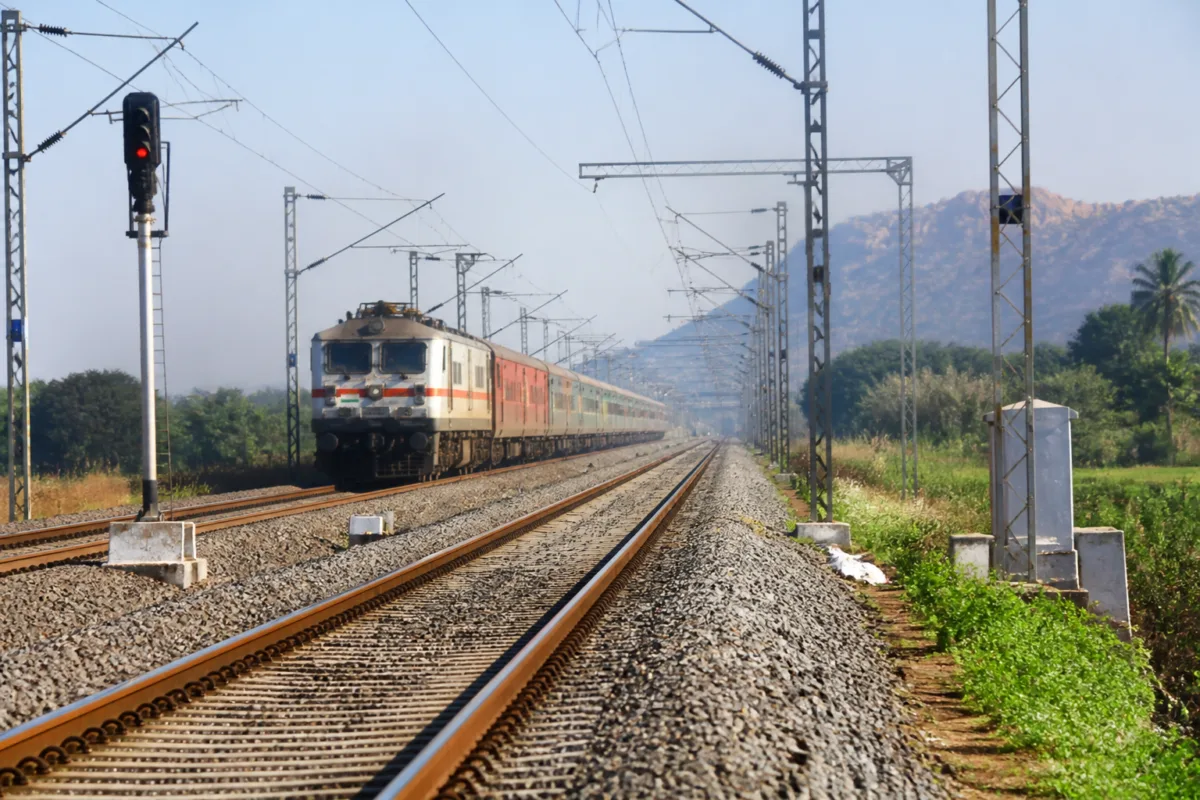
The commissioning of the Nandyal–Gajulapalli double-line section in Andhra Pradesh has removed a single-line constraint on the Guntur–Guntakal railway corridor, adding operational capacity to a route that carries both passengers and freight. The 15.121-km section was commissioned on November 6 after statutory inspection and speed authorisation by the Commissioner of Railway Safety on November 3.
South Coast Railway has authorised train operations on the new section at a permissible speed of 100 kmph. The immediate significance is not the length of the completed track alone, but the change from a constrained section to a two-line operating environment. On a single-line railway, trains moving in opposite directions must be coordinated through crossings or controlled sections, making movement dependent on the availability of passing capacity and the timing of each service. Doubling creates a second track for parallel movement and gives railway operations more room to manage train paths.
The commissioned section forms part of the ongoing Guntur–Guntakal doubling project. The supplied report does not state the total length, cost, funding structure or completion schedule of the wider project. It does, however, identify the Nandyal–Gajulapalli stretch as a critical bottleneck and says its removal will improve line capacity, operational flexibility, passenger convenience and freight throughput.
That combination is important because railway capacity is a corridor issue rather than a station-level issue. A new or doubled section can improve movement locally, but its full operational value depends on how the adjoining sections perform. The report confirms that the new section is part of a larger doubling programme, but does not establish whether all other bottlenecks on the Guntur–Guntakal corridor have been removed. The available evidence therefore supports a clear conclusion about this section, but not a claim that the entire corridor has been upgraded.
The project also illustrates the role of statutory safety approval in railway infrastructure delivery. The Commissioner of Railway Safety carried out the inspection and speed authorisation on November 3, before the section was commissioned three days later. This sequence indicates that the infrastructure was not opened for train operations merely on the basis of construction completion. It first passed the required inspection process and received authorisation for a specified operating speed.
The 100-kmph permissible speed is another operational detail with significance for the corridor. It establishes the approved speed ceiling for train operations on the newly doubled section, although the supplied material does not say that every service will run at that speed. Actual journey-time effects would depend on train schedules, station stops, signalling, traffic priority, rolling stock and conditions on connecting sections. None of those operational details are provided in the report, so the commissioning should be understood primarily as a capacity intervention rather than as proof of a specified travel-time reduction.
For passengers, the reported benefit is improved operational flexibility. A doubled section can give railway controllers more options when sequencing trains and managing services moving in different directions. It can also reduce the dependence on crossing arrangements associated with a single-line section. The report does not provide the number of passenger services using the route, the number of daily trains affected or a forecast of punctuality improvements. The citizen impact can therefore be identified in operational terms, but cannot be quantified from the available evidence.
The freight dimension is equally central. South Coast Railway said the project would bolster freight throughput across the Guntur–Guntakal corridor. Freight trains often require careful path planning because of their length, weight and operating characteristics. Additional line capacity can allow passenger and freight movements to be scheduled with greater flexibility, but the report does not provide cargo volumes, commodity categories, train counts or projected tonnage. It establishes the intended infrastructure benefit without supplying a measurement of the increase that will follow.
This distinction matters in assessing railway projects. Commissioning a physical asset is a measurable milestone: 15.121 kilometres of double line have been placed into service after inspection and authorisation. The broader economic and mobility outcomes are operational results that require further data. Those results may include more train paths, fewer crossing-related constraints and improved ability to accommodate different categories of traffic, but the supplied report does not document their scale.
The Nandyal–Gajulapalli section also shows how corridor upgrades are delivered through incremental packages. Rather than treating the Guntur–Guntakal route as a single construction event, the doubling project is advancing through sections that can be inspected, authorised and commissioned individually. This approach allows completed stretches to enter service while work continues elsewhere. At the same time, it means that the performance of the corridor must be assessed across the full route, since an unresolved constraint outside the commissioned section can continue to affect end-to-end operations.
The administrative chain visible in the report is relatively clear. South Coast Railway commissioned the section, while the Commissioner of Railway Safety conducted the statutory inspection and authorised the operating speed. These are distinct functions: the railway administration is responsible for bringing the infrastructure into operational use, while the safety authority’s inspection and authorisation form part of the approval process before trains run on the section.
The report attributes the wider benefits to a release issued by South Coast Railway. It does not identify the contractor, project cost, land requirements, construction challenges or source of capital expenditure. It also does not state whether the completed section involved new signalling, station modifications, bridges, level-crossing changes or other associated works. These omissions do not undermine the central commissioning fact, but they limit what can be said about the project’s institutional and financial architecture.
The infrastructure outcome is nevertheless significant because rail capacity often determines whether a corridor can absorb additional demand without relying only on faster trains or timetable changes. A single-line section imposes a physical requirement for trains travelling in opposite directions to share the same track at different times. Doubling changes that basic constraint. The report’s reference to a “critical bottleneck” indicates that the section had been identified as a point where the corridor’s operating capacity was restricted.
What remains unestablished is the baseline against which improvement should be measured. The source does not state how many trains previously used the section, how long crossings took, whether services were delayed there, or what additional train paths the doubling will create. It also does not say whether the project is intended primarily to support passenger growth, freight movement, timetable reliability or all three. Without those figures, the commissioning can be evaluated as a clear capacity milestone, but not as a quantified performance success.
The larger urban and regional question is how railway infrastructure connects cities, towns, industrial locations and employment centres beyond metropolitan boundaries. The Guntur–Guntakal corridor links different parts of Andhra Pradesh’s rail network, and the report’s emphasis on both passenger convenience and freight throughput points to a shared infrastructure role. Rail lines are not only transport assets for daily travellers; they are also channels through which goods move between production areas, markets and logistics networks.
That dual role makes capacity planning especially important. Passenger and freight services compete for train paths on the same network, and a constrained section can affect both. A doubling project can provide more operating flexibility, but the actual balance between passenger and freight use will depend on railway scheduling and corridor demand. The supplied material does not disclose that allocation, making it premature to claim how the new capacity will be distributed.
The commissioning also places attention on the next stages of the Guntur–Guntakal doubling project. Since the report describes the Nandyal–Gajulapalli section as part of an ongoing project, the future significance of this milestone depends partly on progress across remaining sections. The available account does not provide a project completion date or identify the next section scheduled for commissioning. Those details will be necessary to determine whether the corridor is approaching continuous double-line operation or remains dependent on other single-line bottlenecks.
For now, the evidence confirms three specific developments: 15.121 kilometres between Nandyal and Gajulapalli have been doubled; the section passed statutory inspection and received speed authorisation from the Commissioner of Railway Safety; and South Coast Railway has commissioned it for train operations at a permissible speed of 100 kmph. It also establishes the stated operational objectives of higher capacity, greater flexibility and improved passenger and freight movement. The scale of the resulting gains, the status of the wider doubling project and the next implementation milestone remain to be reported.

