


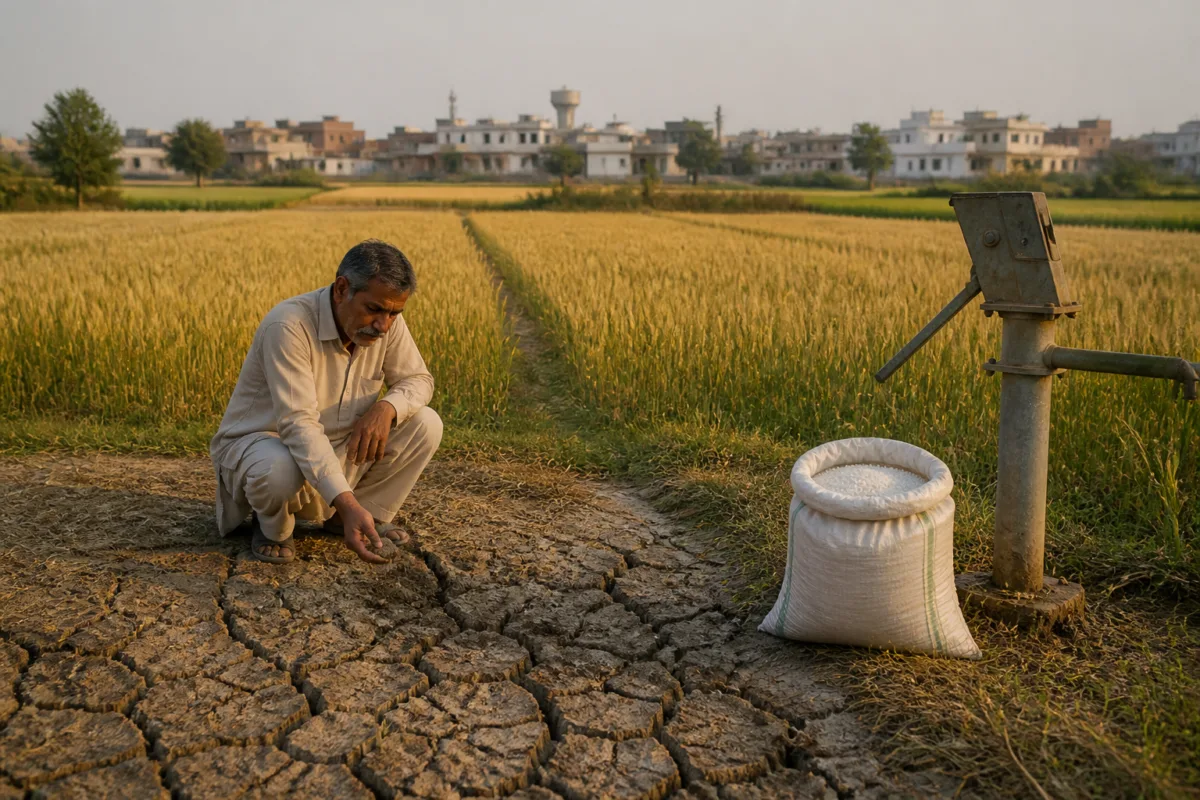
India’s chemical fertiliser subsidy is designed to keep farm inputs affordable, but a new Climate Trends study argues that the policy’s real cost extends far beyond the Union Budget. Soil degradation, groundwater contamination, dependence on imported energy and greenhouse gas emissions are creating liabilities that are absorbed by the wider economy and environment.
The study, titled The Economics of Cultivation, examined wheat and paddy cultivation across eight states. It found that when environmental damage and government expenditure are included, the total economic benefit generated by wheat cultivation was 36% to 182% lower than the direct financial benefit received by farmers. In two of the five cases examined, the overall social benefit became negative.
That finding shifts the debate from the size of the fertiliser subsidy to the way it is structured. The study argues that the problem is not simply that farmers use too much fertiliser. It is also that the pricing system makes urea artificially cheaper than other nutrients, encouraging its greater use. The result is an imbalance that affects farm productivity, soil health and public finances.
### The chemical fertiliser subsidy and soil health
The evidence cited in the study points to a paradox at the centre of India’s fertiliser policy. Despite excessive nitrogen use, 97% of tested soil samples were found to have nitrogen deficiency and 85% showed a shortage of organic carbon. This suggests that higher application of one nutrient is not translating into healthier or more productive soils.
The study also cites groundwater nitrate levels above the Bureau of Indian Standards’ drinking-water limit in Punjab, Haryana, Rajasthan, Uttar Pradesh and Tamil Nadu. These findings connect fertiliser policy to a wider water-security issue. Groundwater contamination can increase the cost and difficulty of providing safe water, particularly in areas where aquifers remain essential for both irrigation and human consumption.
For cities, the issue is not distant from the urban system. Agricultural pollution moves through watersheds and groundwater networks, while water treatment, public health and energy costs are ultimately shared across settlements. The study does not quantify the urban cost of nitrate contamination, but its findings show how an agricultural input policy can produce consequences beyond the farm.
The efficiency of fertiliser use has also declined sharply. In 1970, one kilogram of fertiliser was associated with 13.4 kilograms of grain production. By 2015, the figure had fallen to 2.7 kilograms. The study presents this decline as evidence that increasing input use is not delivering a comparable increase in output.
### An energy and supply-chain vulnerability
Synthetic nitrogen fertiliser is closely tied to natural gas because gas is a major input in its production. This makes fertiliser availability and cost vulnerable to global energy markets and geopolitical disruptions.
The Climate Trends study describes the impact of disruption around the Strait of Hormuz in February 2026. It says the price of urea rose 53.7% in a month to about $726 per tonne, its highest level in four years. During the disruption, Indian fertiliser plants reportedly received only 60% to 70% of their normal gas supply, while domestic urea production fell by 800,000 tonnes in March.
To prevent shortages, India drew on its reserves and, over three months, used 6.9 million tonnes of domestic urea and imported 1.8 million tonnes. The cost was borne by the government. The study says this did not eliminate dependence on imports. It links the episode to a broader exposure: India receives 41% of its crude oil, 55% of its liquefied natural gas and up to 90% of its liquefied petroleum gas through the Strait of Hormuz.
The same vulnerability was visible during the Russia-Ukraine war in 2022, when global supplies of nitrogen and potash were disrupted. The lesson from these episodes is not simply that fertiliser prices can rise. It is that a subsidy system designed around cheap chemical inputs can leave the state responsible for absorbing shocks in global fuel and commodity markets.
### Why a sudden shift would also be damaging
The study does not argue for ending chemical fertiliser use overnight. Its evidence instead supports a gradual transition, because farmers face immediate costs when they change cultivation systems while the financial benefits may arrive later.
Organic certification can take two to three years, during which farmers may not receive the premium price associated with organic produce. The study cites international research suggesting that organic farming can generate 22% to 35% higher profits when premium prices are included, even with a 10% to 18% decline in yields. It says organic products would need only a 5% to 7% premium over ordinary market prices to deliver profit equivalent to conventional farming.
However, these gains depend on market access, certification, training and institutional support. The example of Sikkim shows the risk of reducing subsidies without addressing these conditions. The study says that some farmers there experienced lower yields because of gaps in training and certification. Sri Lanka’s 2021 ban on chemical fertilisers is cited as another warning against imposing a rapid transition without adequate preparation.
Evidence from India indicates that a phased approach may be possible. An experiment at the ICAR-Indian Institute of Farming Systems Research in Modipuram found that fields using 50% to 75% organic alternatives achieved yields comparable to fully organic fields and performed better than fields relying entirely on chemical fertilisers. The study reports an additional profit of Rs 53,200 per hectare compared with chemical farming.
It also cites Andhra Pradesh’s natural farming programme, where farms using natural methods were reported to achieve similar yields and more than twice the profit of chemical-farming plots. These examples do not establish that one model will work uniformly across India. They do indicate that the transition question is more complicated than a choice between unrestricted chemical use and an immediate ban.
### Redesigning the subsidy system
The study recommends redirecting fertiliser support rather than removing it abruptly. One proposal is to calculate subsidies according to the nutrients contained in fertiliser instead of providing disproportionate support to urea. Another is to link part of the subsidy to soil-health-card recommendations, so that public support reflects local soil conditions and crop requirements.
It also proposes changing the basis of the PM-PRANAM scheme, which encourages reductions in chemical fertiliser use, from the previous year’s consumption to a fixed reference year. The study further recommends placing decisions on fertiliser prices and soil health under a single agency rather than leaving them divided among multiple ministries.
These recommendations point to an administrative problem as much as an agricultural one. Fertiliser pricing, energy security, water quality, soil conservation and climate policy are connected, but they are often managed through separate institutional systems. Without coordination, a policy that solves one immediate problem can deepen another. Keeping urea affordable may protect farm input costs in the short term while increasing pressure on groundwater, energy imports and future public expenditure.
The report estimates that shifting paddy cultivation towards a lower-input system would cost Rs 11,554 per hectare. If 1 million hectares were converted, it says annual savings could reach Rs 1,155 crore. It also estimates that eliminating synthetic nitrogen use could reduce nitrous oxide emissions from fields by about 0.49 tonnes of carbon dioxide equivalent per hectare each year.
These figures are study estimates and depend on the scale and design of implementation. They nevertheless show how the subsidy debate can be reframed. Public spending is not only a question of how much support farmers receive. It is also a question of whether support reduces long-term costs or locks the system into higher exposure to environmental and energy shocks.
### The larger resource-security question
The Climate Trends study places fertiliser policy at the intersection of food security, energy security, water quality and climate resilience. Its central argument is that the visible price of fertiliser is only one part of the cost. The less visible components include declining soil quality, nitrate pollution, dependence on natural gas and the public money required to manage supply disruptions.
For policymakers, the evidence supports a carefully sequenced transition with training, suitable inputs, certification, market access and financial protection during the early years. For farmers, it shows why the risk of changing cultivation practices cannot be transferred to them alone. For cities and water agencies, it reinforces the need to treat agricultural pollution as part of the wider water and environmental system.
The study confirms that India’s current fertiliser model carries costs beyond the subsidy line. It also shows that alternatives may improve farm profitability, but only when supported by credible institutions and functioning markets. What remains unresolved is how quickly different regions can reduce chemical dependence without compromising yields, and whether government agencies can coordinate subsidy, soil, water and energy policy effectively. Those implementation questions will determine whether reform reduces the hidden cost of cultivation or merely shifts it elsewhere.

