


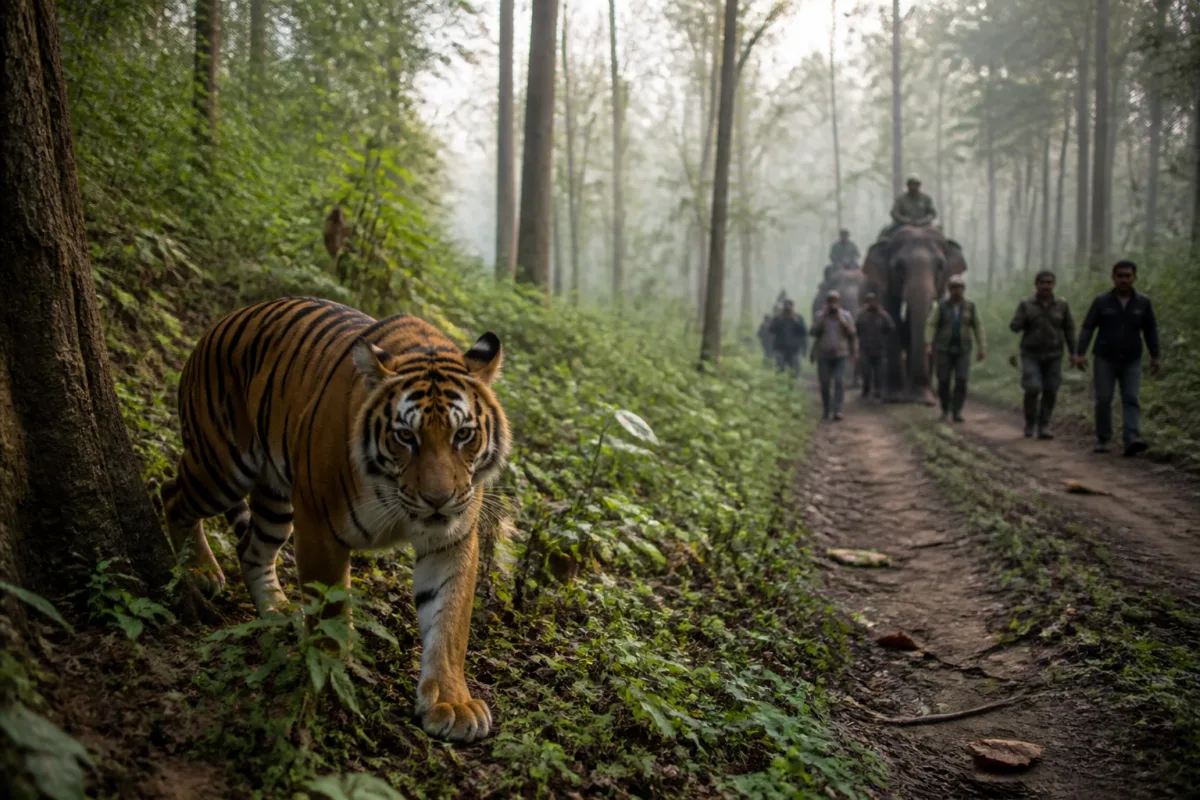
The escape of a tigress from an enclosure inside Buxa Tiger Reserve has brought fresh scrutiny to her earlier transfer from Bihar’s Valmiki Tiger Reserve, after a National Tiger Conservation Authority review flagged injuries to both forepaws and questioned whether her release into the wild was rushed.
The tigress escaped by digging beneath the enclosure on Sunday and was last located in the Kumargramduar area on Monday afternoon, according to sources cited by the Times of India. Tracking teams and three kunki elephants were monitoring her within the Buxa reserve. Officials were also arranging more elephants from nearby forest divisions to prevent her from crossing the Sankosh river and returning to Assam.
The NTCA review meeting, held on October 15 and chaired by Global Tiger Forum secretary general Rajesh Gopal, reportedly concluded that the tigress should not have been released despite visible injuries to the claws of both forepaws. Gopal is also a member of the NTCA expert panel overseeing the Buxa tiger reintroduction project.
According to the meeting minutes reviewed by the newspaper, the tigress was healthy and uninjured when she was darted in Valmiki on September 29. She was transported by road to Gorakhpur, flown for about 2.5 hours on an Indian Air Force aircraft to Hasimara, and then taken by road to Buxa. The journey included a four-hour road leg before the flight.
The minutes state that the tigress displayed resedation effects after the first reversal antidote, prompting a second half-dose at about 10.18pm. During the journey, she struggled inside the transport cage. By the time she reached Hasimara on September 30, she was awake, aggressive and charging at the cage gates.
A veterinary examination on October 1 reportedly found abrasion injuries on the paw pads of both forelimbs, with the claws appearing filed or worn. The review recorded that the injuries occurred after the reversal of the immobilising drugs and said her release should have been deferred until their extent was assessed and treatment prescribed.
The tigress was released from the acclimatisation enclosure on October 4. An official cited by the report said she subsequently made kills of wild herbivores and domestic pigs, indicating that she was hunting after entering the reserve. The NTCA review, however, recommended that future tigers for the Buxa project be sourced from Assam’s Manas or Kaziranga reserves to reduce travel time and transport-related stress.
The report also records questions about the management of a later capture near Raimona in Assam on November 3, when the tigress was brought back to Buxa. Sources questioned whether Assam officials had been invited, whether a joint monitoring protocol had been followed and whether the required NTCA permission had arrived before the capture. These claims were not independently confirmed in the supplied report.
The episode highlights the operational complexity of moving large carnivores across state borders and forest landscapes. It involves veterinary assessment, immobilisation protocols, transport planning, acclimatisation, inter-state coordination and post-release monitoring. The NTCA review report was sent to authorities on October 27. Calls to senior NTCA officials and West Bengal forest minister Manoj Kumar Oraon were unanswered, while tracking teams continued efforts to keep the tigress inside Buxa and monitor her movements.

