


Pune air pollution has worsened despite the city spending ₹275.28 crore on measures linked to air-quality improvement over seven years, according to data cited from the Centre’s PRANA portal and information obtained under the Right to Information Act. The contrast between rising particulate pollution and substantial public expenditure raises a more consequential question than whether the city has spent enough: whether its interventions are controlling pollution at its source.
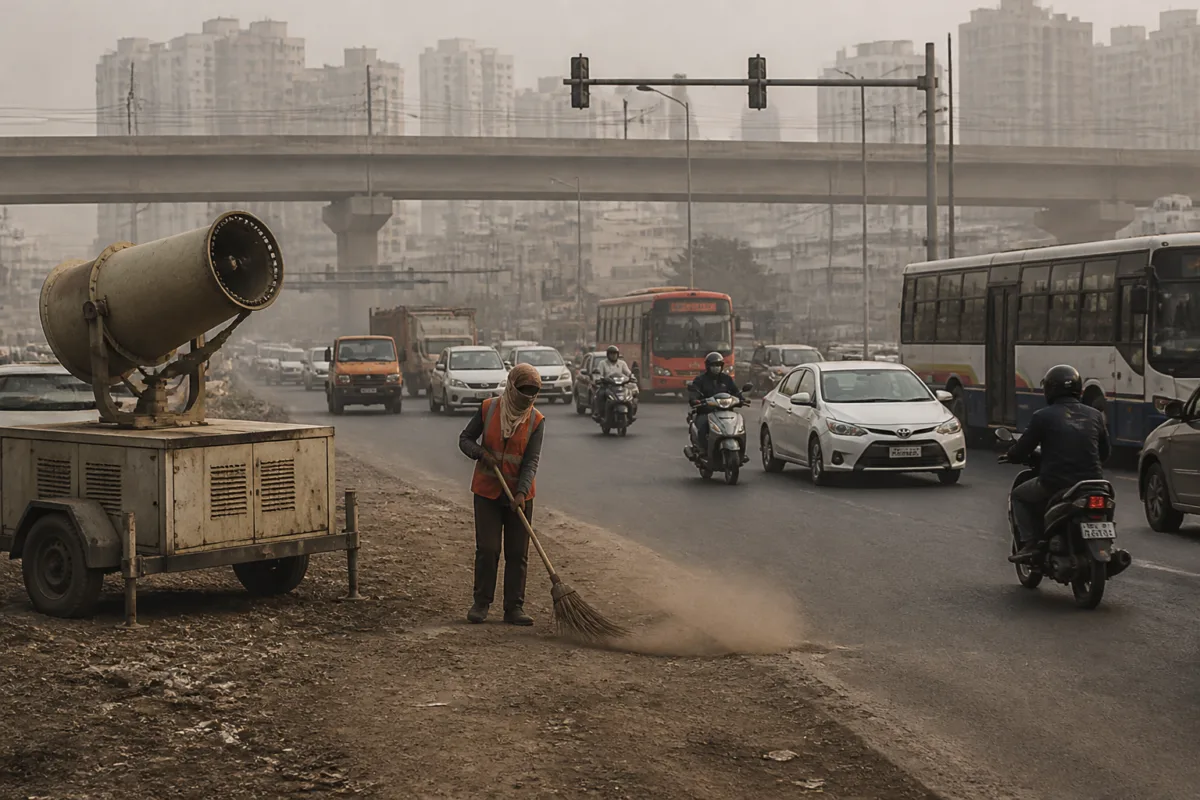
The concern became particularly visible when Pune’s Air Quality Index was reported at around 427.39 on a Sunday evening, placing it in the severe category. The Pune Mirror report attributed the episode to a combination of Diwali firecracker smoke, construction dust and the resuspension of road dust. It also reported that mist fountains installed at major traffic junctions and mobile fog cannon machines acquired for important road corridors were either defunct, rarely operational or stored in municipal sheds.
Those details matter because they expose two different ways of measuring urban environmental policy. One is financial utilisation: how much money has been released and spent. The other is atmospheric performance: whether particulate concentrations have declined at the locations and times where residents are exposed. Pune’s experience, as described in the available evidence, shows that the first measure can improve while the second remains unresolved.
The funding came through the National Clean Air Programme and the 15th Finance Commission. Of the ₹418.45 crore allocated to Pune, ₹275.28 crore had been spent, the report said. Around ₹9.45 crore of the expenditure came under NCAP, while approximately ₹409 crore came through the 15th Finance Commission. The difference between allocation and expenditure also means that the city’s spending record cannot be read as a complete account of the resources available for clean-air action.
What the money bought is wide-ranging. RTI information cited in the report shows that Pune paved or improved 121.4 kilometres of roads and repaired 19 kilometres of footpaths. The city procured two mechanical road sweepers and 19 sprinklers, measures intended in part to address road dust. It also deployed 36 electric buses, installed 65 charging stations, expanded green cover across 38,944.5 units of area, and established 10 waste collection centres, including six Dry Waste Collection Centres and four centres for construction and demolition waste.
The expenditure also supported 381 tonnes of municipal solid-waste collection and transportation, 15 new cremation facilities, including PNG and electric facilities, and the conversion of seven cremation sites. The authorities conducted 36 public-awareness events. These outputs indicate that the clean-air programme was not limited to a single technology or department. It touched roads, public transport, waste management, cremation infrastructure, greenery and public communication.
Yet the reported pollution indicators remain troubling. Pune’s annual average concentration of suspended particulate matter reached 101 micrograms per cubic metre in 2025-26, described in the report as the highest in seven years and above the national permissible limit of 60 micrograms per cubic metre. The report also cited an annual average PM2.5 concentration of 48 micrograms per cubic metre in 2019, followed by fluctuations and a figure of 34.2 micrograms per cubic metre in 2026.
These figures do not tell a simple story of every pollutant moving in the same direction. The evidence suggests that the composition and sources of pollution may be changing. Dr Rakesh Kumar, president of the Society for Indoor Environment, said cleaner fuels, BS-VI vehicles, electric buses and reductions in open burning may have contributed to lower particulate levels in some areas, while urban expansion, Metro works, road widening, concreting and construction activity continued to generate coarse dust.
Kumar also raised a data-quality concern about the 2022 figure, citing differences in monitoring locations, methods and data capture. That qualification is important. Air-quality trends can be difficult to compare when monitoring stations, measurement practices or data availability change. It does not erase the reported increase in the annual average particulate concentration, but it does mean that policy evaluation requires consistent and transparent measurement rather than isolated annual comparisons.
The source-level question is especially important for Pune because the interventions described in the report largely target the movement or suppression of dust after it has entered the urban environment. Sprinklers, sweepers, mist fountains and fog cannons may have a role in particular settings, but their effectiveness depends on where they are deployed, how often they operate, how much dust they remove and whether the material collected is disposed of without being released again.
Kumar said current interventions such as sprinklers and mechanical sweeping appeared suboptimal because suspended particulate matter is strongly dependent on construction activity and resuspension. He argued that the city’s approach should focus more on construction methods, operation and maintenance practices and site-specific interventions. His assessment does not establish that every machine or installation is ineffective, but it identifies a gap between equipment procurement and measurable pollution reduction.
Sharmila Deo of the Pune Air Action Hub made a similar distinction between spending and outcomes. She said fund utilisation figures alone could not establish whether clean-air measures worked. An assessment, she argued, should record the roads covered, sweeping frequency, operational uptime, dust collected and disposal practices. This is a shift from treating procurement and deployment as success indicators to evaluating whether a measure has produced a verifiable change in exposure or emissions.
That distinction also applies to the mist fountains and fog cannons reported to be unused or poorly maintained. The report said mist-based fountains were installed at 10 major traffic hubs under NCAP, including RTO Chowk on Sangamwadi Road, Baner and Bremen Chowk in Aundh. Mobile fog cannon machines were acquired for corridors including Karve Road, Satara Road, Solapur Road and Sinhagad Road through 15th Finance Commission grants. The reported condition of these assets raises questions about procurement decisions, maintenance contracts, operating responsibility and performance audits.
The administrative structure behind the spending is therefore as significant as the technology. NCAP, launched in January 2019, covers 131 non-attainment cities, while PRANA tracks implementation. Pune’s allocation and expenditure are recorded through these systems, but the evidence cited in the report suggests that financial reporting does not automatically provide a complete account of operational performance. A city can report roads improved, machines bought or buses deployed without demonstrating how those interventions changed pollutant concentrations at specific locations.
Pune’s transport spending illustrates the same policy tension. Electric buses and charging stations can support a transition away from combustion-based mobility, while the city’s emission inventory identifies vehicular emissions as a major pollution contributor. Deo said mitigation should prioritise reducing dependence on private vehicles and strengthening the bus and Metro ecosystem. The available material does not quantify how the 36 electric buses affected emissions, ridership or mode share, so those outcomes remain unestablished in the supplied evidence.
The road and construction system is harder to address through visible equipment alone. Road widening, concreting, Metro works and building activity can generate dust across multiple sites, while vehicle movement can resuspend material already deposited on road surfaces. This creates a distributed source problem: responsibility may be divided among municipal agencies, contractors, developers, road operators and transport authorities. A fog cannon at one junction cannot substitute for consistent dust control across an entire construction and logistics chain.
The reported data also shows why Pune needs to distinguish between citywide averages and local exposure. A citywide annual figure can conceal severe conditions near traffic intersections, construction corridors or unpaved edges. Conversely, an improvement at one monitoring station may not represent conditions across the wider metropolitan area. The supplied report does not provide a station-by-station comparison, operating logs or intervention-wise pollution reductions. Those omissions limit the conclusions that can be drawn about which measures worked and which did not.
The larger urban issue is accountability for outcomes. Pune has spent nearly two-thirds of its allocated clean-air funds, but the city’s reported particulate levels remain a concern and the operation of some high-profile interventions is disputed by activists. The evidence does not establish that the entire expenditure was wasteful. It does establish that expenditure, asset creation and activity counts are insufficient substitutes for source-level monitoring and independently verifiable results.
The next stage of the debate will depend on whether Pune’s authorities publish a detailed intervention-wise account: what was purchased, where it was used, how often it operated, what it cost to maintain and what change in pollution was recorded. Until that link is made visible, the city’s clean-air programme will continue to be judged by the size of its spending rather than by whether residents are breathing cleaner air.

