


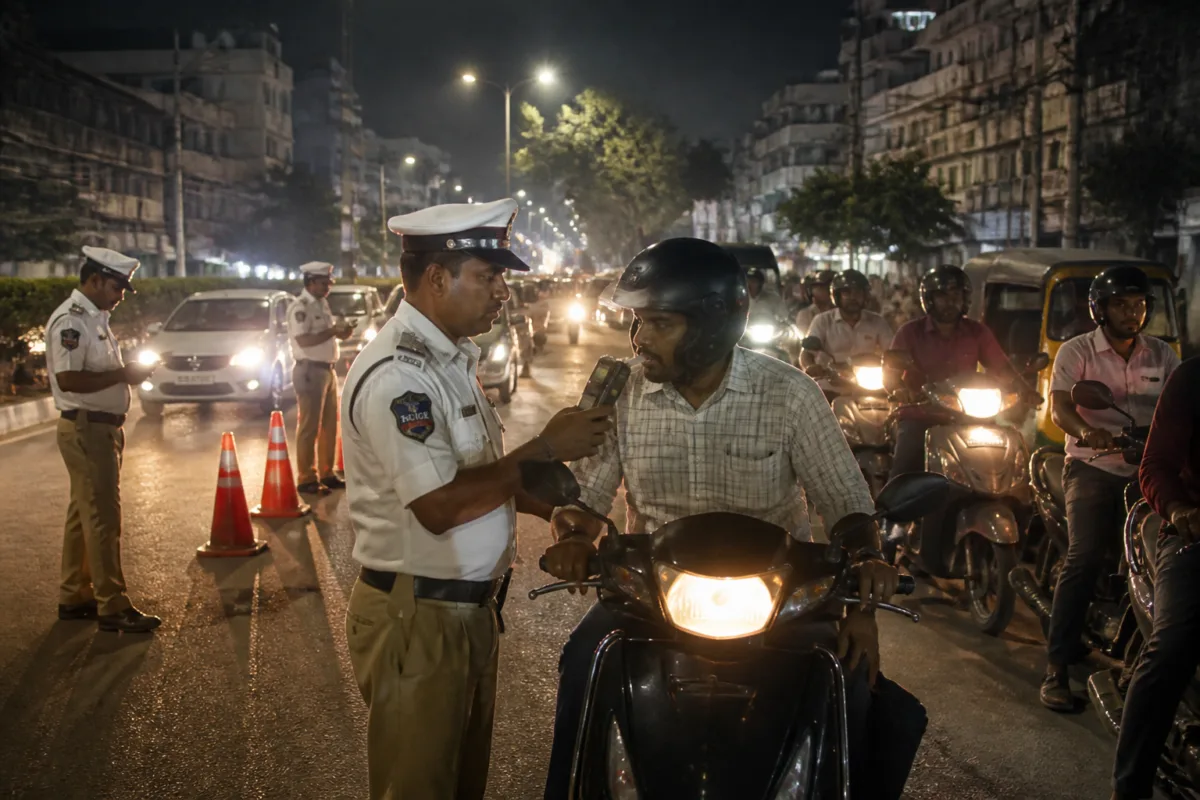
Hyderabad Traffic Police booked 578 motorists for driving under the influence of alcohol during a two-day enforcement drive on November 6 and 7. The figures point to a road-safety problem concentrated overwhelmingly among two-wheeler riders: 495 of those booked, or about 86 per cent, were riding motorcycles or scooters.
The enforcement data, disclosed by D Joel Davis, Joint Commissioner of Hyderabad city traffic police, offers more than a record of police activity. It provides a limited but useful snapshot of how drunk-driving risk is distributed across Hyderabad’s road network. Two-wheelers accounted for 495 cases, while 28 three-wheeler drivers and 55 four-wheeler and other vehicle drivers were booked.
The numbers do not establish how many vehicles were checked, which parts of the city recorded the highest number of violations, or whether the drive targeted locations with a previous history of alcohol-related crashes. Those details were not included in the supplied report. But the vehicle-wise distribution is significant because it shows where enforcement officers found the largest share of violations during this particular operation.
The concentration among two-wheelers also shapes the public-safety implications of the drive. A motorcyclist or scooter rider has less physical protection than a person inside a car or other enclosed vehicle. However, the report does not provide accident figures, injury data or information linking any of the 578 cases to crashes. It would therefore be inaccurate to treat the enforcement total as a measure of accidents prevented or injuries caused.
What the data clearly shows is that the problem is not limited to private cars. Of the total cases, 85.6 per cent involved two-wheelers, 4.8 per cent involved three-wheelers and 9.5 per cent involved four-wheelers or other vehicles. The figures are rounded and based on the 578 cases disclosed by the traffic police.
The blood alcohol concentration, or BAC, breakdown adds another layer to the enforcement picture. Police recorded 115 cases in the 30–50 range, 257 in the 51–100 range, 111 in the 101–150 range, 52 in the 151–200 range, 27 in the 201–250 range, 11 in the 251–300 range and five cases above 300. Together, the categories account for all 578 cases reported from the drive.
The largest group was the 51–100 BAC category, with 257 cases, representing about 44.5 per cent of the total. The 30–50 category accounted for 115 cases, or about 19.9 per cent, while the 101–150 category accounted for 111 cases, or about 19.2 per cent. The remaining 95 cases were recorded at BAC levels above 150, including five above 300.
This distribution matters because it demonstrates that enforcement was not confined to a small number of extreme readings. More than four-fifths of the cases fell in the 30–150 range, according to the disclosed breakdown. At the same time, the presence of 95 cases above 150 and five above 300 shows that the operation also detected a substantial group with higher recorded BAC levels. The report does not state the applicable legal consequences for each category or whether the readings were later upheld in court proceedings.
The way the police have presented the figures also reveals the administrative logic of a special enforcement drive. Officers are not only counting violations; they are classifying them by vehicle type and BAC level. Such categorisation can help an enforcement agency describe the scale and character of a road-safety problem. However, the supplied material does not say whether these classifications are routinely published after every drive, nor does it provide comparable figures from earlier operations.
That absence of comparison limits what can be concluded about trends. The 578 cases could indicate a particularly large operation, a high rate of violations during the two days, or both. Without the number of tests conducted, the number of deployment teams, the locations covered and comparable results from previous drives, the data cannot be converted into a citywide prevalence rate. It is an enforcement count, not a survey of all motorists.
The report also does not identify the timing of the checks. It says the drive was conducted across the city between November 6 and 7, but does not specify whether the operations were concentrated during late evenings, overnight hours, weekends or periods associated with higher nightlife activity. That information would be important for understanding how enforcement is being matched to the times and places when drunk-driving risks may be greatest. No such operational detail is available in the supplied account.
Hyderabad Traffic Police Joint Commissioner D Joel Davis said there would be zero tolerance towards drunk driving and that special enforcement drives would continue to ensure road safety and prevent accidents. The statement places the operation within a continuing enforcement strategy rather than presenting it as a one-off response. The report does not provide a schedule for the next drive or specify whether the department plans to expand testing, change deployment patterns or publish follow-up results.
The institutional responsibility is clear in the material available: Hyderabad City Traffic Police conducted the checks, recorded the BAC levels and disclosed the vehicle-wise results. The supplied report does not discuss the roles of other institutions, including courts, transport authorities, hospitals or municipal agencies. It also does not set out the penalties imposed on the motorists booked. As a result, the administrative chain from detection to prosecution or licence-related action cannot be assessed from these figures alone.
For residents, the immediate message from the drive is direct: the police are treating drunk driving as a road-safety enforcement priority and are asking commuters not to drive after consuming alcohol. But the public-interest value of the data lies in the questions it leaves open. How many motorists were tested to produce 578 bookings? Were two-wheelers more heavily represented because they are more common in the traffic stream, because enforcement was concentrated at particular locations, or because violation rates were higher among their riders? The report does not answer these questions.
Those limitations do not make the figures insignificant. A large enforcement count, combined with the concentration of cases among two-wheelers and the presence of violations across every disclosed BAC category, shows that drunk-driving enforcement is a recurring urban mobility concern. It also indicates why a single headline total is insufficient for evaluating road-safety performance. The number of bookings describes police action, but not the full scale of risky driving or the effect of enforcement on behaviour.
A fuller assessment would require the traffic police to publish the number of tests conducted, the locations and time periods covered, the proportion of motorists found over the legal threshold, case outcomes and comparable results from previous drives. Crash, injury and fatality data would be needed to determine whether enforcement is changing road-safety outcomes. None of those measures is included in the supplied report.
For now, the confirmed evidence is narrower but still consequential: Hyderabad Traffic Police booked 578 motorists over two days, 495 of them two-wheeler riders, and recorded BAC readings ranging from the 30–50 category to above 300. The department has said special drives will continue. The next meaningful measure will be whether future disclosures provide enough operational and outcome data to show how enforcement is affecting Hyderabad’s roads.

