


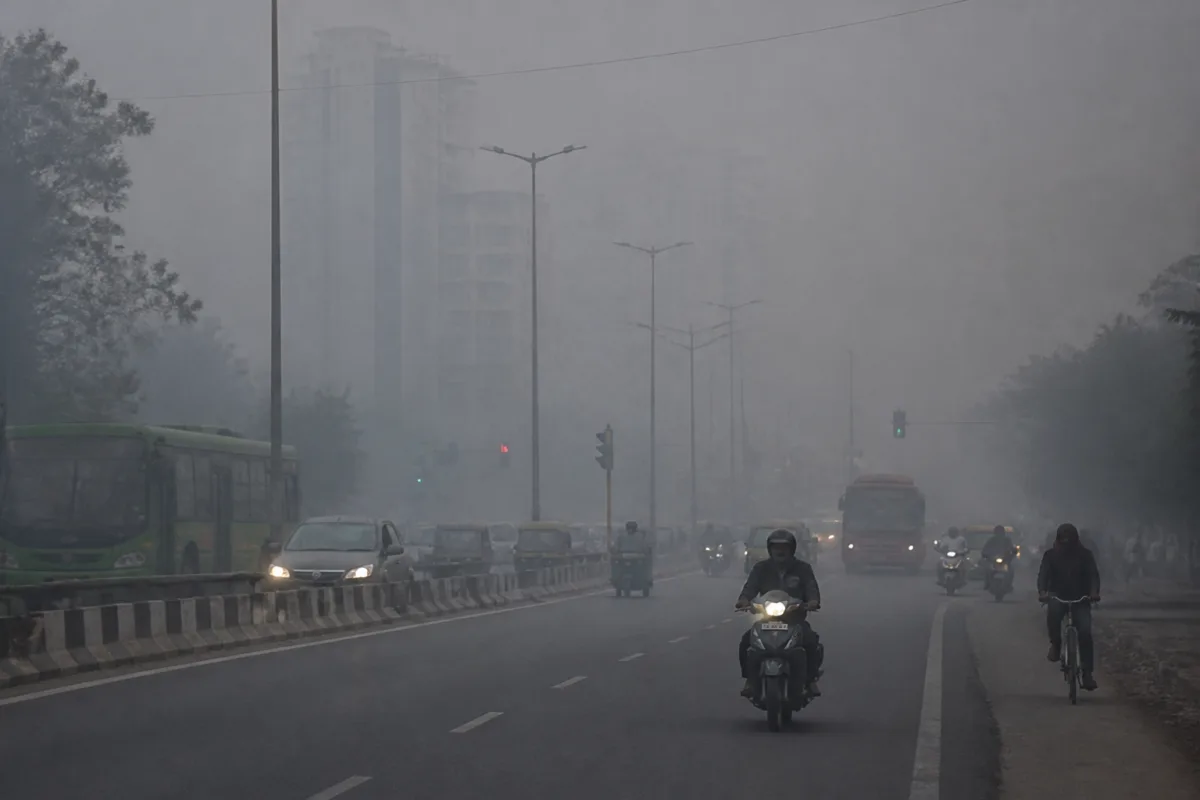
Delhi air pollution reached its worst Diwali-day level in five years, with the city recording an average Air Quality Index (AQI) of 376 on November 8 and remaining in the very poor to severe range the following morning. The AQI stood at 371 at 10am on Monday, while dense smog and fog sharply reduced visibility across the capital, according to data cited by PTI and reported by the Times of India.
The post-Diwali reading was the highest recorded for the day after the festival since 2021. Of the 51 monitoring stations that reported data, 14 were in the severe category, four were in the poor category and 33 were in the very poor category. Delhi Technological University recorded the highest station-level reading at 439.
The Central Pollution Control Board’s data showed that this year’s Diwali-day AQI of 376 was below the 382 recorded in 2021 but higher than the corresponding readings in 2022, 2023, 2024 and 2025. The average AQI was 312 in 2022, 218 in 2023, 328 in 2024 and 345 in 2025. Because Diwali falls on different dates each year, the comparison covers festival days rather than a fixed calendar date.
The city’s air quality was accompanied by hazardous morning visibility conditions. At Safdarjung, visibility fell to 50 metres at 6.30am on Monday, compared with 700 metres a day earlier. Visibility at Palam was 400 metres, down from 800 metres on Sunday. Safdarjung recorded dense fog from 2.30am to 9am, while Palam experienced moderate fog between 5am and 8.30am. The India Meteorological Department described the conditions as smog combined with fog.
IMD officials attributed the deterioration to dry weather and calm winds. The Air Quality Early Warning System said the city’s air was likely to remain in the severe category over the next few days. It identified a ventilation index below 6,000 square metres per second and average wind speeds below 10 kilometres per hour as unfavourable for dispersing pollutants. Vehicular emissions, Diwali fireworks, weather conditions and the ongoing peak stubble-burning season in neighbouring states were also cited as contributing factors.
Fireworks continued in several parts of Delhi despite restrictions. An order issued by the District Magistrate (East) allowed only green firecrackers on November 7 and 8, between 6am and 7am and 8pm and 10pm. The order also prohibited fireworks within 300 metres of hospitals, nursing homes, health centres, old-age homes, educational institutions and other notified silence zones. Reports cited by PTI mentioned fireworks in Pitampura, Burari, Mayur Vihar and parts of Lutyens’ Delhi.
Other air-quality platforms recorded different readings because of differences in monitoring networks and measurement methods. IQAir placed Delhi in the very unhealthy category at 8.30am, reporting a PM2.5 concentration of 170 micrograms per cubic metre. AQI.in recorded a much higher reading after Diwali and classified the city’s air as hazardous on Monday morning. Under the CPCB scale, AQI levels from 301 to 400 are very poor and readings from 401 to 500 are severe. The next operational milestone is the EWS assessment of whether weather and wind conditions improve enough to allow pollutants to disperse.

