


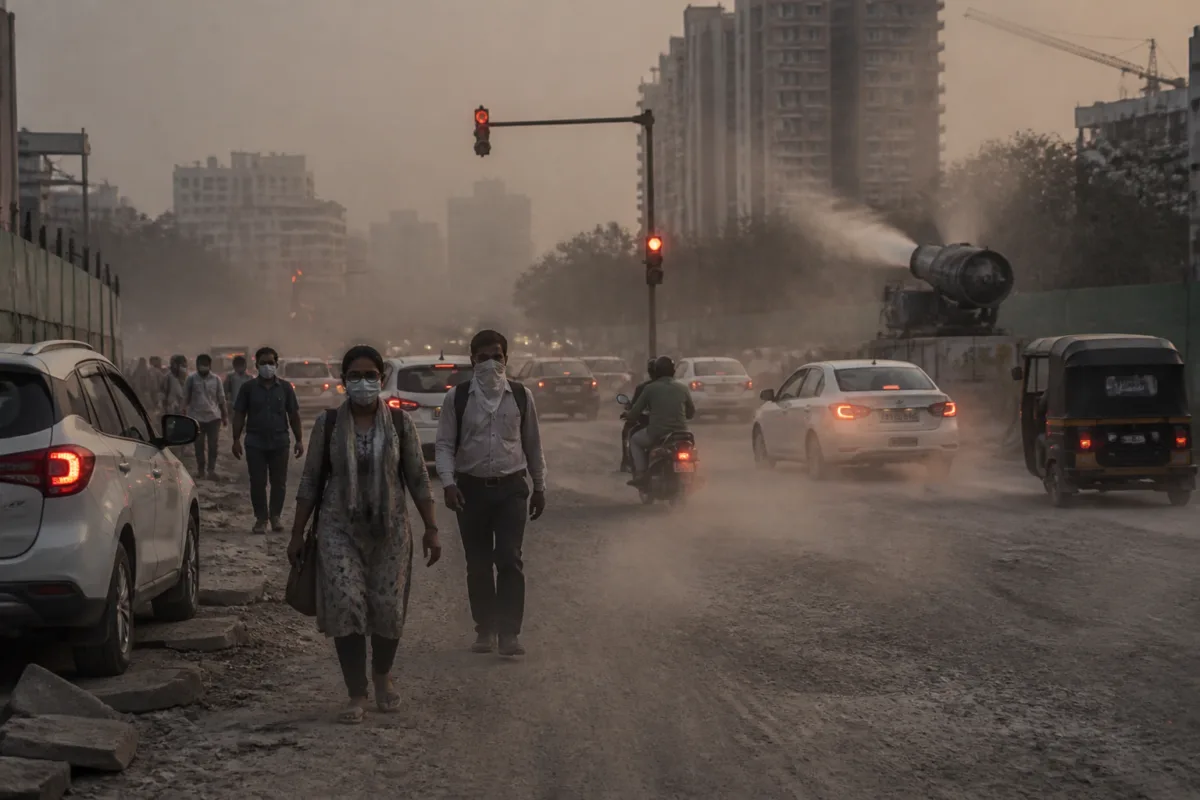
Pune’s air pollution crisis became sharply visible during Lakshmi Pujan, when the city’s air quality index reached about 427.39 on the evening of November 8, according to a report by Civic Mirror – Pune. The episode was triggered by a combination of fireworks smoke, construction dust and road dust, but its larger significance lies in what it reveals about the city’s pollution-control system: Pune has spent ₹275.28 crore from funds allocated for cleaner air, yet its most persistent particulate problem continues to worsen.
The reported AQI placed the city’s air in the ‘severe’ range. The immediate festival-related spike was not the only concern. The report says Pune’s annual average PM10 concentration reached 101 micrograms per cubic metre in 2025-26, the highest level in seven years and substantially above the national prescribed limit of 60 micrograms per cubic metre. PM10 consists of particles measuring 10 micrometres or less that can enter the respiratory system and contribute to respiratory and cardiovascular harm.
This distinction matters because a short-lived fireworks episode and a chronic dust problem require different administrative responses. Fireworks can produce sharp, temporary increases in pollution. Road dust, construction activity and the re-suspension of settled particles are recurring urban processes, connected to how roads are built, maintained, cleaned and used. The evidence cited in the report suggests that Pune’s pollution challenge is increasingly shaped by these everyday systems rather than by combustion alone.
The spending figures make the implementation gap particularly important. Data from the Portal for Regulation of Air Pollution in Non-Attainment Cities, or PRANA, reportedly shows that Pune was sanctioned ₹418.45 crore under the National Clean Air Programme and the Fifteenth Finance Commission. Of this, ₹275.28 crore had been spent. The report says ₹9.45 crore came through the National Clean Air Programme, while about ₹409 crore was made available through the Fifteenth Finance Commission.
The money was not spent on one single intervention. According to information obtained through the Right to Information Act and cited by Civic Mirror – Pune, it supported road infrastructure, public transport, cremation facilities and waste management. The work included concreting or improving 121.4 kilometres of roads, repairing 19 kilometres of footpaths, buying two mechanical road-sweeping machines and 19 water sprinklers, introducing 36 electric buses, building 65 charging stations and creating green cover across 38,944.5 square metres.
The same funding was also used for 10 waste-collection centres, including six dry-waste centres and four facilities for construction and demolition waste. The report says the municipal corporation collected and transported 381 tonnes of solid waste, established 15 new cremation facilities using PNG and electricity, introduced PNG facilities at seven cremation grounds and conducted 36 public-awareness programmes.
These outputs show that spending did produce physical assets and services. They do not, by themselves, establish that the interventions reduced pollution. That is the central accountability question raised by the report. A road improvement project, a charging station or a waste centre may be useful for several urban objectives, but its contribution to PM10 reduction must be separately measured if the expenditure is being presented as clean-air action.
The condition of the city’s specialised dust-control equipment illustrates the problem. Ten mist-based fountains were installed at major traffic junctions, including RTO Chowk, Baner and Bremen Chowk in Aundh, with the stated purpose of reducing vehicle emissions and road dust. The report says these systems are now dry, rusted or non-functional. Mobile fog cannons purchased through Fifteenth Finance Commission funds were also intended for roads such as Karve Road, Satara Road, Solapur Road and Sinhagad Road, but the report says they are rarely visible on these routes and are allegedly lying in municipal storage facilities.
The issue is not simply whether a machine is present. It is whether the equipment operates at the right location, frequency and intensity, whether it is maintained, and whether the collected dust is prevented from returning to the air. Dr Rakesh Kumar, president of the Society for Indoor Environment, said the available data indicated a shift from combustion-related pollution towards pollution from particulate matter. He attributed possible improvement in PM2.5 levels to BS-VI vehicles, cleaner fuels, electric buses and a reduction in open waste burning, while pointing to urban expansion, metro works, road widening, concreting and construction as major sources of dust.
Dr Kumar also questioned whether the city’s existing approach to PM10 was adequate. He said water sprinkling and mechanical sweeping did not appear to be producing the expected results and that interventions needed to account for construction methods, equipment operation and maintenance, and local conditions. His criticism goes to the design of the response: dust control cannot be reduced to spraying water after particles have accumulated on roads.
The available trend data supports the concern. Pune’s annual average PM10 concentration was reported at 81 micrograms per cubic metre in 2019-20, fell to 69 in 2020-21, and then rose to 85 in 2021-22, 96 in 2022-23, 98 in 2023-24, 96 in 2024-25 and 101 in 2025-26. The seven-year pattern shows a broad deterioration after the low recorded in 2020-21. The supplied report does not establish the precise contribution of each source in each year, but it does show that the city’s annual PM10 burden remains far above the national limit.
PM2.5 followed a different pattern. Its annual average was reported at 48 micrograms per cubic metre in 2019 and 34.2 micrograms per cubic metre in 2026, with fluctuations in the intervening years. Dr Kumar said this could indicate that the sources of pollution are changing. However, he also called for an audit of monitoring locations, measurement methods, frequency, weather conditions and the days used for observation, particularly for 2022 data. That caveat is important: trends are only as reliable as the monitoring system behind them.
Sharmila Dev of Pune Air Action Hub said the amount of money spent could not alone determine whether air quality had improved. She called for an assessment of the cost, implementation and actual impact of each intervention. She also said that the number of roads cleaned, cleaning frequency, equipment operating time, disposal of collected dust and reduction in re-suspension should be examined before mechanical sweeping is judged successful.
This points to a wider weakness in the National Clean Air Programme’s local implementation. The programme, launched in January 2019, aims to improve air quality in 131 cities that have not met prescribed pollution standards. PRANA monitors implementation, but monitoring fund utilisation is not the same as measuring pollution outcomes. A city can report completed works and purchased equipment while still failing to demonstrate a reduction in the pollutant those works were intended to address.
Pune’s municipal administration has responsibilities that extend beyond buying equipment. It must regulate construction practices, control the movement and handling of construction and demolition waste, maintain roads and footpaths, manage sweeping operations, coordinate transport planning and ensure that monitoring data is credible. The report also cites a pollution-source assessment that identified vehicle emissions as a major contributor to PM10, making reduced dependence on private vehicles and stronger bus and metro systems part of the source-control discussion.
The episode during Lakshmi Pujan therefore exposes two linked problems. The first is operational: equipment intended to control dust may be unavailable, poorly maintained or insufficiently deployed. The second is institutional: expenditure is being counted more clearly than outcomes. Without a measurable link between each project and the pollutant source it targets, clean-air funding risks becoming an inventory of assets rather than a programme for cleaner air.
The supplied evidence does not establish that every intervention funded in Pune was ineffective, nor does it independently verify the reported condition of every mist fountain or fog cannon. It does establish a significant disparity between the funds spent, the infrastructure reported as created and the continuing rise in annual PM10 levels. The next meaningful test for the city will be whether its authorities publish an intervention-wise audit, clarify equipment performance and connect future spending to independently measurable reductions in road dust, construction dust and vehicle-related pollution.

