


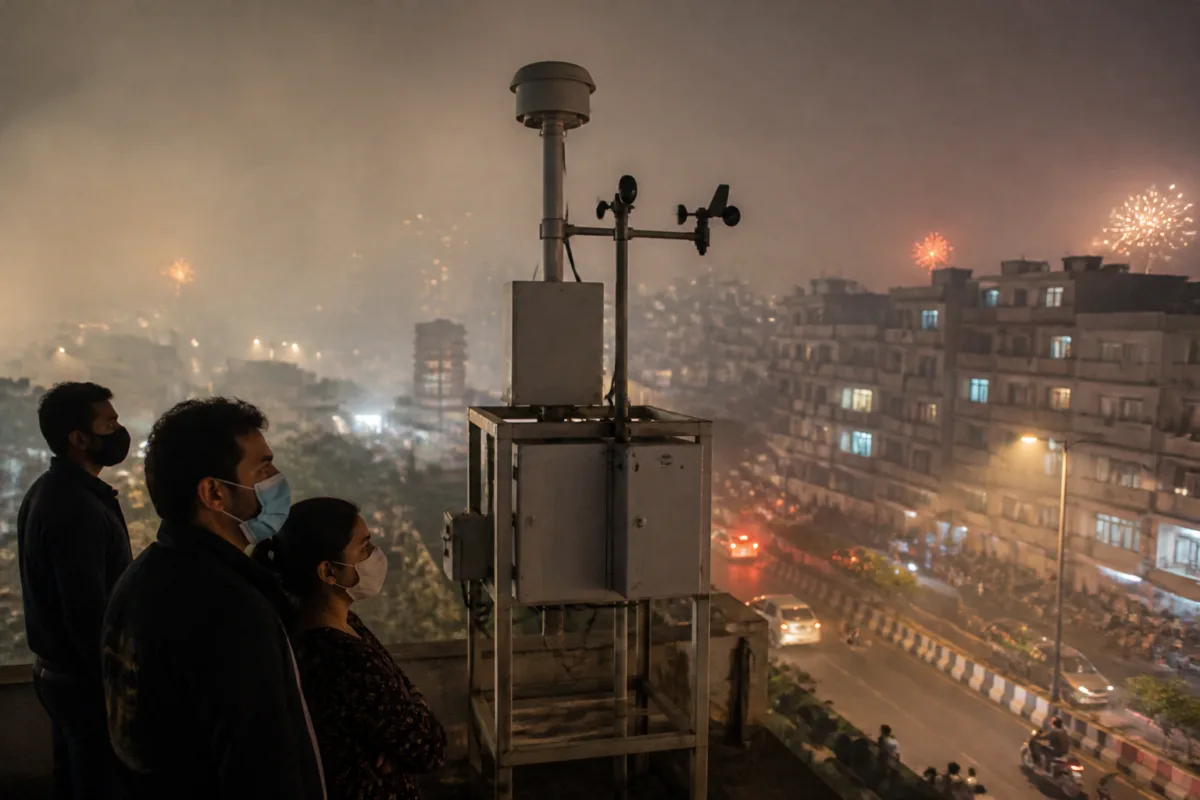
A fresh dispute over Delhi’s air-quality data has intensified after Aam Aadmi Party Delhi president Saurabh Bharadwaj claimed that pollution levels in several parts of the capital crossed an AQI of 3,000 on Diwali night. He alleged that government monitoring data was being manipulated, a claim that has not been independently established in the supplied report.
Bharadwaj said the government’s air-quality figures could not be trusted and alleged that monitoring stations were being shut or placed in locations with comparatively cleaner surroundings. He also claimed that water was being sprayed around stations recording high pollution levels, potentially affecting their readings.
The AAP leader referred to a video shared on his social media account showing an AQI reading of 3,036 at 11.30 pm in the MBS Nagar area of Chokhandi. The report does not provide an independent verification of the video, the monitoring instrument, or the circumstances in which the reading was recorded.
Bharadwaj said that if the government was displaying incorrect data, it could put residents’ health at risk. He urged the Delhi government to accept responsibility for pollution linked to firecrackers rather than presenting what he described as misleading air-quality information.
The allegations come amid a wider political dispute between the AAP and Delhi’s BJP-led government over the reliability of pollution monitoring in the capital. Bharadwaj has previously accused Chief Minister Rekha Gupta and Environment Minister Manjinder Singh Sirsa of allowing manipulation of AQI readings. He has also sought legal action against them over the allegations, according to the report.
The AAP leader claimed that water was being sprayed near air-quality monitoring centres in areas showing high pollution and that stations had been established in distant green areas. The report does not include a response from the Delhi government, the environment department, the Central Pollution Control Board or the agencies responsible for operating the monitoring network.
The dispute has direct implications for how residents interpret official pollution warnings. Bharadwaj said inaccurate readings could lead people to believe that outdoor activities, morning walks, sports or opening windows were safe when pollution levels were actually dangerous. He also said unreliable data could delay restrictions under the Graded Response Action Plan, including controls on heavy vehicles and industrial activity.
Bharadwaj cited doctors’ concerns that polluted air can worsen symptoms among heart patients, children with asthma and older people with respiratory illnesses. However, the supplied report does not identify the doctors or provide independent medical or monitoring data linked to the claimed Diwali-night reading.
The immediate issue for Delhi’s air-quality system is whether the reading shown in the video corresponds to an authorised monitor, whether the instrument was functioning correctly and how it compares with readings from other stations at the same time. No official clarification on those points is included in the source report.

