


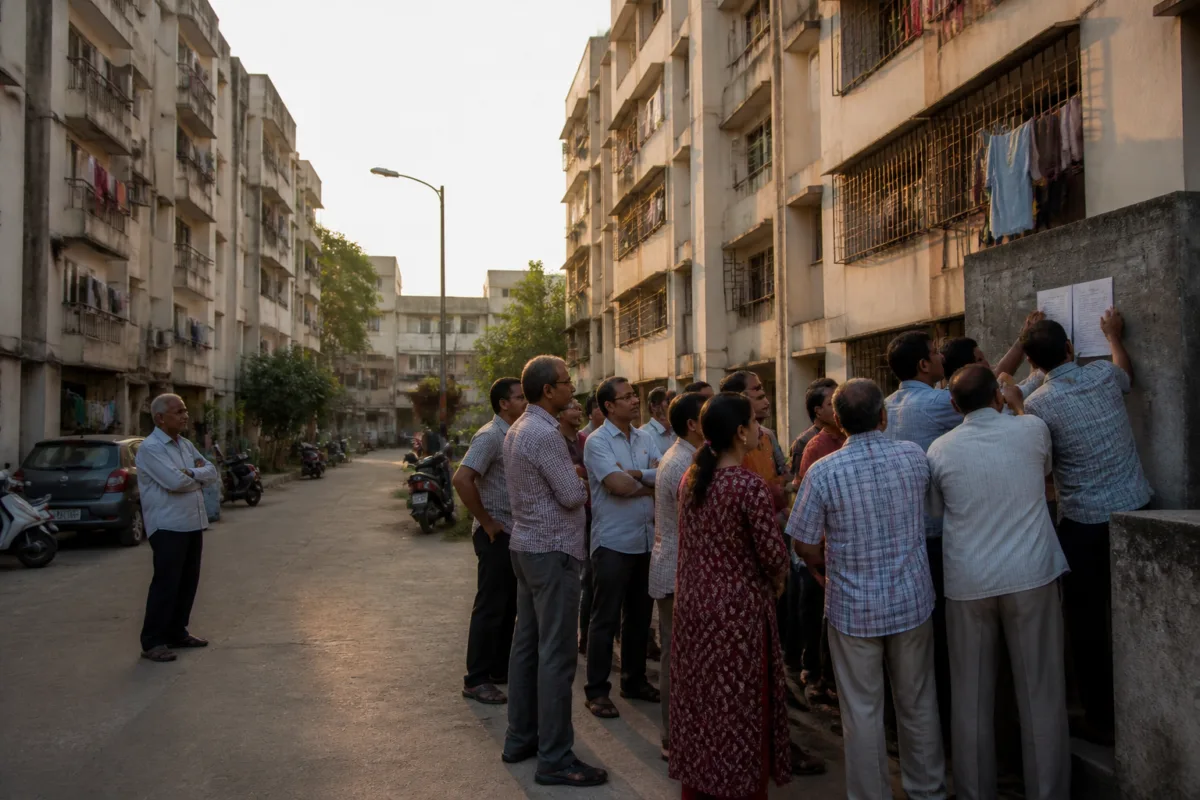
The Gujarat High Court’s scrutiny of an Ahmedabad redevelopment tender has brought a basic but consequential question into focus: can a state housing agency combine two societies and invite developers to bid before securing the level of residents’ consent required under its own policy? The dispute concerns Jawaharnagar and Indiranagar societies in east Ahmedabad, where 348 members have challenged the process through their lawyer.
According to the report submitted to the court, the Gujarat Housing Board issued a joint redevelopment tender for the two societies by merging them for the purpose of the project. The residents’ case is that the Housing Board’s redevelopment policy requires the consent of 75% of members, but that neither the residents nor the associations had approved the merger or the tender before it was issued.
The High Court questioned how the tender could have been issued without the required consent. It also asked how a developer could enter the societies until the members’ consent or an agreement had been secured. The court directed the Housing Board to explain the complete process at the next hearing and said that residents should not face difficulties until a final decision is reached.
The immediate dispute is therefore not only about a redevelopment tender. It is about the sequence in which a public redevelopment project is supposed to move from policy to implementation. A tender is normally a major administrative step: it signals that an agency has defined the project, identified the participating properties and opened the process to developers. In a housing society, however, that step directly affects residents’ homes, agreements, future accommodation and relationship with the selected developer. The court’s questions indicate that the timing of the tender, relative to resident consent, is central to the case.
The 75% threshold cited in the proceedings is particularly important because it establishes a measurable consent requirement. The residents’ submission, as reported, is not that redevelopment is inherently impermissible. It is that the Housing Board allegedly proceeded without meeting the condition prescribed by its own redevelopment policy. That distinction matters. A redevelopment policy can create a framework for action, but the agency implementing it must also show that the procedural conditions within that framework have been met.
The case also exposes the administrative complexity created when separate societies are treated as a single redevelopment opportunity. Jawaharnagar and Indiranagar are described in the report as two different societies. Their joint tender means that the redevelopment process affects both groups together, even though each may have its own membership, association and internal decision-making process. The court’s intervention makes the question of authority especially significant: who approved the merger, on what basis, and whether each society separately provided the consent required under the Housing Board’s rules.
The supplied report does not provide the full text of the Housing Board’s redevelopment policy, the tender document, the societies’ resolutions or the court petition. It therefore does not establish the precise wording of the 75% requirement, whether consent was sought in any form before the tender, or what the Board’s complete explanation will be. Those details are likely to determine how the dispute develops. What is established in the report is that residents have raised the absence of consent before the High Court and that the court has sought a full explanation from the Board.
The institutional question is sharper because the Housing Board is a state entity. During the hearing, the High Court reportedly said that the Board’s functioning should be more transparent because it is a public authority. The court contrasted this obligation with private schemes, observing that if private projects are expected to follow rules, a state entity should meet an even higher standard of transparency.
That observation places redevelopment administration under a different level of scrutiny than a private commercial transaction. Residents dealing with a public housing agency are not only negotiating with a developer or a project promoter. They are also dealing with an institution that is expected to follow its notified procedures and explain its decisions. A lack of clarity at the early stage can create uncertainty over who authorised the project, what rights residents retain and whether participation in the process is voluntary or assumed.
The reported direction that residents should not face difficulty before the case is finally decided is equally significant. The court has not, according to the supplied report, issued a final ruling on the legality of the tender. Instead, it has asked the Board to clarify the process and directed that residents be protected from hardship in the interim. This keeps the focus on preserving the position of the residents while the underlying administrative questions remain unresolved.
For the 348 members involved, the issue is likely to be experienced at the level of consent, access and security of tenure. The report does not specify whether residents have been asked to vacate, whether any developer has entered the premises, or whether construction or demolition has begun. The High Court’s question about how a developer could enter the society before consent or an agreement suggests that physical or operational intervention by a developer is one of the concerns before the court. The exact status of any such activity, however, is not established in the supplied material.
The dispute also highlights the difference between announcing redevelopment and securing a redevelopment agreement. A tender can identify or invite developers, but it does not by itself resolve the terms on which residents will be rehoused or the obligations that will bind the developer and the public agency. In the absence of an agreement, questions about the residents’ rights, project conditions and implementation responsibilities can remain unsettled. The court’s insistence on consent or an agreement before developer access reflects the importance of that gap in the present case.
There is a wider governance lesson in the court’s demand for the “complete process” to be placed before it. Redevelopment is often described through its physical outcome: new buildings replacing older housing. The administrative chain behind that outcome is less visible but just as consequential. It includes identifying the properties, determining whether societies can be combined, recording member consent, issuing a tender, selecting a developer and defining when the developer can enter the site. If these stages are not clearly documented, the physical project can become the least certain part of the process.
The Housing Board’s response at the next hearing will be important because it is expected to explain how the joint tender was prepared, what approvals were obtained and how the 75% requirement was applied. It will also need to address the residents’ contention that the societies and their associations did not approve the merger or tender. The supplied report does not include the Board’s substantive response to these allegations, so its position remains to be placed before the court.
At this stage, the evidence confirms a live legal challenge to the procedure followed for the redevelopment of two Ahmedabad societies. It does not establish that the tender has been finally cancelled, that the Housing Board has been found to have violated its policy, or that the redevelopment project will not proceed. The immediate development is the High Court’s demand for procedural clarity and its direction that residents should not be troubled before the final decision.
The next hearing will determine how the Board accounts for the tender, the proposed merger of the two societies and the consent process. Until then, the Ahmedabad case remains a test of a basic principle in public redevelopment: the authority that seeks to transform residents’ homes must be able to show, step by step, that it had the required consent and followed the rules governing its own actions.

