


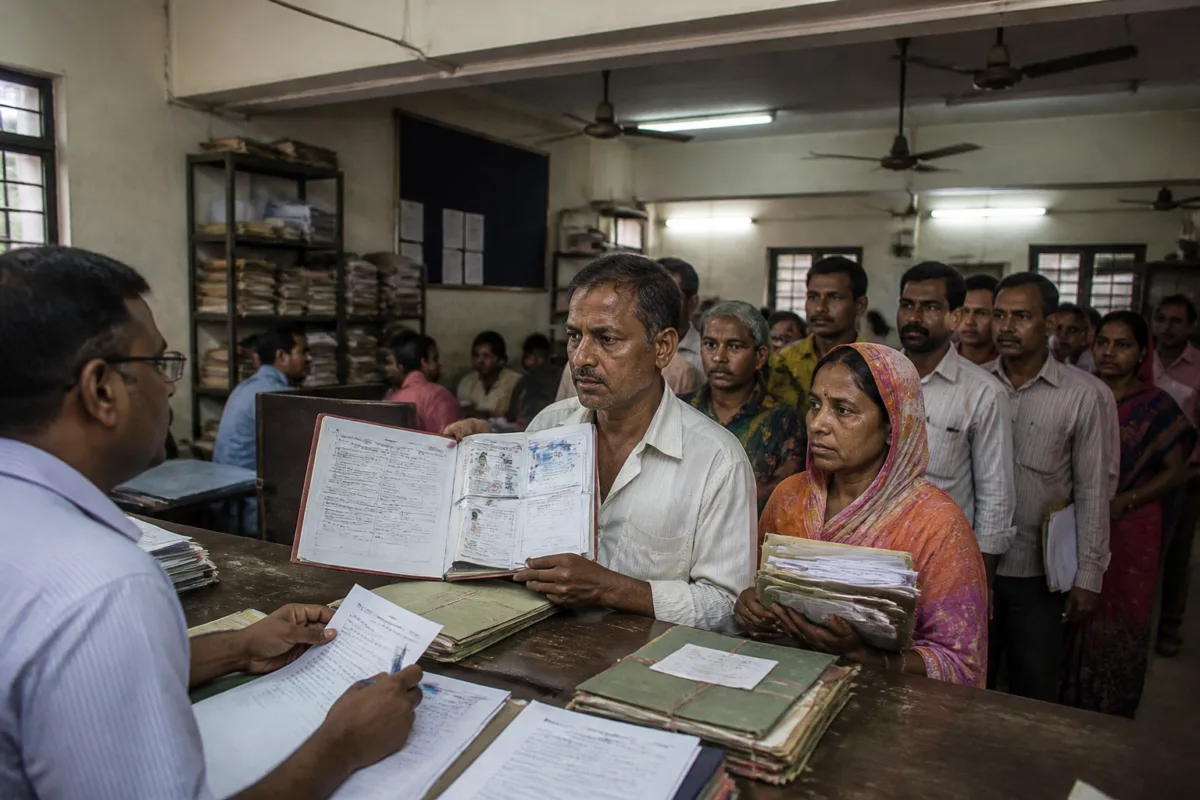
The consequences of SIR voter deletions in Bengal are extending beyond the ballot box, with residents reporting obstacles to vehicle registration, welfare access, loans and land transactions. The cases documented by Telegraph India point to a deeper administrative problem: when electoral records begin functioning as an informal test for access to everyday services, a dispute over a voter roll can become a wider crisis of civic identity and livelihood.
The reported cases involve people whose names were removed from revised electoral rolls and whose appeals before SIR tribunals remain pending. Their experiences differ, but they share a common feature. A record created for one democratic function—the right to vote—is being treated, at least in some offices and transactions, as evidence of whether a person can access other rights, services or economic opportunities.
That linkage is not presented as a formal rule applying uniformly across Bengal. The report instead records how individual officials, service providers and institutions have responded to deleted voters on the ground. This distinction is important. The central issue is not only what the SIR process formally authorises, but also how deletion is interpreted by offices dealing with ration cards, vehicle registration, loans and property registration.
The first case concerns a 35-year-old trader from East Burdwan who urgently needs a new motorbike to visit distributors of fibre doors used in bathrooms. His existing vehicle is almost 15 years old. According to the report, two showrooms told him that a new bike could not be registered in his name until he was reinstated on the voters’ list.
The man, who is Muslim, was placed in the “logical discrepancies” category during the SIR process. His name was missing from the supplementary list released in the last week of March. The discrepancy reportedly arose from a minor difference in the spelling of a prefix used before his name: his birth certificate and Madhyamik admit card use “Sk”, while his voter, Aadhaar and PAN cards use “Seikh”. He has appealed to the SIR tribunals, but his appeal remains pending.
For him, the effect is immediate and economic. The inability to register a vehicle is not simply a documentation inconvenience. His work requires regular travel to distributors, and the vehicle is part of how his business operates. The reported incident shows how a mismatch that appears limited to identity records can acquire practical consequences when an electoral status is introduced into a commercial transaction.
A second case involves a resident of East Burdwan who had taken a loan from the state Minorities’ Development and Finance Corporation in 2021. He repaid it earlier this year and applied for another loan before Durga Puja. At the corporation’s office, he was initially told that loans could not be given to people removed from the voters’ list. A few days later, he received another call and was told that a loan could still be considered if his father was a valid voter. He was asked to return to the office.
The account illustrates the uncertainty produced when eligibility is communicated through changing, informal instructions. The report does not establish whether the corporation has a written policy linking loan eligibility to electoral-roll status. It does establish that the applicant experienced such a link at the point of service, and that the explanation changed within days. For citizens, this difference between formal policy and frontline practice is consequential: an application can be delayed even when the underlying rule is unclear.
The welfare implications are equally significant. A 30-year-old migrant worker who moved from Malda to Murshidabad with his wife and children had transferred his voter card to his new address. His name was later deleted from the rolls. When he tried to transfer his ration card to Murshidabad, the dealer reportedly told him that the document had been “frozen” because his name was no longer on the voters’ list.
The man said he could not receive ration or transfer the card until his name was restored. The report places this account alongside a government drive to remove “ineligible and ghost beneficiaries” from the food and supplies department’s subsidised grain scheme. It also notes that a government order said ration cards of people who had applied for citizenship under the CAA or appealed before SIR tribunals after deletion should remain active until their cases were disposed of.
This creates a clear gap between the protection described in the order and the experience reported by the applicant. If a ration card is kept active on paper but is treated as frozen at the point of distribution or transfer, the administrative safeguard does not reliably reach the household it is meant to protect. The difficulty is particularly acute for migrant households, whose records already span more than one district and whose access to services depends on successful address transfers.
A third account concerns land registration. A government official whose name was deleted from the revised rolls in Behrampore, Murshidabad, went to a sub-registrar’s office to register a plot in her name. Her husband told the newspaper that a clerk warned registration in her name would be difficult and cumbersome, and suggested that the property be registered in his name instead. Since the husband remained on the voters’ list, the couple accepted that arrangement.
The reported outcome shifts ownership away from the person who was intended to hold the property. The account does not establish a formal prohibition on registering land in the name of a deleted voter. It shows, however, how an apprehension about administrative delay can influence a property transaction and alter whose name appears on the record. In a system where land records determine ownership, inheritance and future transactions, that is not a minor procedural matter.
Taken together, the cases reveal three kinds of administrative spillover. The first is operational: a person cannot obtain or transfer a vehicle, ration card or property as planned. The second is economic: a worker’s mobility, a trader’s business and a borrower’s access to finance are affected. The third is social: deleted voters report ridicule, suspicion and repeated demands to explain their status.
The social dimension is visible in the account of a middle-aged man deleted from the revised rolls of the Chowrangee Assembly constituency in Calcutta. Colleagues repeatedly told him to “look for a property in Bangladesh”. He said some made the remark as a joke, but did not understand the pain it caused. The reported taunts demonstrate how an official status can become a marker imposed by others, particularly when deletion is associated with doubts about belonging.
Kushal Debnath, convener of the Sangrami Ganamancha, a platform campaigning for deleted voters, told the newspaper that some people were being threatened with discontinuation of welfare schemes and refused loans. He described the fear as one of being turned into “second-class citizens”. His statement is an advocacy group’s assessment, not an independent measurement of the scale of the problem. But it reflects the common thread connecting the individual cases: the fear that a pending electoral appeal can affect life far beyond elections.
The institutional structure described in the report is divided across several offices. SIR tribunals are handling appeals against deletions. The food and supplies department is pursuing a process to identify ineligible and ghost beneficiaries. Ration dealers operate at the last mile of welfare delivery. Sub-registrar offices manage property registration, while vehicle dealers and registration authorities process new vehicles. The state Minorities’ Development and Finance Corporation handles at least some of the loans cited in the report.
This distribution of responsibility makes administrative coordination critical. A voter-roll correction may be the responsibility of one institution, but its consequences are felt in several others. Unless those institutions have clear instructions on how pending appeals should be treated, citizens may encounter different interpretations at each counter. The reported loan case, in which the applicant received two different explanations, captures the problem.
The government order cited in the report offers one example of an attempt to prevent an electoral dispute from interrupting welfare access. It says ration cards of people who have appealed before SIR tribunals after deletion should remain active until their pleas are decided. Yet the account from Murshidabad suggests that implementation is not automatic. The difference between an order and its execution is therefore central to the story.
The evidence supplied in the report is case-based rather than statistical. It does not provide the total number of deleted voters facing difficulties with vehicles, loans, ration cards or land registration, nor does it establish how widespread these practices are across Bengal. It also does not include responses from the vehicle registration authorities, the Minorities’ Development and Finance Corporation, the sub-registrar’s office or the food and supplies department to the specific allegations.
Those limitations do not make the cases insignificant. They define what can responsibly be concluded. The report establishes that several deleted voters have described concrete barriers and that the barriers are appearing in institutions outside the electoral system. It does not establish that every deleted voter is being denied these services, or that a uniform government policy directs all such denials.
The larger urban question is how citizens prove their identity and eligibility when government records do not align. In the reported cases, the relevant documents include voter cards, Aadhaar, PAN cards, birth certificates, school records, ration cards and property documents. A spelling variation, a district transfer or a pending appeal can cause one record to lose authority in the eyes of another office. The resulting burden falls on the individual, who must continue working, obtain welfare, borrow money or register property while the dispute is unresolved.
For Bengal’s towns and cities, this is also a question of administrative portability. People move between districts for work, marriage and family support. The Murshidabad case shows how a change of address can intersect with voter deletion and ration access. The East Burdwan case shows how a documentation discrepancy can affect a trader’s mobility. These are ordinary urban and peri-urban activities, but they depend on institutions recognising a person consistently across systems.
The immediate developments to monitor are the disposal of pending appeals before the SIR tribunals and whether the safeguards described in the government order are followed at ration outlets. Further clarity is also needed on whether vehicle registration, lending and property registration authorities have formal instructions concerning applicants whose names were deleted but whose appeals remain pending. Until those questions are answered, the reported cases show that the practical cost of SIR voter deletions is being measured not only in lost votes, but in delayed services, constrained livelihoods and heightened uncertainty about civic belonging.

