


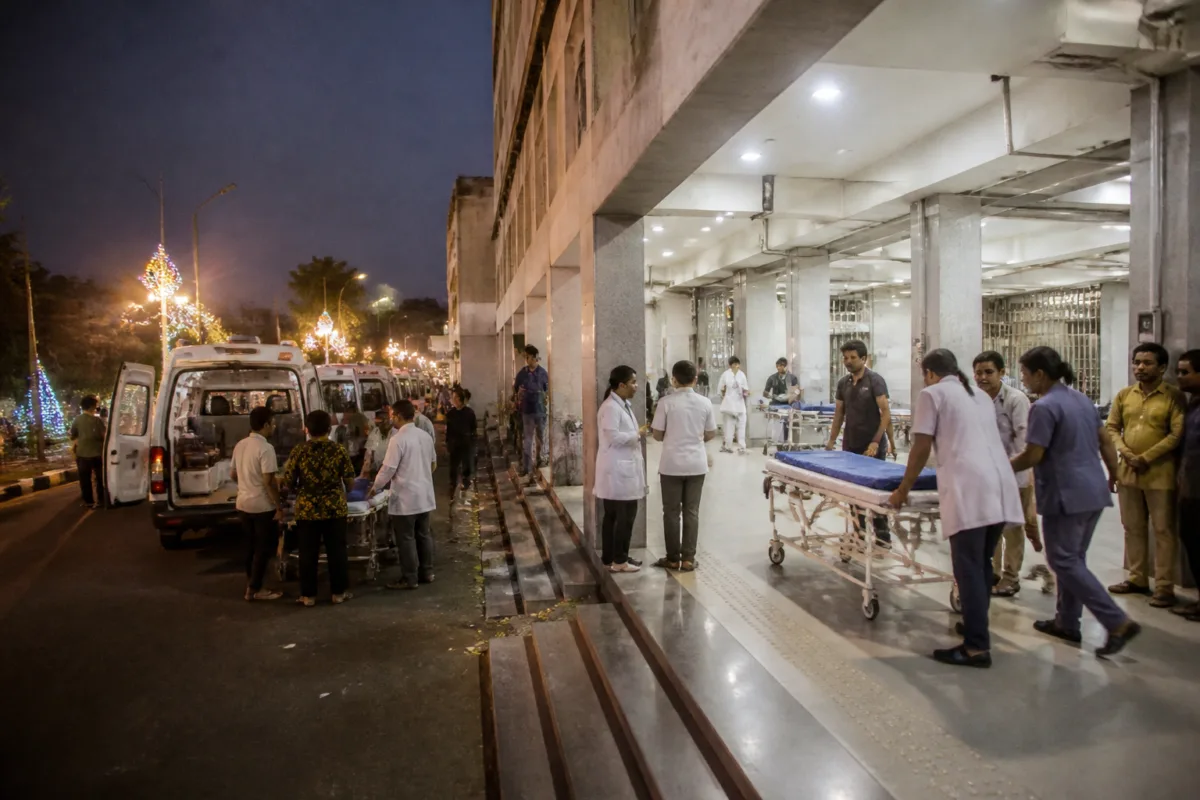
Ahmedabad Civil Hospital’s five-year data show that Diwali burn cases rose from 18 in 2021 to 42 in 2025, a 133% increase that has disproportionately affected children. The figures point beyond festival safety advice to a wider urban public-health question: how households, public spaces and emergency services manage predictable seasonal risks.
Between 2021 and 2025, the hospital treated 143 patients for burns caused by firecrackers or other reasons during the Diwali period. All 143 patients were discharged, according to the data released by the hospital. The record includes 88 children below the age of 18, accounting for 61.5% of the total, compared with 55 adults, or 38.5%.
The increase was not limited to one year. The hospital recorded 18 cases in 2021, 21 in 2022, 31 in 2023, 31 in 2024 and 42 in 2025. This represents a rise of 24 cases over the five-year period. The data therefore describe a continuing upward movement rather than an isolated spike.
The age profile became more concerning in the final two years covered. Children represented about 71% of patients in both 2024 and 2025, according to the hospital’s figures. That shift makes supervision a central part of the safety challenge. The hospital’s medical superintendent, Dr Rakesh Joshi, said children should never be allowed to burst firecrackers without adults present.
The gender distribution also shows a marked difference. Of the 143 patients, 121 were male, or 84.6%, while 22 were female, or 15.4%. The hospital said the figures indicated a higher injury risk among men or young people involved in bursting firecrackers. The data do not establish why this difference occurred, but they identify the group most frequently represented among patients treated during the period.
The severity of injuries varied across the five years. In 2021, all 18 patients were discharged and one surgery was recorded. In 2022, all 21 patients were discharged and no surgery was recorded. The 31 cases in 2023 included three surgeries. In 2024, 10 surgeries were recorded among 31 cases, including one case requiring amputation. In 2025, 42 patients were treated, all were discharged and no surgery was recorded.
These figures combine firecracker-related injuries with burns attributed to other causes, as described in the hospital’s five-year data. They therefore should not be read as a complete measure of every firecracker injury in Ahmedabad, nor as a citywide count across all hospitals. They are the recorded caseload at Civil Hospital during the relevant Diwali periods. Even with that limitation, the series provides a useful view of the pressure placed on one major public hospital during a recurring festival period.
The hospital’s role is important because seasonal emergencies do not replace routine healthcare demand. The data supplied by the hospital show that its outpatient department recorded 6,822 patients and its inpatient department 1,391 patients between November 10 and November 15, 2023. Between October 29 and November 3, 2024, the outpatient department recorded 9,414 patients and the inpatient department 1,353 patients. The hospital also recorded 271 major and 329 minor operations during that 2024 period.
For October 18 to October 23, 2025, the hospital reported 7,468 outpatients and 1,406 inpatients, alongside 218 major and 294 minor operations. These figures do not isolate Diwali burn cases from other treatment, but they show the operational setting in which emergency preparedness has to function. A hospital handling regular outpatient, inpatient and surgical workloads must also remain ready for injuries that can rise sharply during a short festival window.
The hospital has said doctors will be available round the clock during Diwali, including for illnesses unrelated to burns. That arrangement reflects the institutional side of festival safety. Prevention takes place largely in homes, streets and open spaces, but treatment depends on the readiness of public hospitals, emergency staff and surgical teams. The five-year record shows that the hospital was able to discharge all 143 patients, while also recording surgeries in four of the five years.
The data also show why a simple count of cases is not enough to understand the urban safety problem. A rise from 18 to 42 cases indicates higher demand, but the number alone does not explain whether more residents are using Civil Hospital, whether the number of incidents has increased across the city, whether injuries have become more severe, or whether reporting and access to treatment have changed. The supplied hospital figures do not provide those comparisons.
What they do establish is a persistent concentration of risk among minors. Children made up more than three-fifths of all patients across the five-year period, and their share rose to about seven in 10 patients in 2024 and 2025. That pattern places responsibility not only on children but also on adults supervising festival activities, the location where firecrackers are used and the way injured people receive immediate first aid.
Dr Joshi’s instructions include using open spaces away from buildings, vehicles and flammable materials; wearing cotton clothing and suitable footwear; and not attempting to relight extinguished or partly burned firecrackers. The hospital advises that a burned body part should be held under clean, running tap water for at least 20 minutes. It specifically warns against applying ice, toothpaste, oil or ghee. Injuries involving the eyes, mouth, hands or large areas of the body require immediate hospital care, according to the advice attributed to the superintendent.
These instructions connect household behaviour with the capacity of the wider urban emergency system. A burn that is cooled promptly and taken to hospital when necessary may be managed differently from an injury delayed by unsafe home remedies or by attempts to relight a firecracker. The hospital’s guidance is therefore not only a list of precautions; it is also a description of the first decisions that shape the burden on emergency care.
The five-year record raises a question about how Ahmedabad monitors predictable seasonal injuries. Civil Hospital’s data identify the number of patients, their age and gender distribution, surgeries and discharge outcomes. They do not include the locations of incidents, the type of firecracker involved, the time of injury, the distance travelled to hospital or the number of cases treated at other facilities. Without those details, city authorities cannot use this dataset alone to map hotspots or compare risks between neighbourhoods.
That gap matters because the central safety issue is not confined to hospital treatment. Firecrackers are used in residential areas, roads, open plots and spaces near buildings and parked vehicles. The hospital’s own advice recognises these environmental risks by urging residents to use open areas away from flammable surroundings. The data do not say how consistently those conditions are available or followed across Ahmedabad.
The evidence nevertheless supports three clear conclusions. First, Civil Hospital recorded a substantial increase in Diwali-period burn cases between 2021 and 2025. Second, children were the majority of patients and became an even larger share in the last two years. Third, public hospitals must maintain emergency readiness while continuing routine care and surgeries during the festival period.
What remains uncertain is the scale of the problem across Ahmedabad as a whole and the precise causes behind the increase. The hospital figures do not establish whether the rise reflects more incidents, greater treatment-seeking at Civil Hospital or changes in the pattern of reporting. Future monitoring would need comparable data from other hospitals and more detailed information about where and how injuries occurred. Until then, the Civil Hospital series remains a clear warning that festival safety and public-health preparedness cannot be treated as separate responsibilities.

