


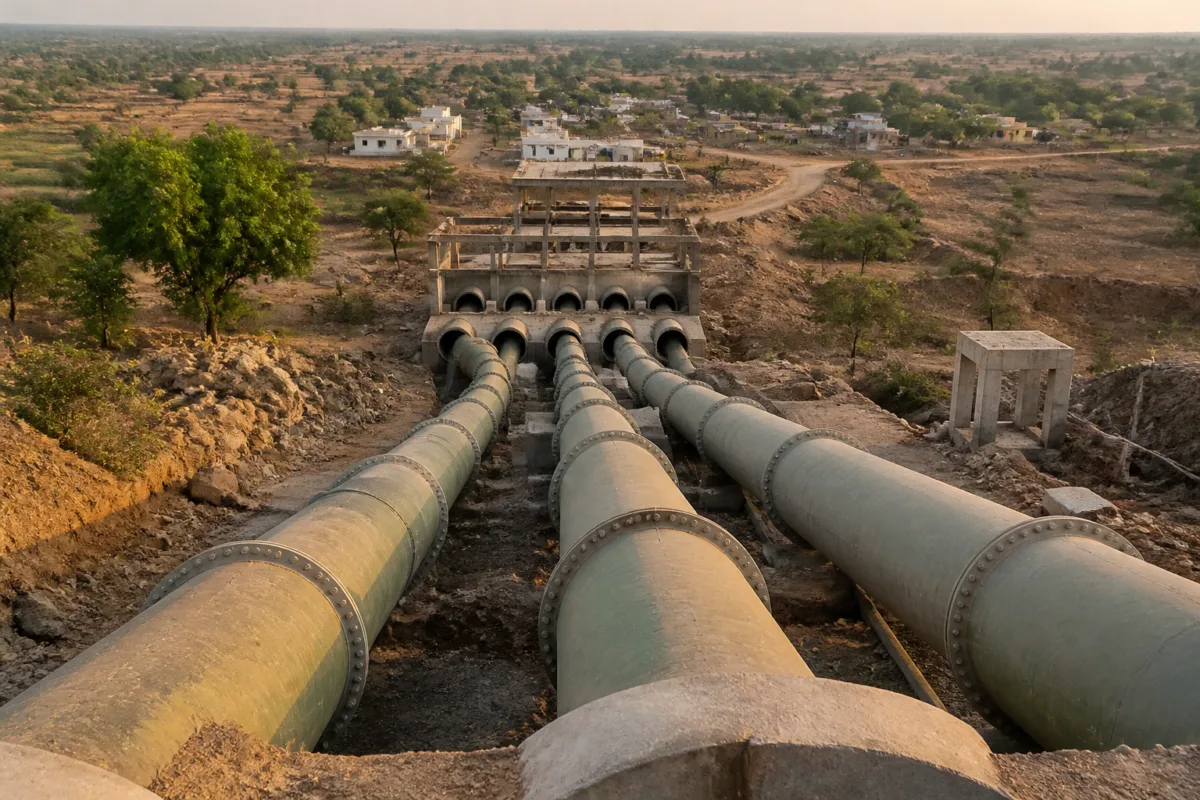
The estimated cost of the Kodangal-Narayanpet-Makthal lift irrigation project in Telangana has risen from about ₹1,450 crore in 2014 to ₹6,825 crore, BRS working president KT Rama Rao alleged in a social media post, while also questioning the transparency of the tender process.
Rama Rao alleged that the project had not delivered a single drop of water to beneficiaries despite the sharp increase in its estimated cost. He accused the Congress-led state government of extending undue favours to a company during the tendering process and of structuring the bidding exercise to benefit selected firms.
According to the allegations reported by Times of India, several companies participated in the bidding process, but the other bidders were only nominal contenders. Rama Rao claimed that this ultimately left one company as the successful bidder. He did not provide further details in the reported account about the companies involved, the tender documents or the basis for calculating the revised project estimate.
The Kodangal-Narayanpet-Makthal scheme is a lift irrigation project, meaning that water must be pumped through a series of infrastructure components rather than moved solely by natural elevation. Such projects typically involve pumping systems, pipelines, reservoirs and distribution networks, making their costs sensitive to design changes, land and construction requirements, power needs and implementation timelines. The report, however, does not specify which components account for the reported increase from ₹1,450 crore to ₹6,825 crore.
Rama Rao also linked the project’s cost and tendering questions to wider concerns over public water management in Telangana. He said people in parts of the state were facing drinking-water shortages and relying on tanker supplies, while public resources were being directed towards high-value irrigation contracts. His criticism framed the issue as one of prioritisation: whether large capital projects are being advanced alongside, or instead of, immediate local water needs.
The allegations also raise an institutional question about how major irrigation projects are estimated, revised and awarded. A fivefold increase between the original estimate and the current reported figure would require scrutiny of the project’s administrative approvals, revised cost estimates, technical scope, tender conditions and implementation record. The supplied report does not include a response from the Telangana government, the irrigation department or the company alleged to have benefited from the tender process.
Rama Rao accused the Congress government of misusing public funds under the cover of development projects and alleged that the bidding process lacked transparency. These remain political allegations contained in his statement; the report does not establish that tender manipulation or financial wrongdoing occurred.
The next point of public scrutiny will be whether the state government or the concerned department publishes a detailed explanation of the revised project cost, the tender evaluation process and the scheme’s implementation status. No such official response or supporting project documents were included in the supplied report.

