


Telangana’s investment strategy is entering a more demanding phase. After securing investment commitments of nearly $69 billion at last year’s summit, the state is now presenting implementation, project conversion and employment generation as the measures that will determine whether its investment ambition produces lasting economic and urban change.
That shift, described by B. Ajith Reddy, CEO of Invest Telangana, in an interview with Deccan Chronicle, is significant because investment announcements are only the first step in building an industrial economy. The harder task is converting interest into partnerships, partnerships into operating projects, and projects into jobs and economic growth. Telangana’s next investment summit is therefore being positioned not simply as another event for signing memorandums of understanding, but as a mechanism for moving commitments towards execution.
The distinction matters for a state that is pursuing an expansive long-term development vision. Telangana Rising 2047 sets an ambition of reaching a $3 trillion economy by 2047, with an intermediate target of a $1 trillion economy by 2034. The targets provide a broad direction, but they do not by themselves explain how new industries will be located, how infrastructure will support them, or how the benefits of growth will be distributed across the state.
The government’s stated answer is a more diversified and spatially distributed economic model. Telangana wants to build on established strengths in aerospace, space and defence, life sciences, information technology, global capability centres and related sectors. At the same time, it is seeking greater attention for artificial intelligence, animation, visual effects, gaming and comics, as well as the creator economy. A planned Raksha Expo, pharma and life sciences expo, IndiaJoy programme and other sector-focused events are intended to bring these priorities into the investment conversation.
This approach reflects an attempt to move away from a single-sector or single-location growth model. Hyderabad remains the central business platform in the state’s investment proposition, but the Telangana Rising 2047 vision also identifies Tier II cities such as Warangal, Mahbubnagar and Nizamabad as potential growth centres. The government is focusing on moving more information technology companies into these towns, although the supplied interview does not establish how many companies are targeted, what infrastructure upgrades are required, or what implementation timetable has been fixed.
The proposed spatial structure is based on different development zones. Services and non-polluting industries would be concentrated in one zone, manufacturing in another, and agriculture and allied sectors in a third. In planning terms, this is an attempt to link industrial policy with land use and regional development. It also raises the practical question of whether the state can provide the transport, power, water, digital connectivity, housing and public services needed to make decentralised industrial growth viable.
Reddy’s remarks suggest that the state is trying to address at least part of this challenge through more customised investment policies. Instead of offering identical packages to every investor, Telangana is considering requirements specific to sectors and company sizes. Policy consultations are under way for data centres, electronics, aerospace, textiles and AVGC. The process, according to Reddy, includes discussions with existing investors in Hyderabad and industry associations, with industry contributing substantially to the drafting of the policies.
This is an important institutional change in emphasis. Investment policy is often judged by the incentives announced, but implementation depends on the administrative systems behind those incentives. The interview refers to possible support involving power, electricity tariffs, available land banks and industrial parks located close to Hyderabad. It does not provide the value of the proposed incentives, the size of the land banks, the tariff structure, or the conditions attached to them. Those details will be necessary to assess whether the policy framework can move beyond broad investor signalling.
The reference to industrial parks also connects investment promotion with the physical geography of development. Industrial activity requires serviced land, reliable utilities and access to transport networks. Technology industries require dependable power and communications infrastructure, while manufacturing requires logistics and supply-chain connections. The state’s investment pitch will therefore depend not only on its ability to attract companies, but also on whether planned locations can offer the operational conditions those companies need.
The same issue is visible in the state’s ambition to expand into data centres, electronics, aerospace and advanced technology. These sectors can diversify Telangana’s economic base, but their infrastructure requirements are different. A data centre depends heavily on power reliability and digital connectivity. Manufacturing requires land, logistics and utilities. Aerospace and defence may require specialised industrial ecosystems and institutional coordination. The source material identifies these sectors as policy priorities but does not establish the proposed capacity, project pipeline or infrastructure investment for each one.
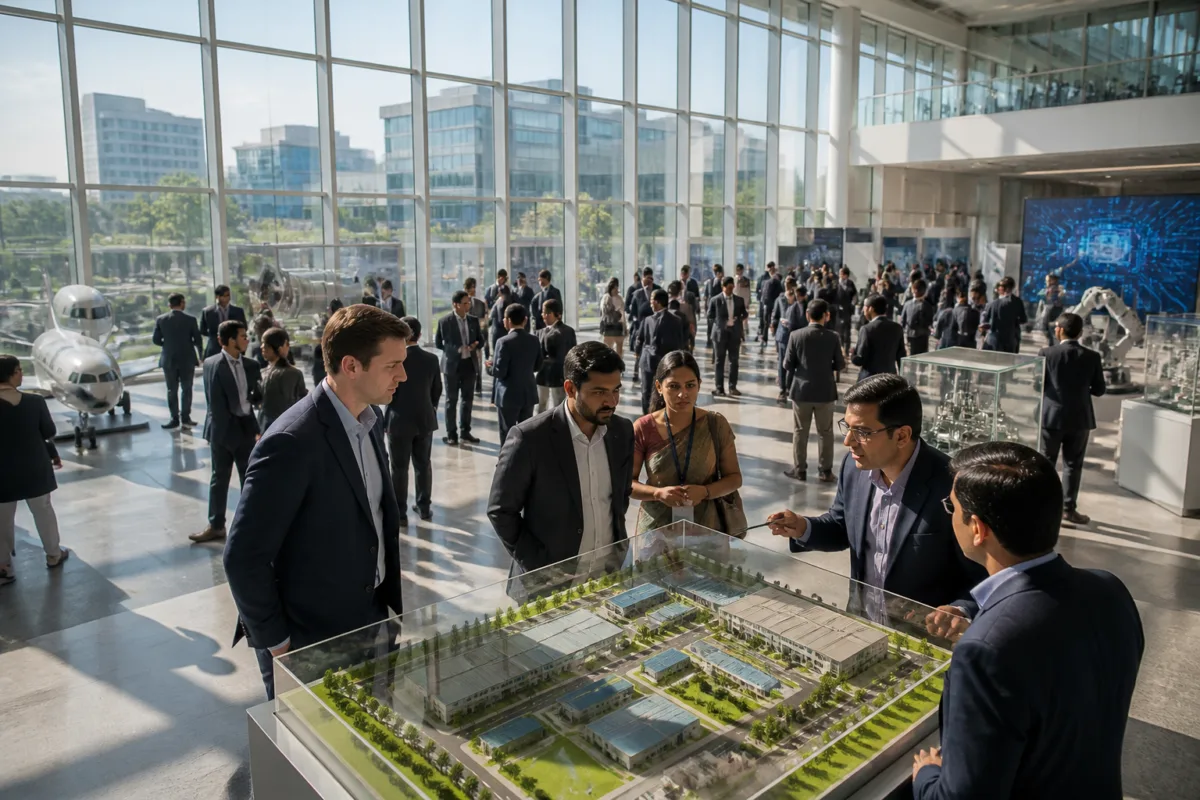
The summit’s design reflects this effort to connect policy with implementation. The state has invited an estimated 600 to 700 international delegates, including diplomats, commercial representatives, defence attachés, consuls general and senior company executives from Europe, North America, Japan, South Korea, Singapore and other countries. Reddy says the focus is intended to be on the quality of participation rather than the number of attendees, and that the event is being planned at a scale estimated at 10 to 20 times that of the previous year.
The government is also presenting the summit as a continuing platform rather than a ceremonial gathering. Reddy says Chief Minister A. Revanth Reddy wants investment summits to continue and that Telangana should be seen as a business platform for investors considering opportunities in India. That ambition will be tested by what happens after the delegates leave. A summit can create visibility and access, but the conversion of discussions into projects requires clear approvals, accountable departments, land availability, financing and monitoring.
The climate conclave planned alongside the summit adds another layer to the state’s development agenda. Policymakers and climate experts are expected to contribute to discussions that could result in an action plan. The source does not specify the proposed targets or sectors covered by that plan. However, its inclusion indicates that investment promotion is being linked to climate policy, an increasingly important consideration for industrial locations and urban infrastructure.
The Telangana Innovation Startup Challenge offers a different implementation route. The government has identified public problems and invited young innovators and startups to propose solutions. Promising ideas could be developed into prototypes, with the government potentially giving contracts to the successful participants. This model is notable because it treats public procurement as a possible route for supporting innovation. It also makes the procurement process central: without defined problem statements, transparent selection and the ability to purchase tested solutions, the challenge could remain an ideas programme rather than become an operational tool.
For cities beyond Hyderabad, the outcome will depend on whether investment decentralisation produces complete economic ecosystems rather than isolated projects. A company moving to Warangal, Mahbubnagar or Nizamabad would need access to workers, housing, transport, education, healthcare, utilities and business services. The interview identifies these cities as emerging growth centres but does not provide population, employment, infrastructure or investment data to show how prepared they are for that role.
That missing information is central to evaluating Telangana’s $3 trillion ambition. The state has supplied a series of targets, sectors and proposed platforms: $69 billion in investment commitments last year, a $1 trillion intermediate economic milestone for 2034, and a $3 trillion goal for 2047. But commitments are not the same as capital deployed, projects under construction, operational capacity or jobs created. The next stage of reporting will need to distinguish among these categories.
The state’s own language acknowledges this gap. The objective is to ensure that investor interest becomes partnerships, that partnerships become projects, and that projects create employment and growth. This sequence provides a useful framework for assessing future announcements. It places equal importance on the administrative work after an MoU and on the announcement itself.
Telangana’s investment push therefore represents both an economic strategy and an urban planning challenge. Its success will depend on whether Hyderabad’s existing advantages can be extended to other parts of the state without creating new infrastructure deficits, whether sector-specific policies can be implemented consistently, and whether investment commitments can be measured through actual projects and employment. The summit may demonstrate the strength of investor interest, but the more consequential evidence will emerge through project execution, regional distribution and the delivery of the infrastructure required to support the state’s proposed growth zones.

