


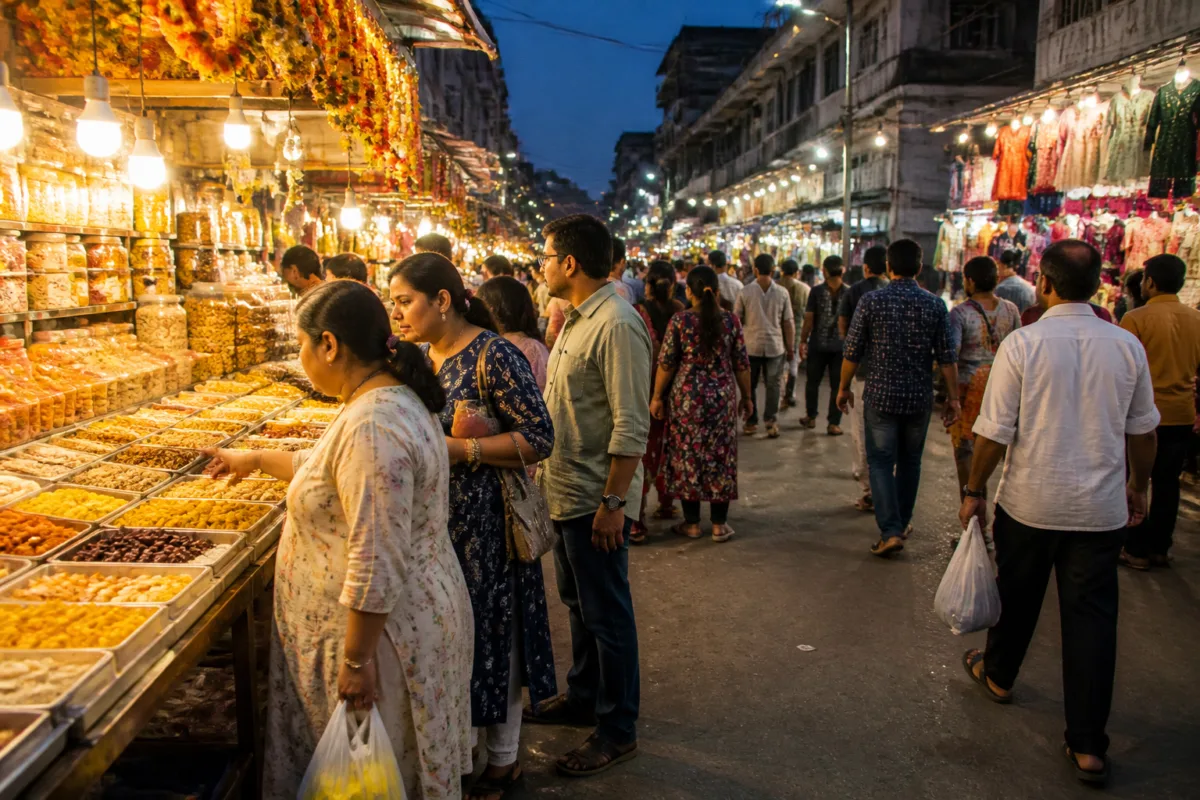
Diwali spending in Pune is becoming more selective, with households cutting back on discretionary purchases while continuing to allocate money to clothing, travel and family celebrations. A survey cited by Civic Mirror estimates that total Diwali expenditure will fall to Rs 1.97 lakh crore this year from Rs 2.2 lakh crore in 2025, even as the average family budget remains around Rs 20,000.
The shift is not simply a story of lower demand. It shows how inflation is changing the way urban households participate in a major festival, and how that change is being transmitted through neighbourhood markets, gold shops, sweet sellers, textile businesses, vehicle showrooms and travel platforms. Consumers still want to spend, but the order of priorities is changing: essential purchases and planned experiences are taking precedence over impulse buying.
The survey cited in the report attributes the restraint to rising prices of daily-use goods and festival-related products, limited household budgets and concern about future savings. More than 30 per cent of families are expected to avoid unnecessary spending. Around 85 per cent plan to use accumulated savings for festive purchases, while 35 per cent are expected to fund about a quarter of their Diwali spending from savings.
That dependence on savings is an important indicator of household pressure. It suggests that the festival budget is being managed not only through lower purchases but also by reallocating money already set aside. The report does not establish how this pattern varies by income group, but the available figures indicate that consumers are making more deliberate trade-offs between present celebrations and future financial security.
The price increases described in the report are uneven across categories. Household appliances have become 4 to 7 per cent more expensive, while sweet prices have risen by 16 per cent. Almond prices are reported to have increased by 34 per cent, and pistachio prices have more than doubled. One sweet seller told Civic Mirror that dry-fruit prices had risen by 30 to 40 per cent, with almonds increasing from about Rs 800 a kilogram last year to Rs 1,200 this year. Pistachio prices, according to the seller, have risen from roughly Rs 1,000 a kilogram in 2025 to Rs 2,200.
These increases matter because dry fruits are embedded in several parts of the festive economy: sweets, gift boxes, home consumption and corporate or family exchanges. When an input becomes significantly more expensive, the impact is felt both in the final price paid by consumers and in the quantity they choose to buy. The report says customers are comparing prices across shops, indicating that price discovery and bargaining have become more important parts of festive shopping.
Local businesses are reporting the effect in different ways. A sweet seller cited by Civic Mirror estimated a 25 to 30 per cent decline in sales compared with last year. A jewellery seller on Laxmi Road reported a 20 to 30 per cent fall in gold sales. A two-wheeler showroom manager linked weaker sales to higher petrol and vehicle prices, as well as to the fact that Dussehra and Diwali fell in the same month last year, creating a stronger combined sales period.
Textile sellers are facing a parallel challenge. Grey fabric, which is later dyed and used in clothing, is reported to have risen from Rs 70 a metre to Rs 100 a metre, an increase of about 43 per cent. A textile trader told the publication that customers who previously bought fabric a month before Diwali and had clothes stitched are increasingly choosing ready-made garments. This change combines price pressure with a longer-term shift in urban consumption habits, where convenience and predictable pricing can matter as much as customisation.
The survey nevertheless shows that festive demand has not disappeared. Seventy-one per cent of respondents said they intended to buy clothes and fashion products. Forty-four per cent were considering household appliances, and 46 per cent planned to spend on tourism. The pattern suggests that the issue is not an across-the-board withdrawal from consumption, but a re-ranking of what households consider worth paying for.
Tourism appears to be gaining from that re-ranking. The report, citing a Business World survey, says spending on Diwali-holiday travel has increased by 60 per cent, with average trip expenditure rising from around Rs 35,000 in 2024 to about Rs 55,000. Group tourism accounted for 65 per cent of October bookings, while international travel attracted 40 per cent of preferences. Udaipur, Goa and Jaipur were identified as popular domestic destinations, while Bangkok was the leading international choice. Flight bookings to Agatti in Lakshadweep were reported to have risen by 130 per cent.
At the same time, the travel data points to a more cost-conscious market rather than unrestricted discretionary spending. Budget hotel bookings reportedly increased by 200 per cent. Bus bookings from Delhi rose by 79 per cent, by more than 75 per cent in Pune and by 58 per cent in Mumbai. These figures suggest that travel is serving two different purposes: leisure holidays for some households and journeys to hometowns for families maintaining the tradition of celebrating together.
This distinction matters for understanding Pune’s urban economy. A household that reduces spending on jewellery, sweets or appliances may still spend on transport, accommodation or clothing. Money is not necessarily leaving the festive economy; it is moving between sectors. Retailers dependent on high-value or repeat purchases may experience a sharper slowdown than businesses connected to travel, ready-made apparel or essential goods.
The evidence also shows how external cost pressures reach local markets. The report links weaker demand to inflation and rising crude oil prices, while local sellers describe increases in fabric, fuel, vehicles, dry fruits and sweets. The available material does not quantify the contribution of each factor or separately measure the effect of the reported Gulf war on Pune households. It does, however, record the combined result: higher prices are narrowing the room available for discretionary purchases.
For municipal and urban policymakers, this is not only a retail story. Festive markets depend on transport access, street-level commercial activity, public safety, pedestrian movement and the ability of small businesses to operate during concentrated periods of demand. When spending patterns change, the effects can be felt across these linked systems. A fall in gold or sweet sales, for example, affects traders and workers, while a rise in travel demand places pressure on intercity transport and hospitality capacity.
The report also highlights the limits of headline consumption figures. Total festive spending may decline, but individual categories can move in opposite directions. Travel spending is reported to be rising even as jewellery and sweet sales fall. Clothing remains relatively resilient, while traditional fabric purchases face competition from ready-made garments. A single aggregate number therefore cannot explain how urban households are adapting to inflation.
What the evidence confirms is a more disciplined form of festive consumption. Families continue to spend, but they are comparing prices, using savings, postponing non-essential purchases and selecting experiences or goods they consider more valuable. What remains unclear is whether these changes are temporary responses to this year’s prices or part of a longer shift in household consumption. For Pune’s traders, the immediate test will be whether festive demand returns after the season or whether the new budget-conscious pattern becomes the normal condition of urban retail.

