


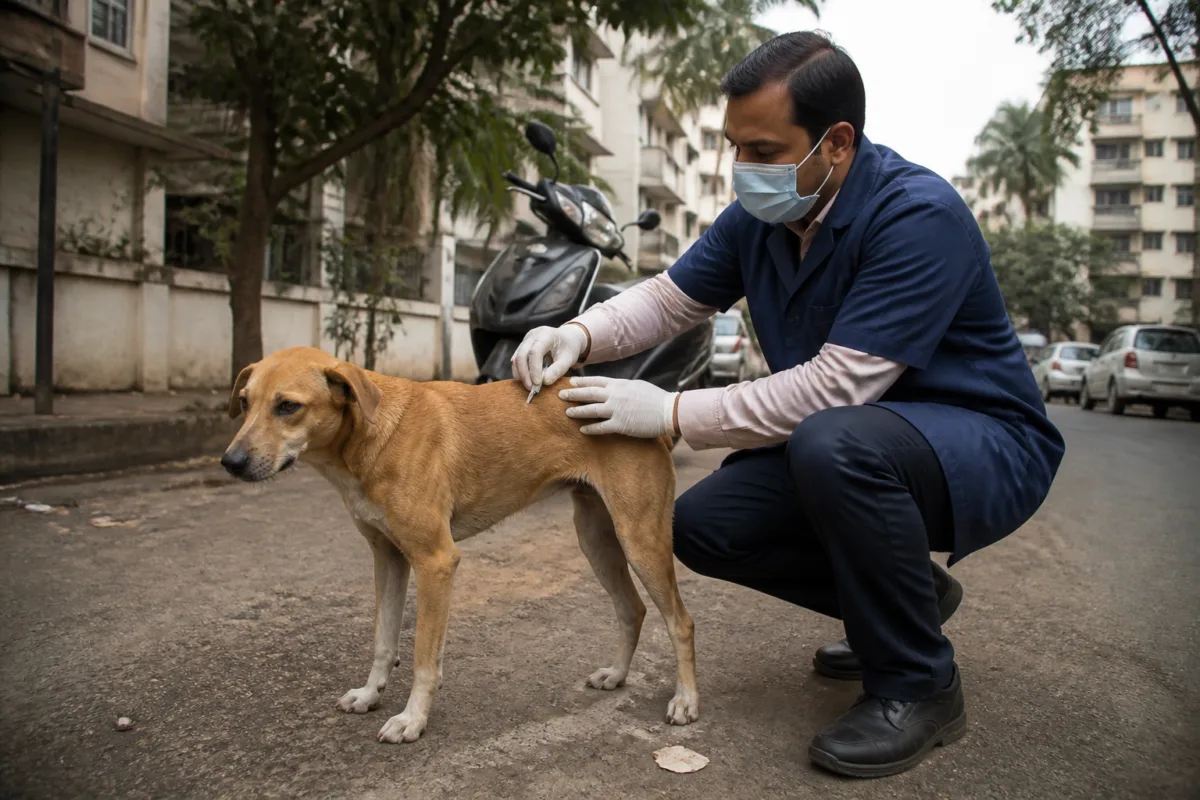
Pune’s rabies-control campaign is showing measurable administrative effort, but the city’s own figures also reveal the scale of the urban system it is trying to manage. The Pune Municipal Corporation has recorded no human death from rabies in the past three years, while reporting 95,550 dog vaccinations across the 2025-26 financial year and the first part of 2026-27. At the same time, 36,191 citizens were reported to have suffered dog bites, scratches or contact with dogs between January and September.
The figures, reported by Pudhari and attributed to officials in the civic body’s veterinary department, place Pune’s rabies strategy at the intersection of public health, animal management and municipal capacity. The city’s progress cannot be assessed only through the absence of human deaths. It also depends on how consistently the municipal corporation can vaccinate free-roaming dogs, register and monitor pets, respond to bite incidents, and expand shelter facilities without losing track of the population it is trying to serve.
Pune is implementing measures under the National Action Plan for Dog Mediated Rabies Elimination, a national framework jointly associated with the Union Ministry of Health and Family Welfare and the Department of Animal Husbandry. The plan’s stated objective is to eliminate rabies transmitted by dogs by 2030. In Pune, the municipal veterinary health department has responded by intensifying vaccination of both stray and owned dogs, according to the report.
That division between owned and free-roaming dogs is important to the city’s operating model. Pet dogs are being vaccinated through online registration records, while vaccination of stray dogs is being conducted ward by ward. The distinction indicates that the corporation is using two different administrative channels: a registration-linked system for animals under household control and a geographically organised field operation for animals living across public spaces.
The available data also shows how difficult it is to measure coverage. Pune’s 2023 animal census counted approximately 179,940 stray dogs. The municipal corporation has not yet received the figures from the current animal census, according to the report. Without an updated count, the city can track the number of vaccinations delivered but cannot establish from the supplied data what share of the current stray-dog population has been covered.
This is the central measurement challenge in Pune’s rabies-free effort. A high vaccination total is an important operational indicator, but it is not the same as confirmed citywide coverage. The two figures answer different questions: the first shows how many vaccinations the civic system administered, while the second would show how much of the dog population was reached. The supplied report establishes the former and identifies the absence of updated census data, but does not provide a current coverage percentage.
The municipal corporation recorded 59,918 dog vaccinations during 2025-26. In the ongoing 2026-27 financial year, 35,632 dogs had received anti-rabies vaccination up to September, taking the combined total for the two years to 95,550. The report describes these as PEP vaccinations. It also states that ward-level vaccination of stray dogs is continuing, while pet-dog vaccination is being maintained through online registration.
The figures suggest a continuing programme rather than a one-time campaign. That matters because rabies prevention depends on maintaining protection over time, not simply conducting a short burst of inoculation. The report does not provide the duration of immunity, the frequency of repeat vaccination, or a ward-wise breakdown. It therefore cannot establish whether vaccination activity is evenly distributed across Pune or concentrated in particular areas.
The city’s response to dog bites provides another measure of the pressure on municipal and health systems. Between January and the end of September, 36,191 citizens were recorded as having suffered dog bites or related incidents. The municipal corporation said that many cases involved a dog’s nail, scratching or contact with teeth. It also said that preventive treatment had been provided and that the affected citizens were in stable condition.
These incidents show that rabies prevention in a city is not limited to veterinary work. It requires a chain linking street-level response, clinical treatment, reporting and follow-up. The supplied report does not provide the number of people who received each stage of treatment, the locations of incidents, or a comparison with earlier years. It does, however, show that the municipal system is dealing simultaneously with animal vaccination and a large volume of human exposure incidents.
Pune’s shelter capacity is being expanded alongside vaccination. Dog shelters are currently operating at Baner, Mundhwa and Naidu Hospital, with a combined capacity of 200 dogs, according to the report. Work at shelters in Bhugaon and Shindewadi was described as being in its final stage, with the facilities expected to begin operating within two months. These additional shelters are expected to manage 150 dogs.
The planned increase would bring the reported shelter capacity to 350 dogs if all the facilities operate at the stated capacities. That remains a relatively specific form of municipal intervention: it creates places for managing selected animals, but it does not by itself define how the wider free-roaming dog population will be handled. The report does not state the admission criteria, operating arrangements, staffing levels or long-term care model for the shelters.
This distinction is significant for urban governance. A city’s street-dog policy is delivered through multiple institutions and locations, including the veterinary department, public hospitals, wards, shelter facilities and households that own pets. Each part generates different records. Vaccination data comes from field activity and registrations; dog-bite data comes through citizen contact and health responses; shelter data reflects the limited number of animals that can be accommodated. Bringing these records together is essential for understanding the full system, but the supplied material does not indicate whether Pune currently has an integrated public dashboard or a unified citywide database.
The registration of owned dogs is therefore more than a compliance exercise. It gives the civic body a mechanism to identify animals, associate them with households and track vaccination through an online system. The report does not provide the number of registered pet dogs or the proportion that are vaccinated. It does show that the corporation is attempting to create a traceable channel for owned animals while using ward-based operations for stray dogs.
The ward-based approach also places implementation responsibility close to neighbourhoods. It can allow field teams to organise work geographically, but the supplied report does not reveal how wards are prioritised, how repeat vaccination is verified or how the corporation handles dogs that move between areas. Those details are not established in the material and remain important to any assessment of programme effectiveness.
Pune’s reported record of no human rabies deaths for three consecutive years is a meaningful public-health outcome, but it should be read alongside the other figures rather than in isolation. The city still recorded tens of thousands of dog-related incidents through September, and its most recent stray-dog count is not yet available. The absence of deaths indicates that preventive and clinical responses have been functioning in the cases reported, while the incident numbers show the continuing scale of exposure risk.
The evidence also reveals a gap between programme activity and outcome measurement. Pune can report vaccinations delivered, shelters operating or under construction, and bite incidents treated. To establish whether it is moving towards the 2030 elimination objective, it would need a clearer account of population coverage, repeat vaccination, geographic distribution, treatment completion and trends in dog-bite cases. None of those additional measurements is supplied in the report, so the city’s broader progress cannot be independently quantified from the available material.
The larger urban question is how a fast-growing city manages a public-health risk that moves across the boundaries of households, streets and institutions. Owned dogs are connected to registration systems, while free-roaming dogs are managed through field operations and shelters. People who are bitten or scratched enter a separate health-response pathway. Pune’s challenge is to make these systems work together consistently enough that a citywide target is not reduced to isolated campaign totals.
For now, the available evidence supports a measured conclusion. Pune has expanded dog vaccination, maintained preventive treatment for reported exposure incidents, recorded no human rabies deaths in three years and begun adding shelter capacity. It has also not yet received the latest animal-census data, and the supplied figures do not establish current vaccination coverage or explain the operational performance of the planned shelters. The next significant indicators will be the updated dog population count, the opening of the Bhugaon and Shindewadi shelters, and the municipal corporation’s continuing ward-wise vaccination and registration data.

