


Maharashtra has approved taluka-level medical assistance cells in areas declared drought-hit under Trigger-1 during the 2026 kharif season, creating a local mechanism to help patients access government healthcare schemes and financial aid from the Chief Minister’s Relief Fund.
The General Administration Department issued a government resolution approving the cells, which will operate from panchayat samiti offices in the affected talukas. Chief Minister Devendra Fadnavis approved the expansion of the Chief Minister’s Relief Fund assistance mechanism, according to the government resolution reported by Mid-Day.
Each cell will be headed by an independent medical officer appointed by the district collector. The officer will be supported by a clerk and a typist, while the Block Development Officer will arrange the required infrastructure and facilities on priority.
The cells will first help eligible patients access existing healthcare programmes, including Ayushman Bharat, the Mahatma Jyotirao Phule Jan Arogya Yojana, Labour Department schemes and treatment facilities at charitable hospitals. Applications from patients who do not qualify under these programmes can be forwarded through affiliated hospitals using the online system for consideration under the Chief Minister’s Relief Fund.
Medical officers heading the cells will identify patients through subdistrict and rural hospitals, primary health centres, subcentres and Accredited Social Health Activists. The stated objective is to ensure that residents in drought-affected areas are identified promptly and do not lose access to treatment because of financial constraints.
The government will also establish health coordination committees at the district and taluka levels. The taluka committee will be headed by the local Member of Legislative Assembly, with the Sub-Divisional Officer serving as co-chairperson. Its members will include the tehsildar, Block Development Officer, taluka health officer, medical superintendent and representatives of the Indian Medical Association and the Chemists and Druggists Association. The head of the assistance cell will act as member secretary.
At the district level, the guardian minister will chair the committee and the district collector will serve as co-chairperson. The District Health Officer will be the member secretary, with two medical-sector social workers appointed as non-government members.
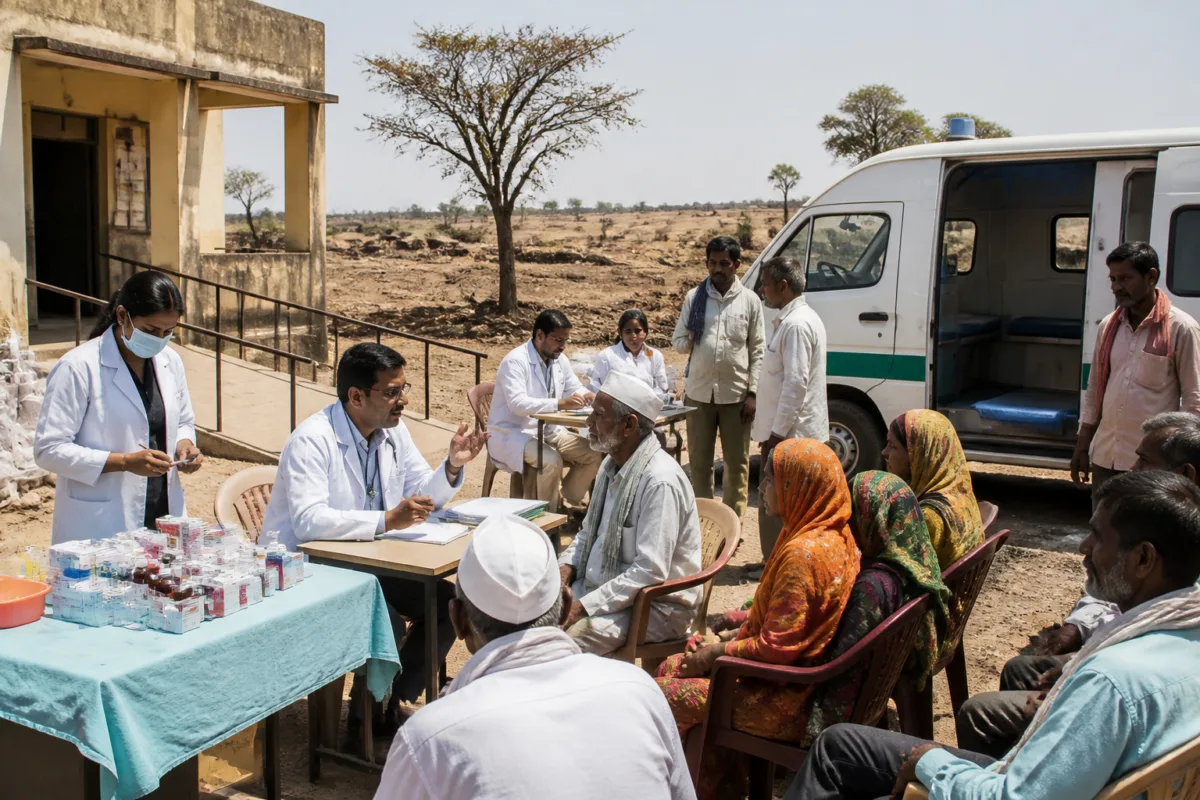
The committees must meet at least twice a month and identify remote areas, densely populated locations and places with inadequate healthcare facilities for priority intervention. They will review illnesses associated with drinking water and heat and plan health camps, mobile medical teams and specialist services. Women, children, senior citizens and people living with diabetes or hypertension will receive special attention.
The government will seek assistance from health experts linked to Maharashtra University of Health Sciences, the Indian Medical Association, the Maharashtra Medical Council, local medical associations and private hospitals. Health camps will be organised in drought-hit areas to provide medicines and treatment.
Taluka cells will submit daily reports on their activities and medical camps to district cells. District authorities will consolidate the reports and forward them to the Chief Minister’s Relief Fund cell at Mantralaya. Rameshwar Naik, head of the CMRF and Charitable Hospitals Assistance Cell, said the expansion was intended to make the relief mechanism more accessible and improve coordination between existing healthcare schemes and financial assistance.

