


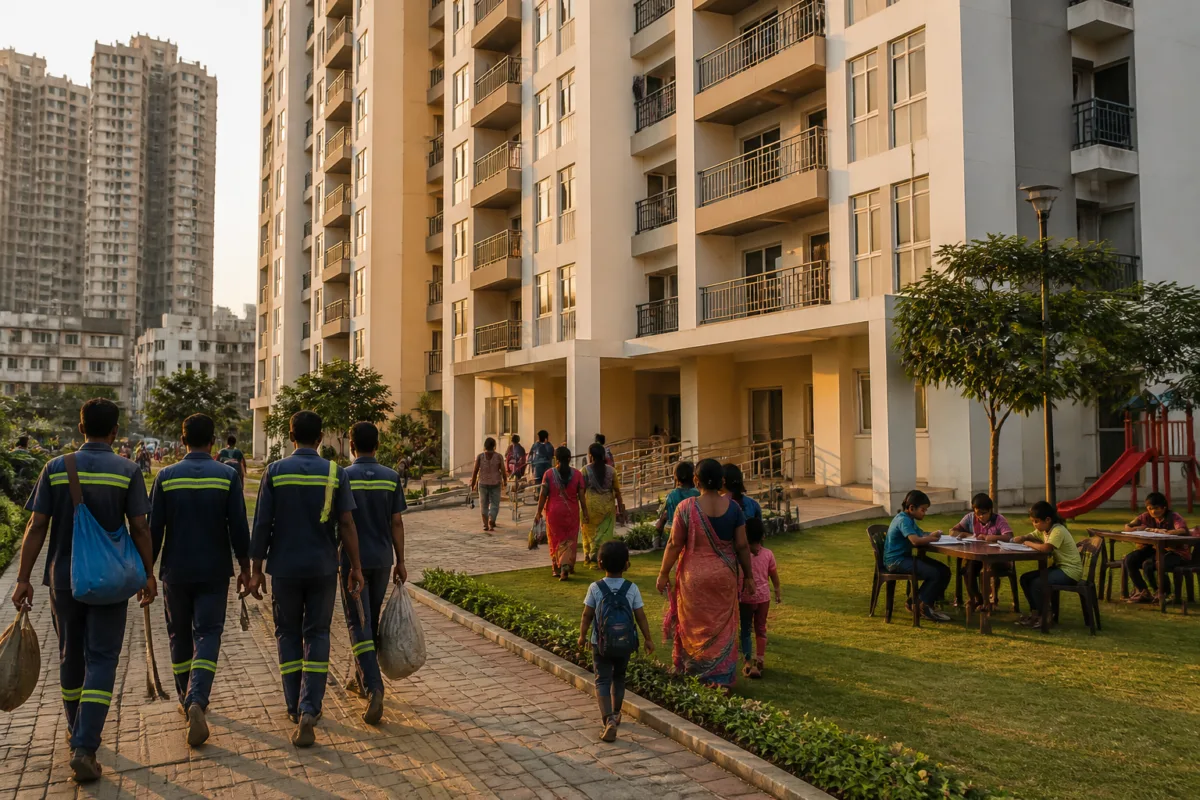
The redevelopment of Mumbai’s sanitation worker colonies is being presented as a housing initiative, but its larger significance lies in how the city treats the workforce responsible for maintaining its public health. The Maharashtra government and the Brihanmumbai Municipal Corporation (BMC) have announced a phased plan covering 146 colonies and 29,000 sanitation workers, combining service accommodation with a stated move towards ownership rights.
The announcement was made at the inauguration and key distribution ceremony for 140 flats at Panchsheel Nagar in Colaba. The homes were constructed under Phase II of the BMC’s Ashray Yojana. Maharashtra Chief Minister Devendra Fadnavis said sanitation workers would receive homes under ownership rights in addition to service quarters, while Deputy Chief Minister Eknath Shinde said the first phase of providing improved service accommodation had begun.
That distinction between service quarters and ownership is central to the scheme. The existing arrangement is linked to employment. According to the report, when a sanitation worker’s son is appointed in place of his father, the accommodation is transferred to him. The government’s stated plan adds a separate ownership-based housing promise, potentially changing the relationship between employment, family succession and access to a home. The announcement, however, does not establish how ownership eligibility will be determined, when individual titles will be issued or how the ownership component will be financed.
The immediate deliverable is more clearly defined. Shinde said 146 sanitation worker colonies in Mumbai would be redeveloped in phases, with workers receiving 300-square-foot homes instead of the existing 150-square-foot accommodation. Under the Ashray Yojana, 30 sanitation worker colonies are being redeveloped through 35 projects across three phases. The plan covers 11,371 homes measuring 300 square feet and 773 homes measuring 600 square feet, for a total of 12,144 homes.
These numbers reveal both the scale and the gap in the programme. The BMC aims to provide service accommodation to all 29,000 sanitation workers, while the Ashray Yojana figures currently account for 12,144 homes. The supplied announcement does not explain whether the remaining workers will be covered through projects outside the Ashray Yojana, through additional phases, or through another accommodation arrangement. It also does not provide a colony-wise construction schedule or a completion date for each phase.
The government has set 2028 as the target for providing service quarters to sanitation workers. That target turns the plan from a ceremonial housing announcement into a long implementation programme. Redeveloping 146 colonies will require the BMC to manage construction, temporary arrangements, resident eligibility, handovers and the continuity of municipal sanitation services at the same time. The report does not state how residents will be accommodated while individual colonies are rebuilt, an issue that can materially affect whether redevelopment proceeds without disruption.
Panchsheel Nagar provides the first completed example described in the announcement. Two buildings contain 140 flats, with 10 lifts and other essential amenities. The complex includes clean surroundings, study facilities for children and spaces for various activities. Five sanitation workers—Bharati Dhotre, Sachin Solanki, Vandana Goregaonkar, Shyamsingh Valmiki, Prashant Sawant and Satish Marchande—were listed for the symbolic key handover, although the report says keys to 140 flats were distributed during the ceremony.
The project also has an institutional significance because the BMC used prefabricated technology for the first time in one of its buildings, according to Fadnavis. Prefabrication can alter construction timelines and site processes, but the announcement does not provide a construction period, project cost, quality assessment or comparison with conventional construction. It therefore establishes the technology as a delivery choice, not yet as evidence of faster or cheaper public housing.
The political and administrative responsibilities are spread across several layers. The chief minister announced the ownership component and referred to the Dr Babasaheb Ambedkar Shram Safalya Yojana and the Valmiki Housing Scheme. The deputy chief minister described the colony redevelopment and accommodation plan. The BMC is the implementing civic body, while the assembly speaker described the distribution of keys as the beginning of the wider initiative. The presence of the Mumbai mayor, BMC commissioner and other representatives underlined the programme’s connection to both state policy and municipal administration.
The announcement also places the redevelopment within a longer policy history. Fadnavis referred to the Lad Page Committee, established in 1973 to address the concerns of sanitation workers. He said its functioning was later discontinued and revived in 2015 through a government resolution that reinstated the hereditary appointment system. He also said the government had decided to provide Class III jobs to children of sanitation workers who meet the required educational qualifications, and that it had won a legal battle to implement the committee’s recommendations.
The housing plan is therefore not an isolated construction project. It sits alongside employment rules, family succession, reservation or eligibility questions, wages and welfare facilities. Fadnavis said minimum wages and other facilities would be extended to sanitation workers engaged as contractual, daily-wage and substitute workers. The supplied material does not specify the legal or administrative mechanism for implementing that commitment, but it broadens the policy question beyond permanent municipal employees.
Shinde’s justification for bringing workers closer to their workplaces points to the relationship between housing and urban service delivery. He said several sanitation workers live outside Mumbai and commute by local trains every day, affecting their health and work efficiency. Providing accommodation within the city, he argued, would improve living conditions and help make Mumbai cleaner and healthier. The statement connects the location of workers’ homes to the reliability of sanitation operations, particularly in a city where daily waste collection and public cleaning depend on a large, often invisible workforce.
The announcement also recognises the household dimension of the programme. Shinde asked the BMC to formulate a separate scheme to support higher education for sanitation workers’ children, including pathways into medicine, engineering, law and architecture. The Panchsheel Nagar complex’s study facilities similarly suggest that the redevelopment is intended to provide more than additional floor area. Yet the source does not establish the scale, funding or eligibility rules of the proposed education support.
The difference between 150-square-foot and 300-square-foot accommodation is a measurable improvement in the stated housing standard. The inclusion of 600-square-foot homes for 773 beneficiaries indicates that the programme may contain more than one unit category. However, the announcement does not explain the criteria for allocating the larger homes, the household sizes involved or whether the unit sizes include common areas or only carpet area. Those details will matter to residents assessing whether the new accommodation meets their actual needs.
The programme’s next challenge is converting commitments into a transparent delivery system. The public information released so far identifies the number of colonies, projects, proposed unit sizes and an overall 2028 service-quarter target. It does not provide a consolidated budget, procurement schedule, project-wise milestones, relocation protocol, title framework for ownership homes or a public monitoring mechanism. These are not secondary details in a redevelopment programme; they determine how residents experience the transition from announcement to possession.
For Mumbai, the central urban question is whether civic infrastructure can be planned together with the housing needs of the workers who operate it. Sanitation workers are essential to the functioning of the city, but their accommodation has historically been tied to service quarters and employment arrangements. The BMC’s plan acknowledges that housing quality, tenure and proximity to work are connected to the delivery of a basic municipal service.
The evidence currently confirms a substantial first step: 140 flats have been handed over at Panchsheel Nagar, 146 colonies are identified for phased redevelopment, and the Ashray Yojana lists 12,144 homes across 35 projects. It also confirms a wider promise of ownership rights and service quarters for 29,000 workers, with 2028 stated as the target for the latter. What remains unclear is how the full numerical gap will be closed, how ownership will be operationalised and how the 146-colony programme will be sequenced. Those details will determine whether the initiative becomes a durable housing reform or remains primarily a series of project announcements.

