


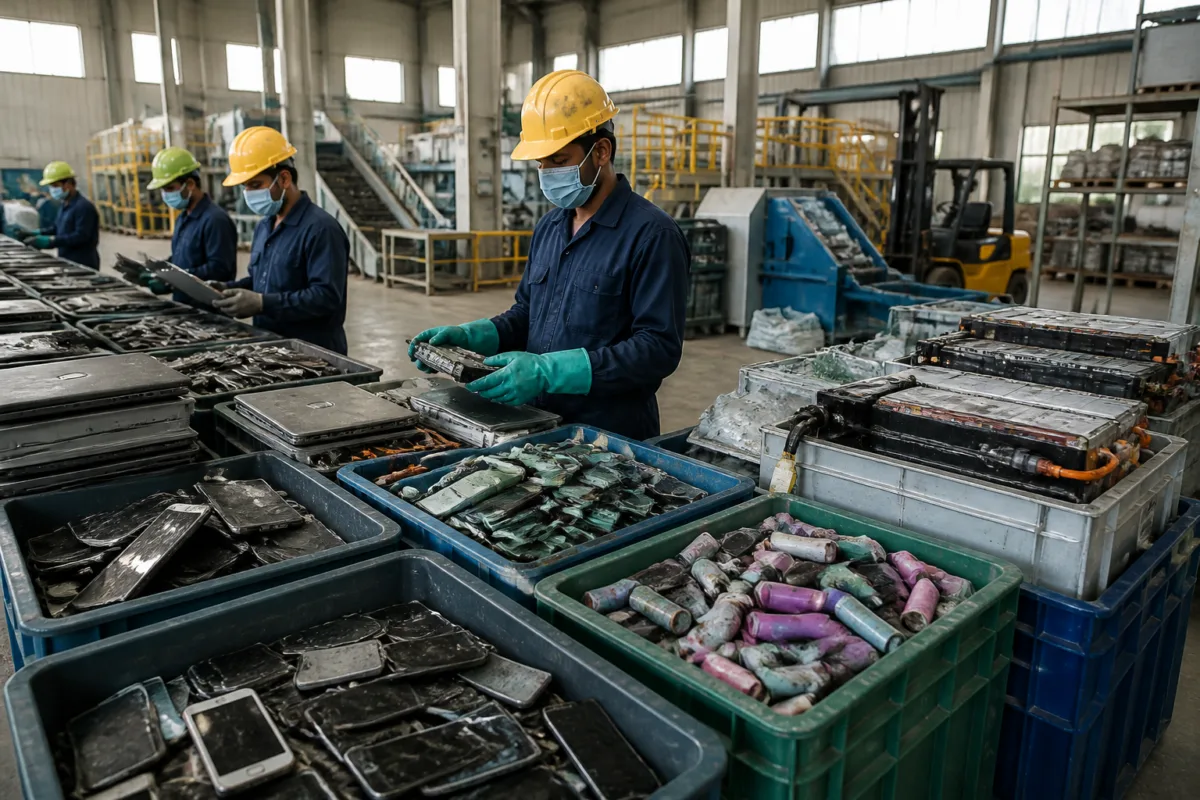
India’s festive-season consumption boom is creating a larger urban question than what consumers will buy next: what happens to the phones, laptops, electric two-wheelers, cars and appliances they replace? The answer will determine whether discarded products become a source of critical minerals or remain an unsafe and poorly tracked waste stream. An assessment cited in an industry presentation estimates that retired lithium-ion batteries could yield 573 kilotonnes of minerals worth around Rs 1.01 lakh crore in India between FY2026-27 and FY2040-41. Yet the same recycling system is still dominated by informal channels, with only a small share of end-of-life batteries converted into battery-grade materials domestically.
This contrast captures the central challenge of India’s urban mining opportunity. Cities are rapidly increasing the volume of electronics and rechargeable batteries entering the consumption cycle, but the systems required to collect, transport, dismantle, process and return their materials to manufacturing remain incomplete. The result is not simply lost economic value. Informal handling of discarded batteries can create fire risks, while the absence of traceable collection makes it difficult to establish where waste goes and whether it is being processed safely.
Urban mining describes the recovery of valuable materials from products already circulating in cities. Retired lithium-ion batteries contain minerals such as lithium, cobalt and nickel, which are used in electric vehicles and battery manufacturing. Mobile phones and laptops also contain recoverable metals, while automobile catalytic converters contain platinum-group metals. In this sense, the urban waste stream is also a dispersed resource inventory. Unlike a conventional mine, however, this resource is distributed among households, repair shops, retailers, vehicle owners, scrap dealers and recycling facilities.
That distribution makes collection the first institutional challenge. The report, citing an ICEA-Accenture assessment, says around 80% of collected lithium-ion battery scrap is handled by unregulated informal channels, while 20% enters formal collection channels. Only 1% of end-of-life batteries is converted into battery-grade materials domestically. These figures show that the problem is not only the absence of recycling technology. It is also the difficulty of bringing discarded products into a system where their origin, condition, ownership and processing route can be recorded.
For municipal and urban systems, this distinction matters. A household may treat an old phone, laptop or rechargeable battery as ordinary discard, but a damaged lithium-ion battery requires particular care because it can create a fire hazard. When such items enter mixed household waste, municipal collection and disposal systems may not be designed to identify or isolate them. When they move through informal scrap channels, the material may be recovered, but the supplied evidence indicates that the process is often outside regulated collection and processing networks. The city therefore loses both control over safety and visibility over material flows.
The scale of the potential resource helps explain why the issue is becoming part of India’s critical-mineral discussion. The assessment cited in the presentation estimates that 573 kilotonnes of minerals could be recovered from retired lithium-ion batteries over the period from FY2026-27 to FY2040-41, with an estimated value of around Rs 1.01 lakh crore. The figure is a projection rather than an amount already recovered. Its significance lies in showing the possible value of products that are already reaching the end of their useful lives, provided they can be collected and processed effectively.
The economic opportunity extends beyond the material inside individual batteries. An ICEA-Accenture report cited in the presentation projects that India’s battery recycling market could reach Rs 31,150 crore, or about $3.5 billion, by 2030. The market would include collection, sorting, dismantling, recycling and the processing of recovered materials. But market size alone does not guarantee a functioning circular supply chain. Formal recyclers need a reliable and traceable supply of discarded batteries and battery black mass, the material from which valuable metals are extracted. If most scrap continues to move through informal channels, regulated operators may struggle to secure the feedstock required to invest in advanced facilities.
The supply problem is connected to India’s import dependence. An IEEFA assessment published in October 2024, as cited in the report, highlights India’s 100% import dependence on lithium, cobalt and nickel. Recycling cannot eliminate the need for primary mineral imports, but the report says closed-loop recycling could potentially meet 10-12% of India’s electric-vehicle battery lithium demand over the next decade. The potential contribution is therefore limited but material: recovered minerals could supplement imported supplies while reducing the amount of value lost when batteries leave the formal economy.
The gap between mineral recovery and battery-grade production is particularly important. Recovering metals from a discarded product is not the same as producing materials that can be used again in battery manufacturing. The report says that only 1% of end-of-life batteries is converted into battery-grade materials domestically. This indicates a processing bottleneck beyond collection. It also means that a recycling system may recover lower-value material without yet creating a closed loop in which recovered lithium, nickel or cobalt is returned to manufacturing at the required quality.
That processing requirement raises the cost and complexity of formal recycling. Battery-grade materials require sophisticated extraction and purification technologies, according to the report. Formal operators therefore need capital, technical capacity, steady supplies and regulatory clarity at the same time. If any one of these is missing, the system can remain dependent on informal aggregation, export-oriented processing or lower-value recovery. The available evidence does not establish how each company or facility performs across these stages, but it does show that India’s stated recycling opportunity is considerably larger than its current domestic battery-grade output.
The policy response is being built around both supply security and producer responsibility. The National Critical Mineral Mission seeks to strengthen indigenous critical-mineral supply chains and reduce import dependence. The report also refers to a Rs 1,500-crore recycling incentive scheme under which 58 eligible companies have reportedly been approved. A separate Rs 3,000-crore scheme for lithium and nickel processing provides a 15% capital subsidy for domestic processing and refining, according to the industry presentation.
These measures address the investment side of the problem, but the Battery Waste Management Rules address responsibility across the product life cycle. The rules provide for extended producer responsibility, requiring producers to meet prescribed obligations for collection and environmentally sound management of battery waste, along with traceability requirements. In principle, EPR moves battery waste away from being treated solely as a municipal disposal issue. Producers become part of the chain that must account for what happens after a battery is no longer useful to the consumer.
The effectiveness of that framework depends on whether traceability reaches the point where products are discarded. Consumers, retailers, manufacturers, collection agencies, informal aggregators and recyclers occupy different positions in the chain. A rule requiring collection or reporting can achieve limited results if the first handover remains invisible. The reported 80% share handled by unregulated informal channels suggests that the formal system is still not capturing most collected lithium-ion battery scrap, even as policy support is being directed towards recycling and processing capacity.
This is where the urban dimension becomes clearer. India’s cities are not only places where e-waste is generated; they are the main interface between consumers and the recycling economy. Festive discounts accelerate product replacement, while the old products remain dispersed across homes, offices, garages, repair markets and retail networks. The waste stream is therefore shaped by purchasing patterns and by the availability of convenient disposal options. A consumer warning not to discard batteries with household garbage is necessary, but it does not by itself create an accessible, trusted and traceable collection route.
The transition to electric mobility adds another layer. Electric two-wheelers and cars bring larger battery packs into the urban product cycle. Their eventual retirement will require systems capable of handling batteries that are heavier, more valuable and potentially more hazardous than ordinary electronic devices. The supplied evidence does not quantify future battery volumes or specify the capacity of individual cities to manage them. It does, however, establish that lithium-ion battery recycling is already being discussed as a source of domestic minerals and that current collection remains substantially informal.
The question is therefore not whether India has valuable minerals inside discarded products. The estimates indicate that it does. The more difficult question is whether the country can build a chain that connects consumers, producers, municipalities, formal recyclers and domestic processors. That chain must preserve safety while also retaining economic value. It must make discarded batteries visible enough to be collected, traceable enough to be regulated and technically accessible enough to produce battery-grade materials.
The evidence currently points to a system with a large projected opportunity but a narrow formal recovery base. India’s battery recycling market could reach Rs 31,150 crore by 2030, and retired lithium-ion batteries could contain minerals valued at around Rs 1.01 lakh crore over the longer assessment period. At the same time, 80% of collected battery scrap is reported to move through unregulated informal channels and only 1% is converted into battery-grade materials domestically. The next developments to monitor are whether policy incentives expand formal processing, whether EPR traceability improves collection and whether more recovered material is returned to domestic battery manufacturing rather than lost from the formal urban economy.

