


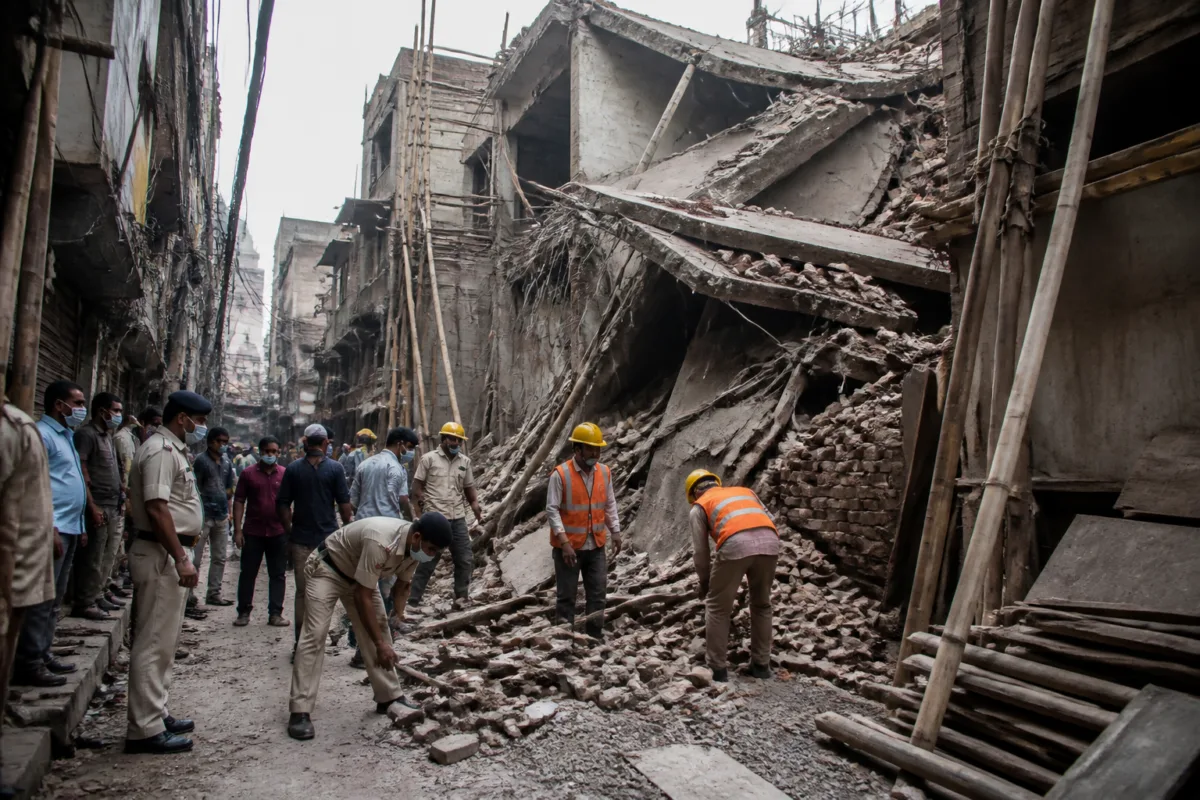
Delhi’s latest building collapse in Chawri Bazar is not an isolated construction accident. It is the newest entry in a series of structural failures across the capital in which unauthorised additions, repair work, ageing buildings, inadequate oversight and difficult rescue conditions have repeatedly converged. The immediate question in each case is what caused the structure to give way. The larger urban question is why known risks continue to remain embedded in the city’s building stock.
The Chawri Bazar collapse occurred on November 5 at property number 4548 in Gali Sheesh Mahal, near Ajmeri Gate. A three-storey under-construction building fell at around 10.30am, killing two people and injuring five. The Municipal Corporation of Delhi’s preliminary inquiry identified alleged unauthorised construction on the second and third floors as a possible trigger.
The inquiry also points to a gap between what the civic authority permitted and what was allegedly carried out. The building owner had received an MCD advisory on April 28 to undertake structural strengthening under the supervision of an empanelled structural engineer. That advisory did not permit fresh construction or reconstruction. According to the preliminary assessment, extensive reconstruction and additional floors were nevertheless undertaken under the description of minor repairs.
The immediate structural failure may have occurred when the shuttering of a newly cast third-floor lintel was removed before the slab had cured. The uncured slab then collapsed, bringing down the rest of the building. This sequence, as described in the preliminary inquiry, shows how a building can move rapidly from an apparently limited repair exercise to a high-risk construction site without the formal approvals or supervision required for new structural work.
The physical setting amplified the consequences. The building stood in a dead-end lane barely three feet wide, preventing heavy rescue vehicles and machinery from reaching the site. Rescue personnel and civic workers had to remove debris manually. In dense neighbourhoods such as Old Delhi, the same urban form that supports intense commercial and residential activity can also restrict access for firefighting, rescue and inspection equipment. A safety failure therefore becomes an emergency-management problem as well as a construction problem.
The Chawri Bazar incident follows several other collapses reported across Delhi this year. In Satya Niketan, a multi-storey building housing a boys’ paying guest accommodation near Delhi University’s South Campus collapsed while repair and construction work was under way, killing seven people. In Karol Bagh’s Regarpura, an old two-storey building collapsed during demolition work; police said no permission had been obtained for the demolition.
Two adjacent under-construction four-storey buildings collapsed in Rohini Sector 16 in July amid heavy rainfall. Structural and plumbing work was examined as a possible contributing factor. In Saidulajab near Saket, a four-storey building collapsed while additional floors were being constructed. The debris fell on an adjoining student canteen, killing six people. Three people were arrested in connection with that incident.
A residential building near Idgah Machhli Mandi in northeast Delhi’s Seemapuri collapsed after the structure developed cracks following earthquake tremors, killing four people, including a pregnant woman. The building owner was subsequently arrested. In the same month, an old structure at Milan Garden in Harsh Vihar gave way while an additional floor was being constructed, killing a 60-year-old man and his 33-year-old son. Police later added a charge of culpable homicide not amounting to murder against the accused.
The incidents differ in location and immediate cause, but the reported pattern is significant. Some involved additional floors or reconstruction, others demolition or repair, and at least one was linked by officials to cracks following tremors. Together, they show that building risk in Delhi is not limited to one category of structure. New construction, old buildings, informal modifications and work carried out without adequate permission can all create failure points.
An expert cited in the report identified several technical factors that can contribute to building collapse. These include a poor foundation, a foundation unsuitable for ground conditions, a superstructure that cannot bear the load, ageing and deterioration, and poor construction quality. The assessment is important because it widens the focus beyond visible violations. An unauthorised floor may be the most obvious problem, but structural safety also depends on whether the foundation, materials, design and construction sequence can support the altered building.
The same expert called for regular safety audits and timely identification of structural and non-structural cracks. Structural cracks, if ignored, can compromise a building’s integrity and must be repaired properly, the report said. This places responsibility not only on civic agencies but also on building owners, contractors and engineers involved in repair, strengthening, demolition and construction.
The institutional challenge is that an advisory, inspection or regulation has value only when it changes activity on the ground. In Chawri Bazar, the MCD had reportedly advised structural strengthening under professional supervision, but the preliminary inquiry alleges that the building was instead subjected to wider reconstruction and additional-floor work. The case illustrates the difficulty of regulating buildings where permitted repairs and unauthorised structural changes can appear similar at street level, particularly in congested areas with limited access for inspection.
The response after the collapse has included both enforcement and broader inspection. Delhi Chief Minister Rekha Gupta ordered the suspension of the area’s Assistant Engineer and Junior Engineer, directed officials to register an FIR against the building owner and contractor, and ordered safety audits of adjoining properties. She also directed action against unauthorised construction across the capital.
Those measures address the immediate accountability question. The recurring pattern, however, raises a wider administrative question: whether inspections are sufficiently regular, technically informed and capable of detecting changes before construction reaches a dangerous stage. The supplied incidents show that action is often visible after a collapse, through arrests, suspensions and criminal cases. They provide less evidence about how consistently risky structures are identified and corrected before lives are lost.
The city’s building-safety problem is also connected to the way urban land is used. In dense districts, additional floors can increase usable space without requiring a new plot, while old structures may be adapted repeatedly as residential, commercial or institutional needs change. The report does not establish the economic reasons behind each modification, but the sequence of repairs, additional floors, demolition and reconstruction indicates how frequently buildings are altered after their original construction.
That makes enforcement dependent on more than approving a building plan once. Authorities must also be able to monitor subsequent alterations, ensure that structural engineers are involved when required, and distinguish maintenance from work that changes load, height or stability. Owners and contractors must understand that a repair label does not make new construction safe or lawful. The Chawri Bazar inquiry specifically indicates that an advisory for strengthening did not authorise fresh construction or reconstruction.
The data available in the supplied report is a list of incidents rather than a citywide building-safety database. It records at least seven collapse episodes or groups of collapses across locations including Satya Niketan, Regarpura, Rohini Sector 16, Saidulajab, Seemapuri, Harsh Vihar and Chawri Bazar. The reported deaths include seven in Satya Niketan, six in Saidulajab, four in Seemapuri, two in Harsh Vihar and two in Chawri Bazar, apart from injuries in several incidents. These figures should not be treated as a complete annual tally because the source describes selected cases rather than an official consolidated record.
Even with that limitation, the locations show that the issue cuts across Delhi’s urban geography. It is present near a university district and student accommodation, in congested commercial areas, in planned sectors, in neighbourhoods near major residential and commercial centres, and in older settlements. The risk is therefore not confined to a single building type or municipal condition.
The repeated involvement of construction, demolition, additional floors and structural alterations also makes the contractor-owner-engineer relationship central to the safety chain. A building does not become dangerous only because it is old, nor only because construction is unauthorised. Collapse can result when the load, foundation, materials, construction stage and surrounding conditions are not assessed together. Rainfall, earthquake tremors and narrow access lanes can intensify the consequences, but they do not by themselves explain the entire pattern described in the report.
For residents, the practical warning signs identified in the report include structural and non-structural cracks, ongoing work in occupied or adjoining buildings, sudden additional floors and construction activity that is not clearly covered by permission. The responsibility for acting on such signs cannot rest on residents alone. The reported deaths and the difficulty of reaching Chawri Bazar underline the need for an institutional system that can inspect, document, order corrective work and intervene before a failure.
Delhi’s latest collapse has therefore brought construction safety back into focus, but the evidence points beyond a single unsafe site. It shows a recurring interaction between ageing structures, unauthorised modifications, weak construction practices, limited inspection and constrained emergency access. The immediate next steps are the FIR, the official inquiry, safety audits of adjoining properties and action directed by the government. What remains to be established is whether these responses will produce a systematic record of vulnerable buildings and prevent the next repair, demolition or additional floor from becoming another collapse site.

