


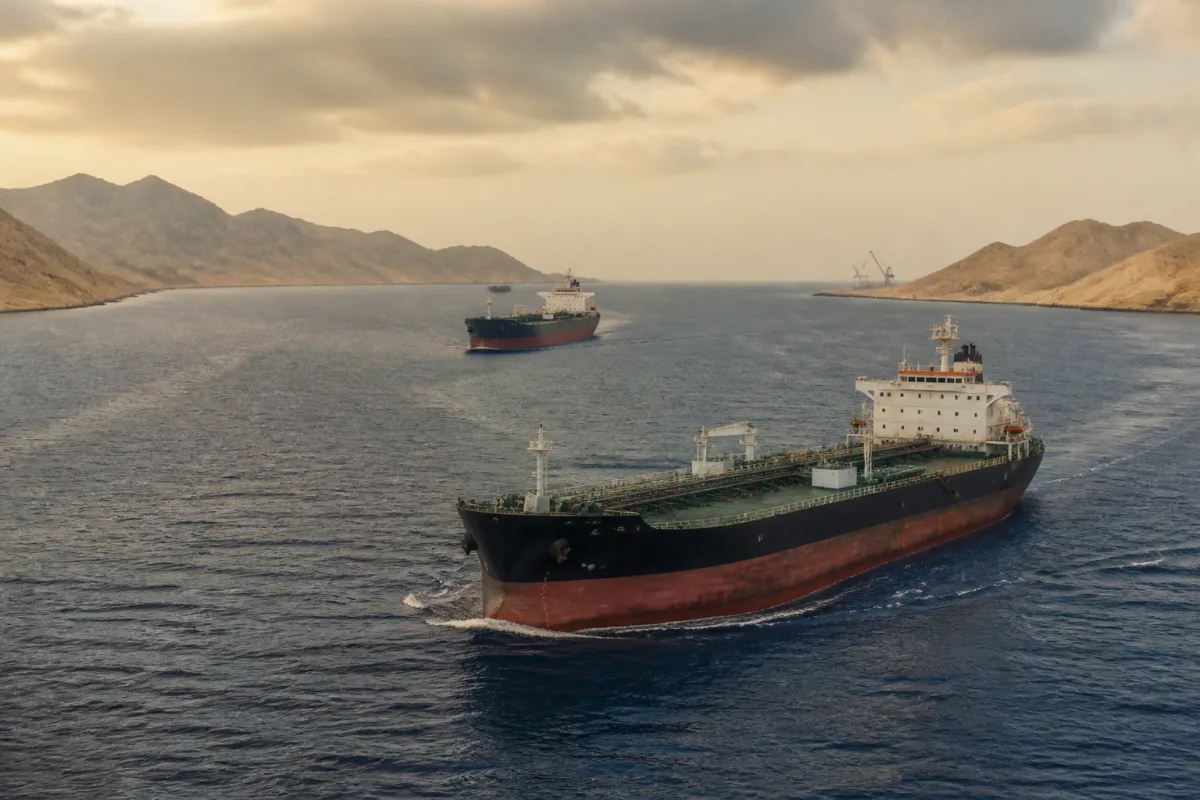
Hindustan Petroleum Corporation Ltd’s difficulty in securing tankers through the Strait of Hormuz is revealing a less visible vulnerability in India’s energy system: crude may be available for purchase, but the transport capacity needed to deliver it is not assured. For a Mumbai-based refiner that bought an average 256,000 barrels a day of Middle East oil last month, the constraint is not simply a question of maritime conflict. It is a logistics problem involving vessel availability, loading dates, shipowner risk decisions and the location at which crude is transferred to the buyer.
The issue was described by HPCL Chairman Vikas Kaushal in an interview in Abu Dhabi this week, according to a Business Standard report based on Bloomberg. Kaushal said the company was facing challenges booking ships to enter the Persian Gulf and pick up cargoes, even as more vessels were crossing the Strait of Hormuz and crude flows from the region were rising. The company’s ability to complete such transits has varied, he said, while supplies can still be collected from outside the chokepoint.
That distinction matters. A crude purchase is not complete when a refiner agrees to buy a cargo. The shipment also requires a vessel available for the relevant loading window, an owner willing to undertake the voyage and an operational arrangement for delivery to the refinery. HPCL’s experience, as described by Kaushal, shows how each link can become a separate point of failure.
“The main challenge has been hiring of ships. Even if we have crude available for purchase from the Persian Gulf, sometimes finding vessels for the available loading dates is a challenge,” Kaushal said. “Sometimes the ship is contracted and then at the last minute the shipowner says I can’t do it.”
## Strait of Hormuz shipping has become a capacity problem
The report places HPCL’s difficulties within a wider shift in tanker logistics. Oil flows from the Middle East have risen in recent months to near prewar levels, while an increasing number of vessels have crossed the Strait despite Iran stepping up maritime attacks. At the same time, the report says an unprecedented scarcity of vessels has pushed up the cost of transporting barrels around the world.
The combination creates a problem that cannot be measured only by the number of ships crossing the waterway. More traffic does not necessarily mean that every buyer can obtain a vessel for a particular cargo. Tankers are allocated according to loading dates, routes, commercial terms and the willingness of owners to accept the perceived risks of a voyage. A refiner can therefore face difficulty even when the overall flow of oil appears to be recovering.
The Strait is especially sensitive because a relatively narrow pool of shipowners is willing to transit it, according to the report. This reduces the practical availability of vessels for companies seeking to collect crude from inside the Persian Gulf. The constraint is not a complete shutdown, but a narrower and more uncertain logistics market.
For Indian refiners, that uncertainty affects the way crude is purchased and delivered. HPCL typically collected most of its Middle East purchases from inside the Gulf. In recent times, however, it has increasingly shifted to the spot market and taken deliveries directly at its plants, Kaushal said. Gulf producers have also been moving exports out themselves and transferring cargoes to customers just outside the waterway.
This change relocates part of the transport burden. Instead of a buyer arranging a voyage into the Gulf, a producer may take the cargo to a handover point outside the chokepoint. The arrangement can preserve access to crude, but it also changes who controls the voyage, where risk is absorbed and how the shipment is coordinated. The supplied report does not establish the cost or long-term contractual consequences of this shift, but it shows that the delivery model itself is being adjusted.
## The numbers show a rapid procurement swing
HPCL’s purchasing pattern provides the clearest indication of how quickly maritime conditions can affect refinery sourcing. Data provider Kpler estimated that the Mumbai-based refiner bought about 240,000 barrels a day of Middle East oil in 2025. That average fell to 57,000 barrels a day in April, when the war had nearly shut the Strait of Hormuz, before rising to an average 256,000 barrels a day last month as more supplies from the region became available.
The movement between those figures is significant even without assuming that all of it was caused by one factor. It shows that HPCL’s access to Middle Eastern crude can change sharply over a relatively short period. The later recovery indicates that supply routes have not been permanently closed, but the earlier fall demonstrates how quickly a disruption at a strategic maritime passage can reach a major Indian buyer.
The figures also complicate a simple definition of supply security. If the question is whether crude exists in the producing region, the answer may be positive. If the question is whether HPCL can obtain the right vessel for the right loading date and bring the cargo to its plants, the answer is less certain. The difference between availability of oil and availability of transport is at the centre of the current challenge.
For Mumbai and other urban economies, this distinction is relevant because refineries are part of the infrastructure that supports movement, industry and daily consumption. The report does not state that HPCL has cut refinery output or that consumers have faced a fuel shortage. It does, however, document pressure on the procurement mechanism that supplies a Mumbai-based refiner. That pressure sits upstream of fuel distribution, freight movement and industrial activity.
## A maritime disruption becomes an institutional issue
The episode also demonstrates that energy resilience depends on more than national import volumes or refinery capacity. It involves commercial contracting, marine insurance and risk decisions by private shipowners, although the supplied report does not provide details on insurance terms or government intervention. The immediate operational decision may belong to a vessel owner, while the wider consequence is felt by a refiner and, potentially, by the urban systems that rely on regular fuel supplies.
HPCL’s response has been operational rather than declaratory. The company is continuing to buy Middle Eastern crude, but its routes and delivery arrangements have become more flexible. The shift towards spot-market purchases and direct deliveries at its plants suggests that procurement is being adjusted to match changing vessel access. It also indicates that a refiner may need to manage several delivery pathways at once rather than depend on a customary collection pattern.
The Gulf producers’ decision to shuttle exports out themselves represents another institutional adaptation. It places greater responsibility for the movement of cargo before the transfer point on the seller. Customers then receive the crude outside the chokepoint, potentially reducing the number of buyers that need to arrange voyages into the most sensitive section of the route. The report does not say whether this method will become permanent or how broadly it is being used.
What is established is that the market is reorganising around risk. Producers, refiners and shipowners are not necessarily abandoning the route, but they are changing where cargoes are handed over and who undertakes the most exposed part of the journey. This is a practical response to uncertainty rather than evidence that the underlying vulnerability has disappeared.
## The wider urban question is reliability, not just supply
India’s cities depend on infrastructure networks that extend far beyond municipal boundaries. Fuel reaches urban transport, construction equipment, factories, logistics fleets and power-related operations through international supply chains that are rarely visible in everyday city planning. A disruption in a narrow maritime passage can therefore become an urban infrastructure concern even when the initial event occurs thousands of kilometres from Indian streets.
HPCL’s case shows why resilience must be understood as a chain. Crude production, purchase contracts, tanker availability, voyage risk, loading schedules, transfer points, port operations and refinery intake all have to align. Failure at any one stage can force a buyer to change suppliers, use a different market or accept a different delivery arrangement. The available evidence does not establish the effect on retail prices, fuel stocks or refinery utilisation, so those outcomes should not be inferred from the tanker constraint alone.
The evidence does establish a narrower but important conclusion: rising oil flows through the Strait have not removed the logistics risk faced by individual refiners. HPCL’s purchases recovered from the April low to an average 256,000 barrels a day last month, yet the company continues to report difficulty finding ships for available loading dates and instances in which owners withdraw at the last minute.
That leaves the key uncertainty at the level of continuity. The report does not indicate how long the tanker shortage will last, whether ship availability will improve, or whether HPCL’s modified sourcing and delivery arrangements will become its normal operating model. Those developments will determine whether the present challenge remains a procurement complication or becomes a longer-term change in how Indian refiners access Middle East crude.

