


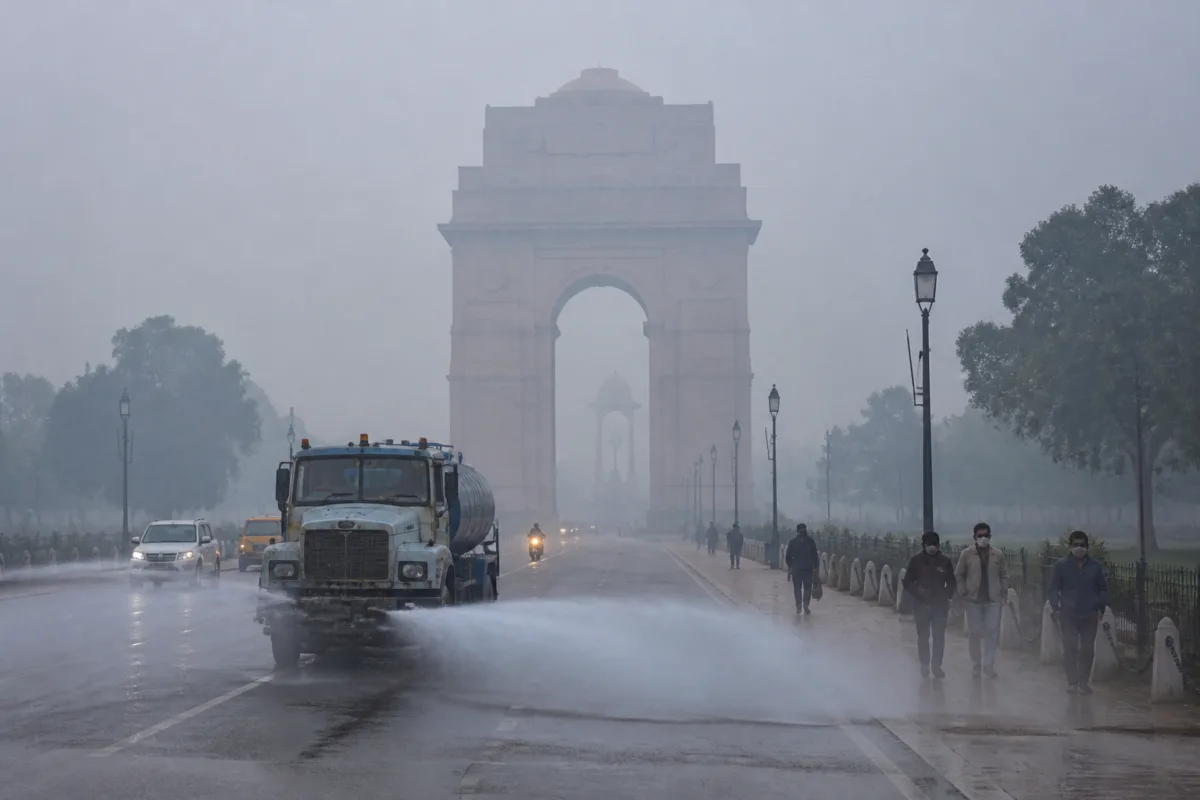
Delhi’s air quality deteriorated sharply on Friday, with the city’s overall Air Quality Index reaching 389 in the very poor category and several monitoring stations recording severe pollution, according to Central Pollution Control Board data reported by the Times of India. Municipal authorities responded with water sprinkling operations under Stage II of the Graded Response Action Plan.
The highest readings were recorded at IIT Delhi and Rohini, where the AQI stood at 474 each. Punjabi Bagh recorded 465, followed by RK Puram at 443, ITO at 422, Firoz Shah Road at 420 and India Gate at 403. The readings place several prominent locations in the severe category, indicating that pollution levels were substantially worse in those areas than the citywide average.
Other locations also reported high pollution. Anand Vihar and Akshardham recorded an AQI of 359, while the reading at Indira Gandhi International Airport Terminal 3 was 385. Aya Nagar recorded 393 and Chandni Chowk recorded 391, according to the CPCB figures cited in the report.
Municipal authorities deployed truck-mounted water sprinklers around India Gate as part of measures under Stage II of GRAP. The operation was intended to control dust in the area amid the worsening air quality. The report did not provide details of any broader restrictions or additional enforcement measures implemented elsewhere in the capital.
Weather conditions remained a factor in the city’s pollution episode. The India Meteorological Department recorded Delhi’s minimum morning temperature at 17.8 degrees Celsius, while skies remained mainly clear. The IMD forecast shallow fog over the following four days, followed by fog or mist during the early morning hours of November 10 and 11.
Residents reported direct discomfort from the polluted air. Sarvesh, a local resident quoted in the report, said breathing had become difficult and described eye irritation, smog and anxiety despite limited morning traffic. Another resident, 71-year-old Nemichand Sharma, linked the deterioration to unchecked urbanisation and what he described as inadequate ground-level action by authorities.
Delhi Environment Minister Manjinder Singh Sirsa separately attributed a significant share of the deterioration to stubble burning in Punjab. Speaking at the Integrated Command and Control Centre in Shastri Park on Thursday, Sirsa accused Punjab Chief Minister Bhagwant Mann of misleading the public over paddy harvesting and claimed, citing Punjab government data, that 77% of the stubble had already been burnt. The claim and the political exchange were reported by the Times of India; the supplied report did not include an independent assessment of the contribution from farm fires.
The immediate response remains tied to the GRAP measures already under implementation, while weather conditions and readings from monitoring stations will determine how the episode develops. Authorities are continuing water sprinkling operations, and the IMD’s fog forecast points to further early-morning visibility and air-quality concerns in the coming days.

