


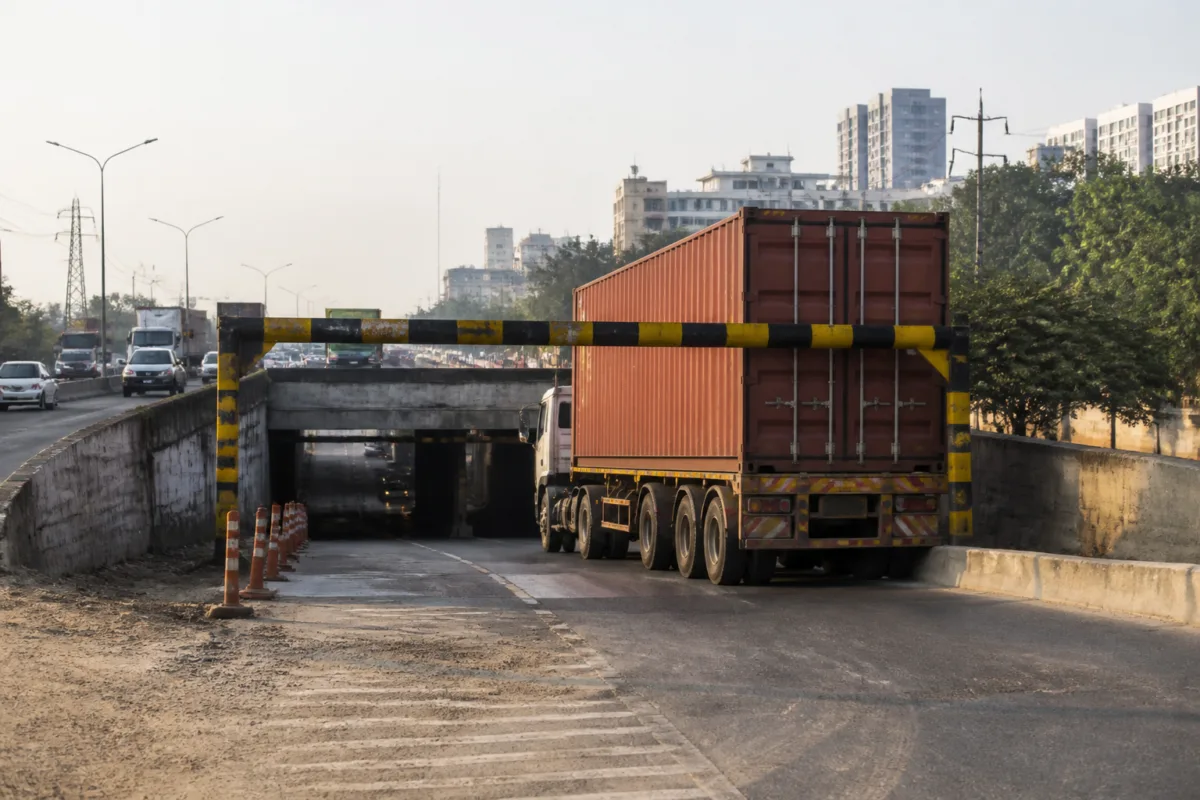
The recurring stoppage of oversized container trucks at Pune’s Morwadi underpass is not simply a problem of careless driving. It is a failure at the point where road geometry, vehicle enforcement, warning systems, maintenance work and municipal coordination are expected to work together. Between February and October, seven to eight such incidents were reported at the underpass on the Mumbai-Pune highway, according to a Times of India report, repeatedly closing lanes on one of the region’s busiest road links.
The latest reported incident took place at about 5am on October 17, when a container truck became stuck inside the underpass. One lane remained closed for nearly four to five hours. In February, another container reportedly remained trapped for more than 11 hours. Traffic police said such incidents now occur once or twice a month, with the problem concentrated largely on the Mumbai-to-Pune carriageway and occurring mostly at night.
That frequency changes the nature of the issue. A single vehicle misjudging clearance can be treated as an enforcement incident. Repeated blockages at the same structure indicate that the system is allowing a foreseeable conflict between the vehicle fleet using the highway and the physical limits of the underpass. The result is a recurring operational failure rather than an isolated traffic disruption.
The underpass is designed to restrict vehicles taller than its available clearance, but effective access control appears to be inconsistent. The report said containers taller than 4.5 metres have entered the stretch, while officials also noted that vehicles reportedly below that height have become stuck. That second detail raises a separate question about whether the usable clearance is uniform and whether later road repair work may have reduced the space available to heavy vehicles.
The distinction matters because height control depends on an accurate and visible physical threshold. If the clearance has changed after resurfacing or other road work, an old sign or barrier may no longer describe the actual operating condition. The supplied report does not establish that repairs caused the reduced clearance, but traffic officials have questioned whether road work may be contributing to the incidents. That uncertainty itself points to the need for a documented clearance assessment rather than reliance only on driver judgement.
PCMC officials told the Times of India that height barriers had been installed at the location several times in the past. Heavy vehicles, however, frequently damaged or broke them within hours. This creates a weak cycle: a barrier is installed, an oversized vehicle damages it, the access restriction disappears, and another truck eventually enters the underpass. The report does not indicate that a permanent enforcement or monitoring system has yet replaced this repeated repair-and-replace approach.
Traffic police have proposed two barriers at separate points on the same stretch. Their reasoning is operational: if one barrier is damaged, the other could continue restricting oversized vehicles. They have also sought barriers comparable to those installed by the Railways, which they said are harder to damage. PCMC’s current plan, as described by joint city engineer Sandhya Wagh, was initially to install one stronger barrier. A decision on a second barrier was to be taken later.
The disagreement over one barrier versus two illustrates the institutional split behind the problem. Traffic police deal with the immediate consequences: lane closures, vehicle removal, diversion management and action against drivers and owners. The municipal corporation controls the physical infrastructure, including the barrier and repairs to the underpass. Neither response alone can resolve the full chain. A barrier without enforcement can be damaged or bypassed; enforcement after a truck is stuck comes too late to prevent congestion; and repeated repairs do not address the conditions that allow the same event to recur.
The cost is also broader than the time taken to remove a truck. Traffic police said cranes and heavy machinery must be called whenever a container becomes stuck. Personnel remain deployed until the carriageway is cleared, while one or two lanes may remain closed and queues can stretch for several kilometres. The operation therefore consumes traffic-management capacity and heavy-recovery resources while imposing delays on commuters and freight movement.
The underpass’s location makes the repeated disruption especially significant. It is on the Mumbai-Pune highway and close to the PCMC headquarters. Residents quoted in the report said they had witnessed container trucks getting stuck there for four to five years. Their account suggests that the current series of incidents is part of a longer-running problem rather than a new consequence of one unusual vehicle or one recent road change.
Warning signs have recently been installed, but officials said oversized vehicles continue to enter the stretch. One civic official attributed this partly to language and visibility: many drivers come from outside Maharashtra and may not understand the boards, while others may overlook them at night. That explanation points to a basic design principle in road safety: warnings must be legible, visible in operating conditions and backed by a physical intervention when the risk is predictable. Signs alone cannot reliably stop a tall vehicle from entering a low-clearance structure at night.
The case also shows why freight routes require a different form of infrastructure management from ordinary urban roads. Container trucks are not only local traffic; they are part of a regional logistics system connecting Mumbai and Pune. When a heavy vehicle becomes trapped, the incident occupies road space for hours and requires equipment capable of moving a large load. A restriction that is weak at the entry point becomes expensive at the recovery point.
PCMC said the material for a new barrier was ready and that it was awaiting clearance for traffic diversion before beginning the work. Another civic official said the stronger barrier would be installed within a week. Those steps provide an immediate administrative response, but the evidence in the report leaves several implementation questions open: whether the actual clearance will be measured after road work, how the barrier will be protected from repeated damage, whether a second barrier will be installed, and how drivers will be warned before reaching the final approach.
The recurring Morwadi underpass incidents therefore reveal a gap between formal infrastructure provision and usable infrastructure performance. The underpass exists, warning boards have been added and barriers have been installed before, yet the same failure continues. The central issue is not only whether a stronger barrier arrives, but whether responsibility for clearance, signage, enforcement, maintenance and incident response is being managed as one system.
The immediate milestone is PCMC’s planned installation of the new height barrier after traffic-diversion clearance. The authority’s decision on a second barrier, along with the results of any assessment of available clearance, will determine whether the next intervention addresses the recurring access failure or merely repairs its latest symptom.

