


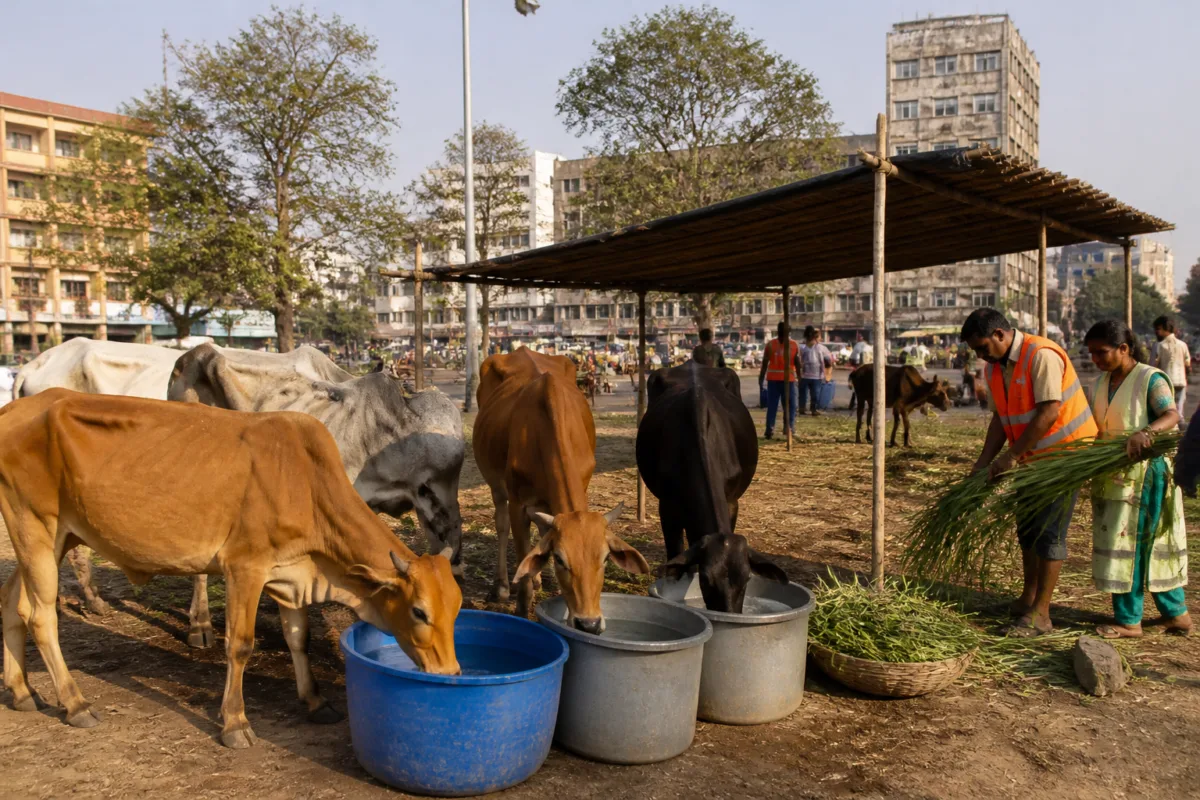
The Pune Municipal Corporation’s Standing Committee has approved temporary fodder shelters and drinking-water facilities for stray and abandoned cattle, as the city prepares for the possible introduction of alternate-day water supply. The arrangements are intended to prevent animals from being forced to travel long distances in search of food and water during periods of scarcity.
The proposal, moved by corporator and Standing Committee member Suhas Tingre, was approved on Thursday. Under the plan, temporary fodder shelters will be established in parts of Pune where the population of stray cattle is high. The Pune Municipal Corporation will also place water containers and tanks at public locations, including major junctions, open spaces and areas frequently visited by stray animals.
The facilities are expected to provide free drinking water and fodder to the animals. However, the source report does not specify the number of shelters, their exact locations, the volume of water to be made available or the budget allocated for the programme.
The proposal comes against the backdrop of the possible implementation of alternate-day water supply in Pune. Tingre said reduced availability of water could make it difficult for stray cattle to access drinking water, potentially forcing them to move through the city in search of it. The proposed response links water-supply management with the civic responsibility of caring for animals living in public spaces.
Pune’s municipal limits expanded after 32 villages were merged into the PMC area. Following that merger, Tingre had proposed the construction of permanent, well-equipped gaushalas for the care of abandoned and stray cattle. The proposal for permanent shelters had already received approval from the PMC General Body, but construction is expected to take time.
The temporary facilities are therefore intended as an interim arrangement until permanent infrastructure is created. Tingre has demanded that the fodder shelters and drinking-water points become operational from the first day of alternate-day water supply, although the report does not state whether the PMC has fixed an implementation date.
The initiative is expected to involve gaushala organisations, cow-protection groups and animal-welfare non-governmental organisations. The proposal also calls for the PMC to provide land, manpower and financial resources for implementation. This places responsibility for coordination and basic operating arrangements with the civic body, while bringing specialist and community organisations into the delivery system.
The PMC’s decision highlights an operational challenge that can accompany changes in urban water supply: public infrastructure must account not only for household consumption but also for animals that depend on shared spaces and informal access to water. The immediate next step is the creation of temporary fodder shelters and the placement of water containers and tanks, particularly in locations identified as having high concentrations of stray cattle.

