


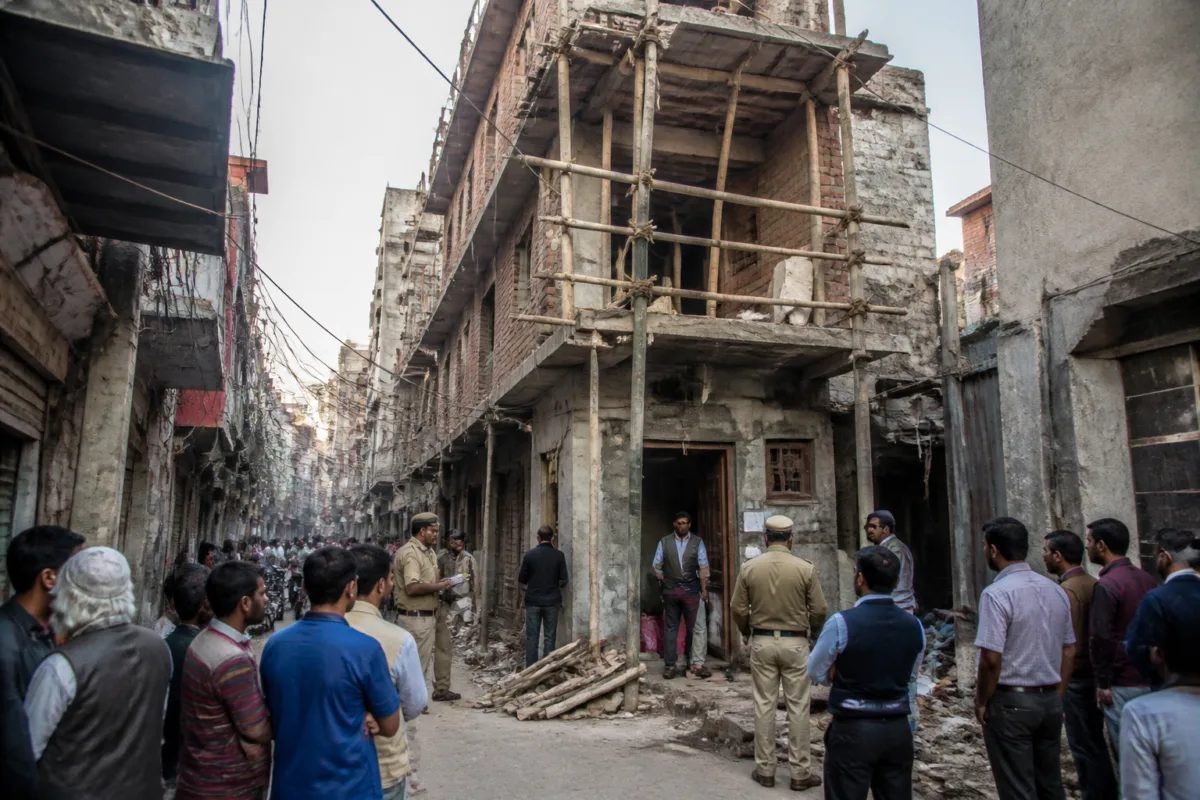
The collapse of a building under illegal construction in Delhi, which killed two people, has exposed a failure that goes beyond one unsafe property: the municipal system received a police complaint, inspected the site and still failed to prevent additional floors from being built. An internal inquiry by the Municipal Corporation of Delhi (MCD), as reported by Jagran, acknowledged that officials did not adequately monitor the property after identifying what they described as repair work.
The case is significant because it shows how a building can move from a known structural risk to a larger unauthorised project without a sustained enforcement response. According to the report, the property was in an area of Old Delhi, where many buildings are decades old and several are in poor condition. The immediate tragedy therefore sits at the intersection of two urban pressures: the need to repair ageing buildings and the risks created when repair, alteration and new construction are not clearly distinguished or effectively supervised.
The MCD’s internal findings provide the central institutional record in the report. On 28 April 2026, the civic body issued the property owner an advisory to repair the dilapidated building. The owner was also asked to undertake the work under the supervision of a structural engineer and submit a structural certificate after the repairs. The advisory indicated that the building’s condition had already come to the corporation’s attention before the fatal incident.
The next reported warning came from Delhi Police on 15 June, when it informed the MCD about alleged illegal construction at the property. During the inspection that followed, the owner was found carrying out repairs. The report says the civic body treated the activity as repair work and did not maintain further surveillance of the site. No subsequent inspection was carried out, and no action was taken to stop the construction that followed, according to the MCD inquiry as cited by Jagran.
The reported construction continued for four to five months. During that period, the owner allegedly added the second and third floors without approval. The inquiry found that MCD engineers and other staff failed to detect or stop the work. The building subsequently collapsed during the illegal construction, killing two people. The sequence matters: the failure was not described as a lack of information alone. The corporation had issued an advisory, received a police complaint and inspected the property, but the enforcement chain did not continue after the first visit.
This distinction is important for understanding how building regulation works in dense, older urban areas. A warning or inspection has limited value if it does not lead to a documented decision, a follow-up visit, a stop-work measure or a safety assessment. The report does not establish that every such case follows the same pattern, but this incident shows how a system can record a risk without ensuring that the risk is controlled.
The property owner, identified in the report as Samiullah, was also alleged to have deposited property tax for a four-storey building. The MCD inquiry reportedly viewed this as an attempt to create a record suggesting that the additional construction already existed, rather than being newly built. Property-tax records and building approvals serve different administrative purposes, and the reported allegation highlights the danger of treating one as proof of the other. A tax payment may place a property in the municipal record, but it does not by itself establish that its floors, structure or alterations comply with building regulations.
That administrative distinction becomes particularly important in neighbourhoods where properties are altered incrementally. A building may begin with repair work, gain additional rooms or floors and gradually become a substantially different structure. If field inspections are irregular and records are not reconciled across departments, enforcement can lag behind the physical changes taking place on the ground. The report does not provide the MCD’s full operating procedures or the complete internal inquiry, so it does not establish how widespread this specific failure is. It does, however, document a serious gap between information received by the authorities and action taken at the site.
Old Delhi’s built environment makes that gap more consequential. The report describes the Walled City as an area dominated by buildings that are decades old, with many in poor condition. It also states that the approval process for new construction is complex and exploitative, and that a builder lobby is active in arranging rapid construction without sufficient restraint. These descriptions are attributed to the report and its account of the local construction environment; the supplied material does not provide an independent survey or official dataset to quantify the scale of the problem.
The report estimates that 70 to 80 per cent of buildings in the area may involve illegal construction or violations of building rules. That figure is presented as an estimate, not as a verified municipal statistic. It should therefore not be treated as a definitive measurement of the Walled City’s building stock. Even with that limitation, the estimate points to a governance problem in which unauthorised construction may be widespread enough to overwhelm occasional, complaint-driven enforcement.
The planning framework adds another layer. The report says that building plans in the area cannot be approved without prior clearance from the Delhi Urban Art Commission. This requirement reflects the special planning and heritage sensitivities of the Walled City, but a complex approval process can also create pressure for informal construction when residents need repairs, extensions or redevelopment and cannot navigate the formal system. The supplied report does not provide approval timelines, fee details or data on pending applications, so the relationship between procedural complexity and illegal construction cannot be quantified from this account alone.
What the case clearly shows is that enforcement cannot be separated from the availability of safe and lawful building options. Older structures require regular structural assessment, repairs and, in some cases, rebuilding. If authorities respond only after a collapse or rely on one-time inspections, residents and owners may continue to operate in a grey zone between maintenance and unauthorised expansion. That does not remove the owner’s responsibility for unapproved construction, but it does make the municipal system’s ability to identify, record and intervene central to public safety.
The incident also raises questions about the division of responsibilities between the police and the civic body. Delhi Police reportedly alerted the MCD on 15 June. The MCD then inspected the property, but the inquiry found that no continuing oversight followed. The report does not say whether the police received a follow-up response, whether a stop-work notice was issued or whether any prosecution was initiated before the collapse. Those missing details matter because a complaint-based enforcement system depends on a traceable chain: receipt, inspection, finding, order, compliance check and escalation where necessary.
The MCD’s reported response after the collapse is to conduct a comprehensive survey of the area and identify illegal construction. A survey can establish the scale and location of violations, but the supplied report does not specify its start date, methodology, staffing, inspection criteria or enforcement timetable. It also does not say whether the exercise will separately identify structurally unsafe buildings, unauthorised additions and properties awaiting formal approval. Those distinctions will determine whether the exercise becomes a safety intervention or only an inventory of violations.
The broader urban question is whether Delhi’s building-control system is designed to manage the realities of ageing, crowded neighbourhoods. A regulation that focuses on approval documents without ensuring timely structural assessments may miss the risks created by incremental construction. Conversely, an enforcement model that acts only after complaints or collapses will struggle in areas where unauthorised changes are frequent and visible. The case reported from Old Delhi suggests that the failure lies not only in the existence of illegal construction, but in the absence of sustained monitoring after authorities have already been alerted.
The available evidence confirms four points: the building was considered dilapidated enough for the MCD to issue a repair advisory; the police reported alleged illegal construction; the MCD inquiry acknowledged inadequate follow-up; and the subsequent collapse caused two deaths. It also records wider claims about the prevalence of building violations in Old Delhi, but those claims require official data and a transparent survey before they can be treated as measured facts. The next important developments are the MCD’s proposed area-wide survey, the publication or disclosure of the internal inquiry’s findings, and any documented action against the property owner or officials identified in the report.

