


Hyderabad’s emerging 100 million gallons per day water shortfall is being treated as a contingency linked to the next summer, but the measures discussed by the city’s civic agencies reveal a more persistent problem: the metropolitan region is still managing water stress through emergency sourcing rather than a fully integrated system of groundwater protection, wastewater reuse and local recharge.
Commissioners of the Greater Hyderabad Municipal Corporation, Cyberabad Municipal Corporation and Medchal-Malkajgiri Municipal Corporation joined the managing director of the Hyderabad Metropolitan Water Supply and Sewerage Board and the commissioner of HYDRAA at a workshop on El Nino contingency organised by NAREDCO Telangana in collaboration with CREDAI Hyderabad. The meeting brought together agencies responsible for municipal administration, water supply, development enforcement and large parts of the region’s construction and real estate activity.
The immediate concern is the condition of the Manjira-Singur reservoirs and the weak recharge of groundwater. HMWSSB managing director K Ashok Reddy said Hyderabad could face a shortfall of around 100 MGD, while the reservoirs approach depletion and groundwater recharge remains poor. The figure is not presented as a confirmed supply cut already affecting every consumer; it is the estimated gap that the board and civic agencies are planning around.
The proposed response has three linked components. The first is to protect groundwater for domestic use. Reddy said the first priority for groundwater should be domestic consumption across the city and that commercial establishments must look at alternative sources. The second is to move construction, commercial activity, landscaping and cleaning towards treated wastewater. The third is to expand rainwater harvesting and improve the functioning of sewage treatment plants within large residential complexes.
The numbers show why the response may not fully close the gap. According to the report, HMWSSB is working to secure an additional 40 MGD through a pending scheme and another 50-60 MGD from alternative sources. Even if those sources become available, officials estimate that a deficit of 40-50 MGD could remain. The contingency plan therefore combines additional supply with demand substitution: rather than using potable or groundwater sources for every non-domestic activity, more users would be directed towards treated wastewater.
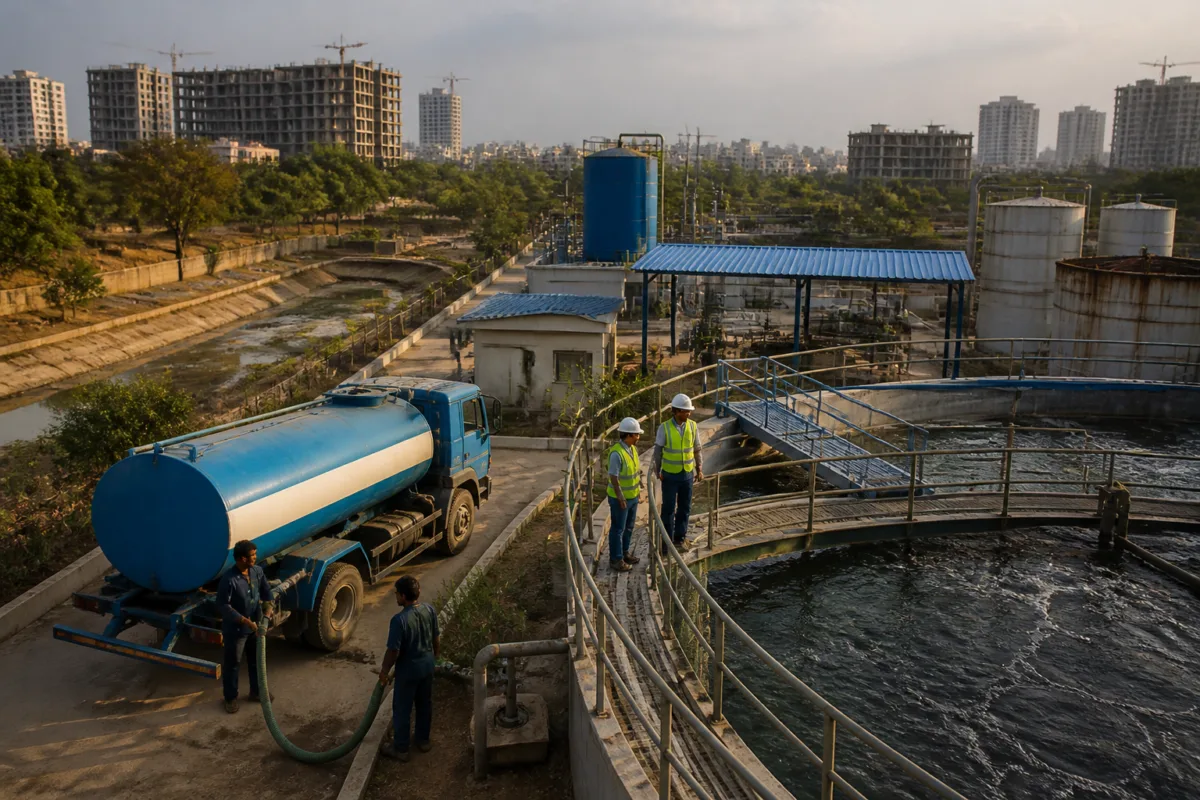
That shift is already being supported by infrastructure at sewage treatment plants. HMWSSB has installed filling stations at 30 STPs and introduced a digital Green Tanker platform through which industries and builders can procure treated wastewater. The water is priced at ₹25, while users can either arrange their own tankers or book deliveries. The supplied report does not specify whether the price is per kilolitre or under another billing unit, so the cost cannot be compared here with the price of other sources.
The platform is significant because wastewater reuse depends not only on treatment capacity but also on a functioning distribution system. A treatment plant can produce water, but that water will not replace groundwater unless users can access it reliably, understand its quality and receive it at a practical cost. Filling stations and digital bookings address part of this logistical problem by creating a formal channel between treated-water suppliers and high-volume users such as builders and industries.
The arrangement also places the construction and commercial sectors at the centre of the water response. These users can generate substantial demand for water that does not need to be potable, particularly for construction, cleaning and landscaping. The officials’ approach is to reserve groundwater for households while shifting suitable commercial demand to treated wastewater. That is a form of allocation policy, even if it is being implemented through supply alternatives rather than a single citywide regulation.
The second institutional challenge lies inside residential complexes. HMWSSB plans to revive non-functional STPs in large housing developments and install separate electricity meters to monitor whether the plants are operating. The measure connects water reuse to basic operational accountability. A treatment plant that is built but not operated cannot provide a dependable alternative source, and separate electricity metering could help authorities identify whether the system is functioning.
The report, however, does not establish how many residential STPs are currently non-functional, how much additional treated water they could produce or what enforcement mechanism would apply if complexes fail to operate them. Those details will matter in assessing how much of the proposed supply substitution can be delivered locally. For now, the plan is an administrative direction rather than a quantified citywide recovery programme.
Cyberabad’s response illustrates another layer of the proposed model. Commissioner G Srijana said the corporation would continue using treated water for landscaping, construction and cleaning even after the current crisis. The corporation also plans to build rainwater-harvesting structures in every ward, with the civic body and residents sharing responsibility for installation. Srijana described the approach as participatory rather than regulatory.
That distinction matters because rainwater harvesting is often treated as a property-level obligation, while its effectiveness depends on ward-level drainage, open land, maintenance and groundwater conditions. The proposed structures could help local recharge, but the supplied report does not provide targets for the number, capacity or location of the installations. It also does not state how the authorities will monitor whether the structures remain functional after construction.
HYDRAA commissioner AV Ranganath identified illegal commercial borewells and large-scale groundwater extraction as another source of pressure on local supplies. He said the agency had acted against such operations following complaints and would continue enforcement. This places groundwater protection within the wider remit of metropolitan land and development oversight, rather than leaving it only to the water board.
The division of responsibility is therefore becoming clearer. HMWSSB is working on supply augmentation, treated-water distribution and sewage treatment plant operations. Municipal corporations are responsible for local rainwater-harvesting measures and continued reuse in civic activities. HYDRAA is addressing unauthorised extraction and related enforcement. Developers, industries, commercial establishments and residents are expected to change how they source and use water.
Yet the proposed institutional arrangement also shows why water resilience is difficult in a metropolitan region divided among several agencies. Hyderabad, Cyberabad and Medchal-Malkajgiri have separate municipal corporations, while HMWSSB manages the metropolitan water and sewerage system and HYDRAA has an enforcement role. The workshop created a forum for coordination, but the supplied material does not indicate whether it established a common water budget, a single implementation schedule or binding performance targets across the agencies.
The available figures describe a system under pressure but do not amount to a complete water balance. The potential shortfall is around 100 MGD. Proposed additions include 40 MGD from a pending scheme and 50-60 MGD from alternative sources, leaving an estimated 40-50 MGD deficit. At the same time, the city is being asked to conserve groundwater, increase treated-water use and improve recharge. The evidence supports the conclusion that supply augmentation alone is not expected to solve the problem.
It also shows that the city’s contingency planning is moving beyond the traditional question of how to bring more water into Hyderabad. The debate now includes who should receive groundwater, which activities can use treated wastewater, whether local treatment plants operate consistently and how groundwater extraction is controlled. These are governance questions as much as engineering questions.
The El Nino framing gives the meeting an immediate trigger, but the measures described are not limited to one season. Cyberabad’s decision to continue using treated water after the current crisis, the plan to revive residential STPs and the proposal for ward-level rainwater harvesting all point towards systems intended to remain in place. Their long-term value will depend on implementation, maintenance and the ability of agencies to measure results.
For residents, the immediate concern is whether domestic supply will remain protected if reservoir levels fall and recharge remains weak. For builders and commercial users, the policy direction is a move away from unrestricted reliance on groundwater towards formal access to treated wastewater. For authorities, the unresolved question is whether the planned 40 MGD, 50-60 MGD and local reuse measures can be delivered at the scale required.
The evidence currently confirms a coordinated contingency effort, not a completed solution. Hyderabad’s water risk is being addressed through new supply, wastewater reuse, rainwater harvesting and enforcement against illegal extraction. The next milestones will be the pending scheme for additional supply, the operation of the Green Tanker network, the revival of residential STPs, ward-level rainwater-harvesting implementation and continued action against unauthorised commercial borewells.

