


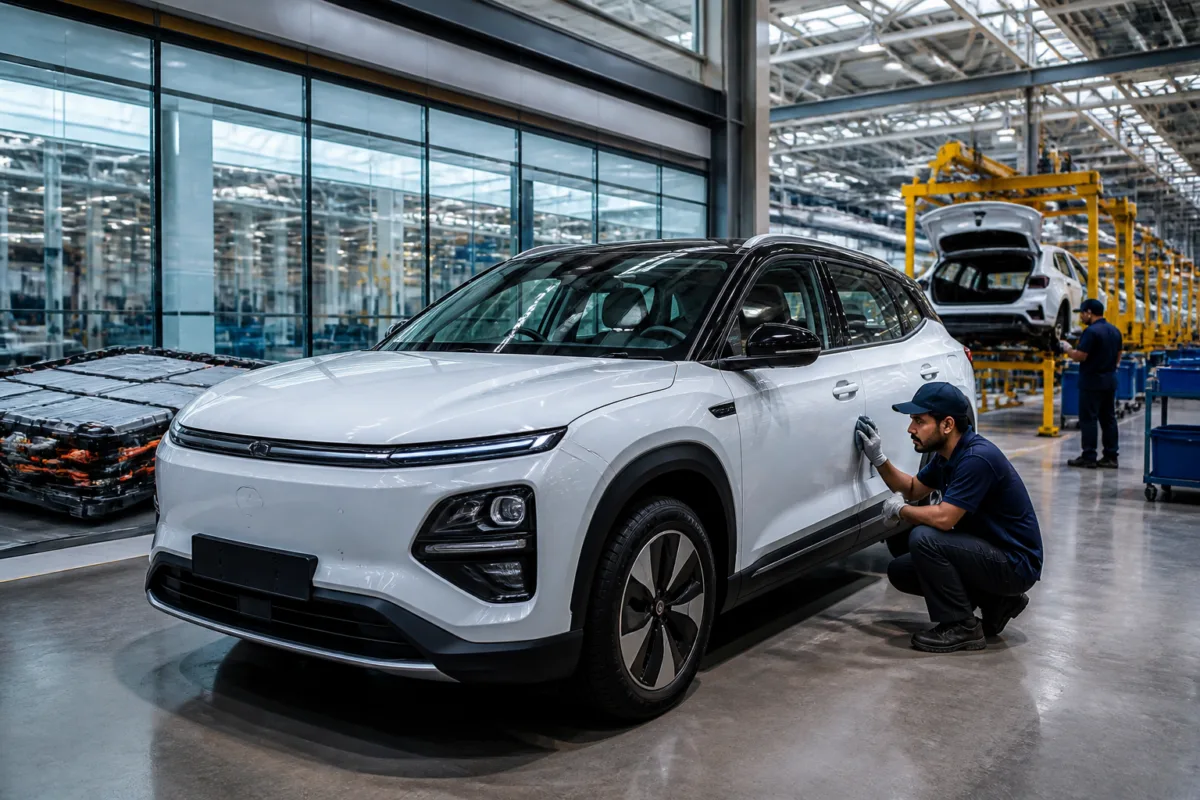
Maharashtra is seeking to turn Pune and its surrounding industrial belt into a global centre for electric vehicle technology, research and advanced mobility, Chief Minister Devendra Fadnavis said at the launch of Mercedes-Benz’s electric GLC at the company’s Chakan facility.
Fadnavis said Maharashtra wanted to move beyond its established identity as a major automobile manufacturing state and play a larger role in developing the technologies shaping future mobility. The state’s next phase of industrial growth, he said, would focus on electric vehicles, battery systems, power electronics, semiconductors and artificial intelligence, along with automotive software, vehicle design and research and development.
The announcement places the Mercedes-Benz launch within a wider industrial strategy rather than treating it only as the introduction of a new vehicle. Chakan has been part of Maharashtra’s automobile industry for several years, while Pune and Pimpri-Chinchwad have developed a concentration of vehicle manufacturers, component suppliers and supporting industries.
According to Fadnavis, Maharashtra contributes more than 20% of India’s total vehicle production. The state government wants to use that existing manufacturing base to attract investment and capabilities in higher-value engineering and technology. He also encouraged Mercedes-Benz to use the Chakan plant as a production base for Indian customers as well as markets across Asia and other parts of the world.
The electric GLC launch marks the start of local electric vehicle production by Mercedes-Benz at the Chakan facility, according to remarks made at the event. Deputy Chief Minister Sunetra Pawar described the development as another milestone in Maharashtra’s manufacturing sector and said Mercedes-Benz had contributed to the state’s industrial growth over the past three decades.
Pawar linked the company’s electric powertrains, artificial intelligence and environmentally conscious production methods to the direction of the automobile industry. She said Pune’s existing industrial base could help the district strengthen its position in the next generation of vehicle manufacturing and technology.
The state’s electric vehicle policy targets electric vehicles accounting for 30% of new vehicle registrations by 2030. Meeting that target will require more than local production. Maharashtra is also working to expand fast-charging infrastructure along highways, while planning sustainable mobility corridors on the Mumbai–Pune Expressway and Samruddhi Mahamarg.
Battery recycling is another part of the state’s proposed electric mobility ecosystem. The government is encouraging recycling as it seeks to support a more sustainable transition to electric vehicles, alongside investment in vehicles, batteries and related systems.
The policy links industrial expansion with transport infrastructure. Manufacturing capacity can support vehicle supply, but adoption will also depend on the availability of charging facilities and systems for managing batteries after use. The government’s stated focus on research, engineering and advanced automotive technologies indicates that it is seeking to build capabilities across that wider chain.
The event was attended by Sunetra Pawar, senior Mercedes-Benz executives and Santosh Iyer, Managing Director and Chief Executive Officer of Mercedes-Benz India. The immediate next steps identified at the event include expanding electric vehicle production, developing charging infrastructure along key highways and strengthening the state’s focus on battery recycling, automotive software and research and development.

