


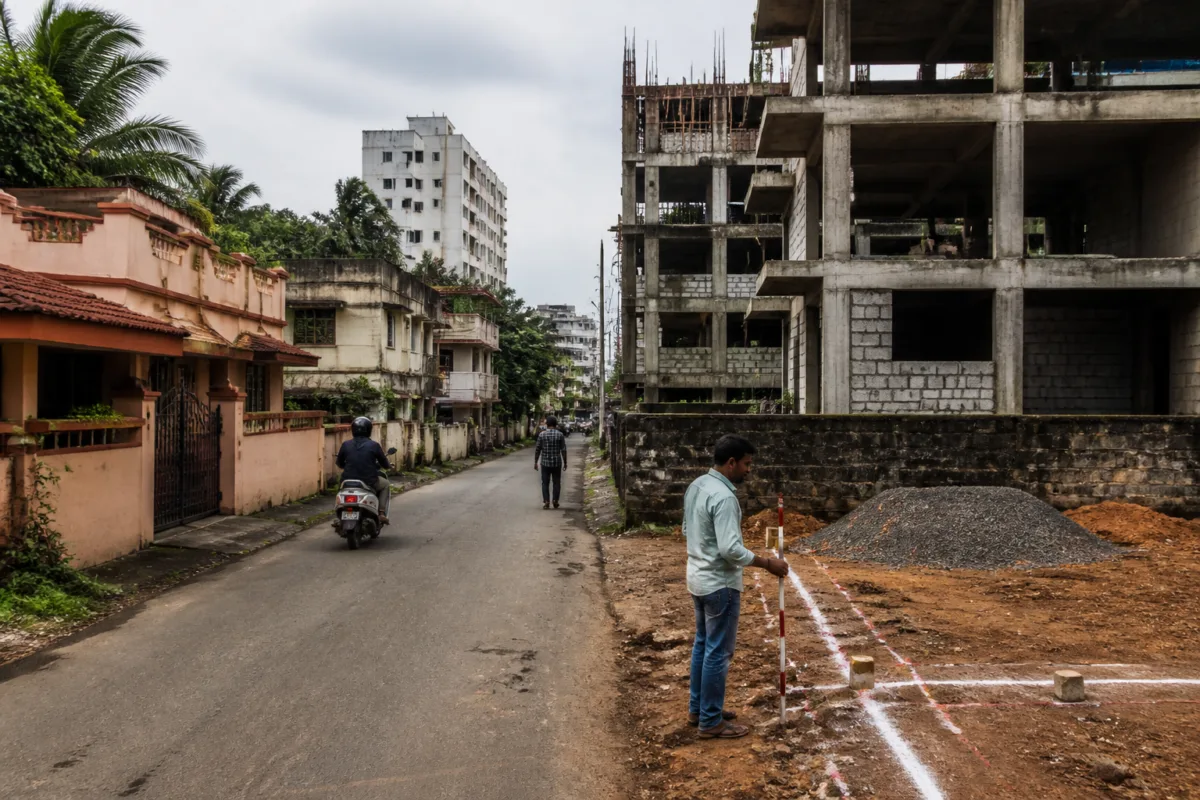
Mangaluru’s current development-control framework is facing a public challenge from within the city’s construction ecosystem, with entrepreneur and former minister Krishna J. Palemar alleging that the proposed Comprehensive Development Plan (CDP) rules and building regulations could make ordinary house construction, layout approvals and several institutional projects more difficult. His objections point to a larger urban governance problem: development rules are being changed or digitised without, he said, resolving how roads, land records, approval agencies and building permissions work together.
Palemar made the allegations at a press conference after the Mangaluru Urban Development Authority, or MUDA, submitted the CDP and building rules to the state government. He called for the rules to be reviewed and amended before implementation. The report does not include a response from MUDA, the municipal corporation, the Revenue Department or the state government, and the specific provisions cited by Palemar could not be independently examined from the material supplied.
The dispute matters because a CDP is not simply a technical planning document. It determines how land can be used, what kinds of buildings can come up, the road access required for different activities and the development intensity permitted on a plot. These rules influence the cost and feasibility of housing, the expansion of schools and religious institutions, the approval of hotels and service apartments, and the ability of builders to assemble and develop land.
Palemar’s central criticism is that the new zoning CDP rules, technical problems in the building-permission process and delays in layout approval are operating together. He said the Unified Land Management System, or ULMS, an online system used for applications, is delaying permissions for people seeking to build homes. The problems he listed include repeated one-time-password verification, repeated document uploads, a complicated workflow and difficulty identifying the correct ward.
Digitisation is often presented as a way to reduce visits to government offices and make approvals more transparent. But the concerns described in the report show that an online application system does not automatically create a simpler approval process. If land records, property accounts, ward boundaries and planning permissions are held by different institutions or use incompatible information, the applicant may still have to resolve the same problems manually, only after encountering them on a digital portal.
Palemar specifically cited a lack of coordination between e-Khata records, the Revenue Department, MUDA and the municipal corporation. According to his account, citizens are being forced to move from office to office to obtain building permissions. This is an institutional issue rather than merely a software problem. A building approval depends on a chain of records and decisions: ownership and land classification, property identification, road access, zoning, plan scrutiny and the authority responsible for issuing the final permission. When those functions are not synchronised, the applicant experiences the state as a series of separate counters rather than as one approval system.
The reported objections also focus on the proposed telescopic setback rule. Palemar said the rule would prescribe a one-metre setback for a seven-storey building and a 1.5-metre setback for a two-storey ordinary house, while describing the provision as unusual compared with other parts of the state. The report does not provide the full regulation, the technical basis for these measurements or MUDA’s explanation. Those details are important because setbacks affect fire access, ventilation, daylight, privacy, structural safety and the relationship between a building and the street.
His questions extend to development rights on narrower roads. He asked why transferable development rights and premium floor area ratio provisions connected to six-metre and 7.5-metre roads had been withdrawn. TDR and premium FAR are planning instruments that can determine whether development rights are transferable or whether additional permissible floor area can be obtained through payment or other conditions. Their availability can affect the economics of small plots and redevelopment, but the supplied report does not establish the policy rationale for their reported withdrawal.
Road width is another point of tension. Palemar questioned what he described as unscientific road widening within MUDA limits and asked why road widths were reduced after land had already been donated to the government for roads. The report gives no site-specific examples or documentary details. However, the issue illustrates how road reservations can shape private property rights and development potential. When a plot is affected by a road proposal, uncertainty over the final width can influence building lines, setbacks, access and the usable area of the site.
The consequences are particularly relevant in a city where, according to the report, many roads are six metres wide or narrower. Palemar said rules requiring a 12-metre road for hotels, service apartments, small lodges and primary schools could obstruct new construction or expansion in such areas. He also cited possible difficulties for temples and other buildings. Whether those activities should require wider access is ultimately a matter of planning, safety and traffic management, but the rule’s effect depends on how it is applied to established neighbourhoods with older, narrower streets.
This is where a development plan can produce different outcomes for different groups. A wider-road requirement may be intended to provide safer access, manage traffic or support emergency vehicles. At the same time, if much of the existing urban fabric does not meet that standard, the requirement can freeze legitimate improvements or push development towards locations with larger plots and better roads. The supplied report does not quantify how many properties or neighbourhoods would be affected, so the scale of the impact remains unestablished.
Palemar also contrasted the proposed framework with an earlier CDP, which he described as more people-friendly and said had been revised three times despite opposition from officials. That claim is an important part of the political and administrative context, but the report does not identify the earlier plan, list the revisions or compare the text of the old and new rules. A meaningful assessment would require the notified provisions, revision history, road hierarchy, zoning maps and the technical studies used to support the changes.
The reported dispute therefore brings together three layers of urban regulation. The first is the spatial layer: zoning, road width, setbacks and permissible floor area. The second is the administrative layer: which authority controls land records, khatas, layouts and building permissions. The third is the digital layer: whether ULMS can process applications without repeated verification, unclear ward identification or document duplication. A weakness in any one layer can delay construction; weaknesses across all three can make the formal rules difficult to navigate even when an applicant is otherwise eligible.
For homeowners, the immediate concern described in the report is delay and procedural complexity in obtaining permission for small houses. For developers, the uncertainty relates to layout approval, road requirements, development rights and the viability of projects on constrained urban plots. For public institutions, the question is whether schools, temples and hospitality uses in established areas can expand under the new access standards. These are distinct interests, but they meet at the same point: the predictability of planning decisions.
The institutional responsibility is correspondingly divided. MUDA is responsible for the development-planning framework referred to in the report, while the municipal corporation and the Revenue Department are part of the records and approval chain identified by Palemar. The state government is the authority to which the CDP was submitted and would therefore be central to any review or approval process. The report does not state whether a formal public consultation, technical review or amendment process has been announced.
Palemar said that an organised protest would be launched if the CDP rules were not revised. That is the stated next step from the critic of the framework, not an announced government decision. The report also records the presence of Yogesh Pai, president of the Diploma Engineers Association, but does not provide a separate statement from the association. Palemar additionally rejected speculation about joining the Congress and said he remained loyal to the Bharatiya Janata Party; that political exchange is separate from the planning and approval issues at the centre of the report.
The evidence currently establishes that a named public figure has called for a review and identified specific concerns about setbacks, road widths, TDR, premium FAR, ULMS and coordination between agencies. It does not establish whether the cited rules have been finally notified, how many applications are delayed, whether the technical claims are correct, or what MUDA and the state government say about the proposed framework. Those are the facts that will determine whether the controversy remains a political objection or becomes a formal revision of Mangaluru’s development-control system.
The next significant developments are the state government’s treatment of MUDA’s submitted CDP, any official clarification from MUDA and the publication of the applicable building and zoning provisions. Until those documents and responses are available, the clearest urban lesson is that planning rules and approval technology cannot be assessed separately: a regulation is only as workable as the institutions, records and digital systems that allow residents to comply with it.

