


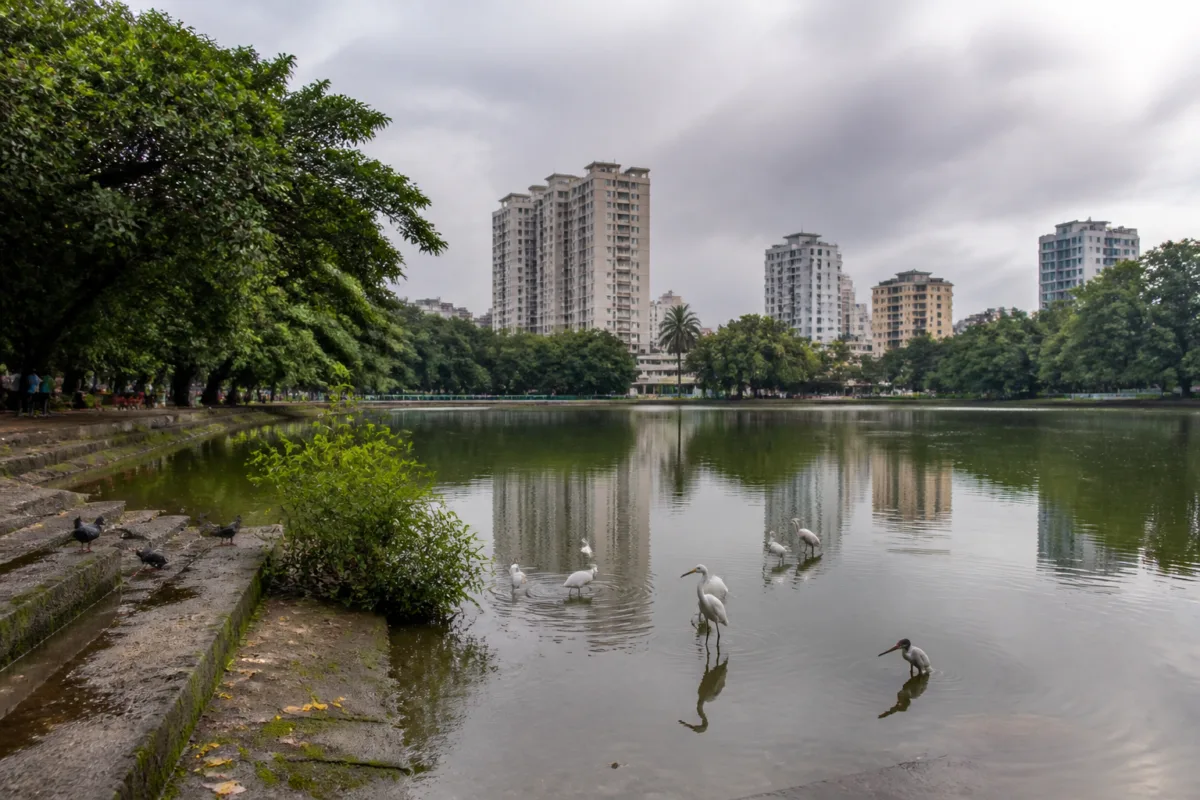
The debate over allowing Chhath Puja at Rabindra Sarobar is not only about access to a familiar public space. It exposes the difficulty of governing an enclosed urban lake where religious use, biodiversity protection, water quality and political decision-making intersect. Environmentalists and regular visitors have warned that reversing the restriction could damage the ecosystem of the 192-acre complex, while the larger question is whether Kolkata can protect its natural assets when public demands compete for the same limited spaces.
The National Green Tribunal has prohibited religious rituals and festivals within Rabindra Sarobar to protect its fragile ecosystem, bird populations and water quality. Chhath Puja has not been permitted inside the lake premises since 2019. The current concern, as reported by The Telegraph, is that the restriction could be reconsidered after discussions, despite the existing legal and environmental rationale.
That distinction matters. The issue is not whether Chhath Puja should be held. Several environmentalists cited in the report expressly said they had no objection to the festival itself. Their objection is to holding the rituals at Rabindra Sarobar, a site they describe as ecologically sensitive and unsuitable for large congregations. The proposed alternative is to provide isolated water bodies for the rituals, while using the opportunity to rejuvenate and treat other urban ponds.
Rabindra Sarobar’s vulnerability arises partly from its physical character. The lake is an enclosed water body with little natural flushing, according to a regular visitor quoted in the report. That means materials entering the water can remain in the system rather than being quickly dispersed. Flowers, fruit and other offerings add organic matter and nutrients such as nitrogen and phosphorus. Ghee and oil can also enter the water during the rituals.
The ecological chain described by the visitor is straightforward. As bacteria break down organic material, they consume dissolved oxygen. Excess nutrients can encourage algal blooms, while oil films on the water surface can hinder oxygen exchange. Fish are among the first organisms to suffer when oxygen conditions deteriorate, and the effects can move through the wider food chain. These are not only aesthetic concerns about floating waste or a temporarily dirty shoreline; they involve the functioning of the lake as an ecosystem.
The volume of human activity is a second pressure. The report refers to thousands of people gathering in a limited space. That concentration would bring offerings, footfall, sound, lighting and waste into a site already being managed for ecological protection. The environmental impact would therefore not be limited to the water immediately used for rituals. It could also affect the surrounding habitat and the ability of birds and other species to use the complex.
A naturalist quoted by The Telegraph warned that the disturbance could extend to both resident and migratory birds. Migratory birds are often associated with wetlands and water bodies, but terrestrial birds also use urban green spaces during migration. Blaring music and the noise generated by large gatherings could disturb these habitats, making the question one of urban biodiversity as well as water pollution.
This is important because Rabindra Sarobar performs more than one public function. It is a green space, a lake, a habitat and a daily destination for residents. The same physical features that make it valuable to people—open space, water, vegetation and accessibility—also make it vulnerable when use intensifies. A large gathering may be temporary, but the ecological burden of pollutants and organic waste can persist in a water body with limited natural flushing.
The controversy also reveals a recurring weakness in urban environmental governance: protected spaces are often treated as interchangeable with ordinary public venues until damage becomes visible. Naba Dutta, general secretary of the environmental organisation Sabuj Mancha, said Rabindra Sarobar was not an ordinary pond and described it as a national lake whose conservation receives central government funding. His argument places the dispute within a formal conservation framework rather than treating it as a local disagreement over access.
That institutional status creates obligations for decision-makers. The NGT’s restriction was intended, according to the report, to protect the ecosystem and biodiversity, not to exclude a particular community or festival. Any decision to alter the restriction would therefore have to address the environmental purpose of the order, the carrying capacity of the lake and the consequences for water and habitat management. The central administrative question is whether a change in use can be reconciled with the stated reason for protection.
The political dimension makes the decision more difficult. The Trinamool Congress government has favoured allowing Chhath at Rabindra Sarobar, while environmentalists have argued that the government’s priority should remain conservation. This places the lake at the intersection of electoral representation and environmental regulation. The report does not establish that a reversal has occurred. It records concern over the possibility of allowing the rituals and the consequences that opponents say would follow.
That uncertainty is itself significant. Urban environmental rules are most effective when the basis for them is transparent and consistently applied. If restrictions are changed, residents need to know whether the decision follows a new assessment, a legal process, a management plan or a political negotiation. If the restriction remains, authorities still need to provide workable alternatives for worshippers rather than relying only on prohibition.
The alternative-water-body proposal points to a broader planning opportunity. Providing suitable sites for Chhath could reduce pressure on Rabindra Sarobar, but only if those locations have safe access, adequate water quality, crowd management, sanitation and waste collection. The source material does not establish whether such a network currently exists. It does, however, show why festival planning cannot be separated from the condition of the city’s ponds and lakes.
The proposal to rejuvenate and treat other water bodies also raises an issue of distribution. Kolkata’s environmental assets are not equally protected or equally usable. If one prominent lake is closed to a major public ritual while other water bodies are offered as alternatives, the city would need to ensure that those alternatives are not unsafe, polluted or poorly maintained. Otherwise, the burden could simply shift from a protected lake to less visible and less regulated water bodies.
Rabindra Sarobar therefore represents a test of how Kolkata defines public access to urban nature. Public spaces are not valuable only because people can gather in them. Their value can also depend on limits that protect the ecological systems making them usable in the first place. In the case of a stagnant or weakly flushed lake, the difference between a short event and lasting damage may be determined by the volume of waste, nutrients, oil, noise and human presence that the site can absorb.
The evidence supplied in the report establishes three facts: the NGT has imposed restrictions to protect the lake’s ecosystem; Chhath has not been allowed inside the premises since 2019; and environmentalists, a naturalist and regular visitors fear that reopening the site would harm water quality, fish and bird habitat. It does not establish that the ban has been lifted or that a final government decision has been taken. The next stage of the dispute will therefore turn on whether authorities uphold the existing restrictions, seek a lawful modification, or create credible alternative sites while preserving Rabindra Sarobar’s ecological protections.

