


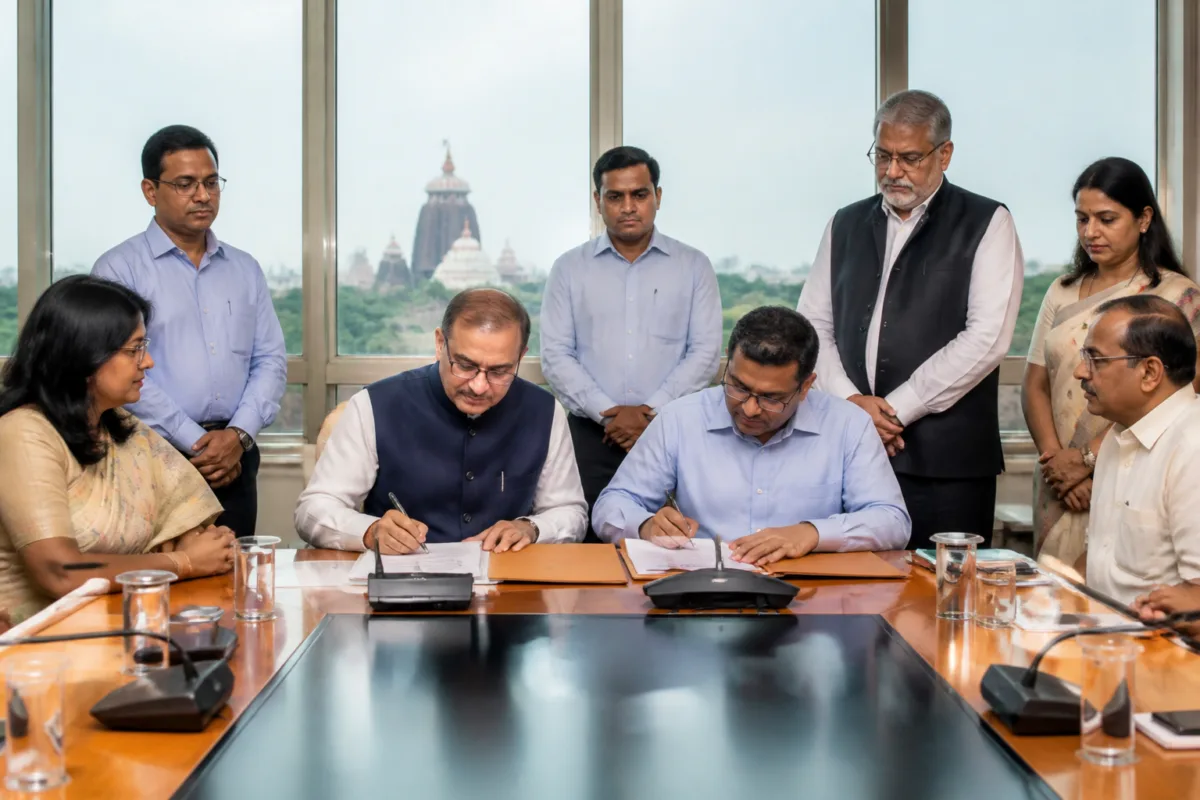
Odisha has signed a three-year agreement with J-PAL South Asia to strengthen evidence-based policymaking across state departments, using research, data and innovation to improve governance and public service delivery.
The memorandum of understanding was signed by Rashmi Kabi, financial adviser-cum-additional secretary in the Planning and Convergence Department, and Shobhini Mukerji, executive director of J-PAL South Asia. Chief secretary Anu Garg, development commissioner Deoranjan Kumar Singh and other senior government officials were present at the signing.
Under the agreement, J-PAL South Asia will work with Odisha departments to identify important policy challenges, conduct rigorous research and convert the findings into recommendations for government action. The partnership is intended to give departments a structured mechanism for assessing whether proposed interventions work before they are expanded.
Garg said the state’s vision included engaging research institutions in policy research, piloting innovations and adopting data- and artificial intelligence-based interventions in line with global best practices. She said J-PAL South Asia would help bring global evidence to Odisha, adapt successful approaches to the state’s needs and test solutions before scaling them up.
The agreement places research and evaluation within the state’s policymaking process rather than limiting them to academic or standalone studies. Its stated focus is on working with multiple departments, although the announcement did not identify the first departments or public programmes that will be covered under the partnership.
For public service delivery, the practical significance of the arrangement will depend on how research questions are selected, how departments share data and whether findings are used to change programme design. The source announcement did not specify the data systems, evaluation methods, funding arrangements or performance indicators that will govern the collaboration.
The partnership also reflects the administrative challenge of moving from policy intent to implementation. Government departments often need evidence not only on whether a programme produces results, but also on how an intervention performs in a particular local context. The agreement’s stated approach is to adapt evidence to Odisha’s needs and test solutions before wider adoption.
The MoU was announced in the presence of senior state officials, signalling that the collaboration is being positioned as a cross-departmental governance initiative. Its three-year duration provides a defined period for identifying policy challenges, undertaking research and translating results into recommendations.
The next steps will involve J-PAL South Asia and state departments identifying priority policy issues and developing research and innovation work under the agreement. Details of the first projects and their implementation timelines were not provided in the announcement.

