


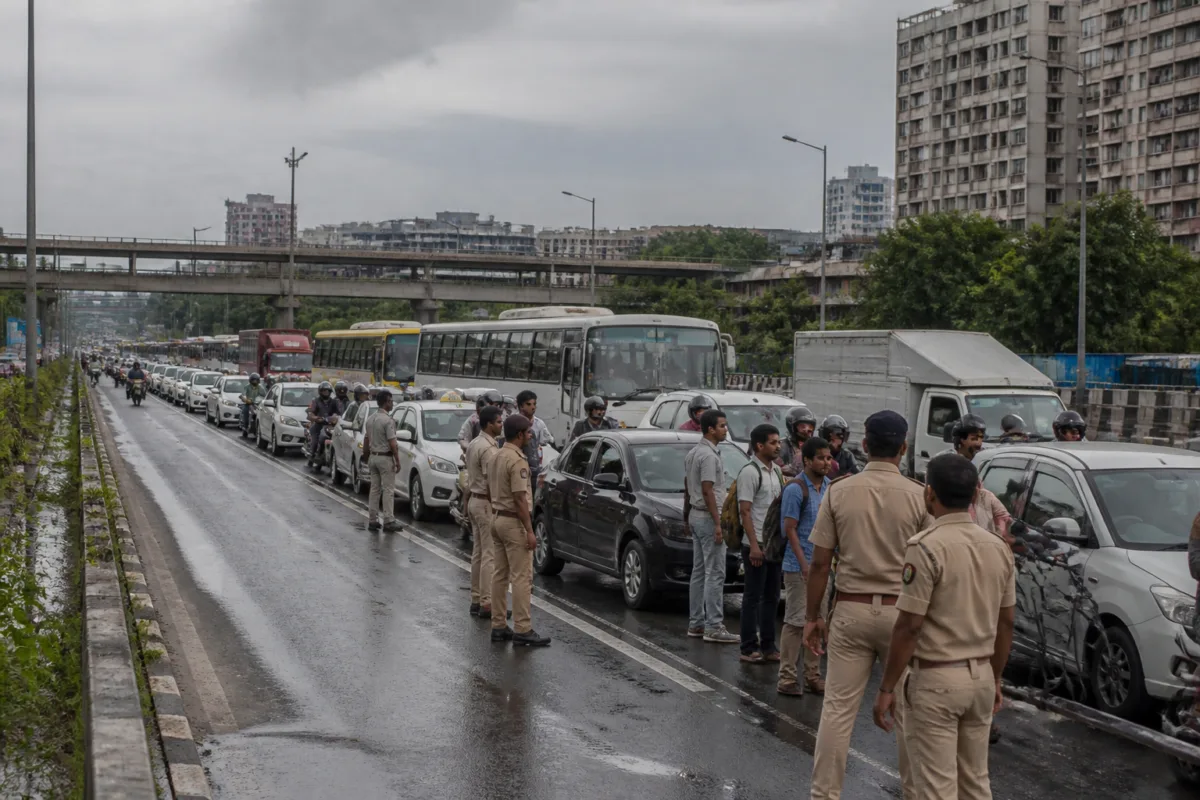
The October 27 protest over the murder of Shiv Sena (UBT) functionary Pradeep Purnekar escalated into a highway blockade at Manpada, leaving thousands of commuters stranded for hours. The immediate disruption was a law-and-order incident, but the account also reveals a wider urban governance problem: Thane’s traffic system was not able to separate a politically charged public gathering from the movement of people through a critical road junction.
The Times of India report attributes the escalation to three linked failures identified by experts: inadequate intelligence about the protest’s likely trajectory, delayed police intervention and the absence of a contingency plan for traffic management. Thane police, however, said officers initially chose dialogue over coercive action and intervened only after the road blockades continued and the situation escalated.
That distinction is important. Managing a protest in a dense urban environment is not limited to deciding when police should disperse a crowd. It also involves identifying how the gathering could affect arterial roads, preparing alternative routes, coordinating with transport agencies and informing commuters before they reach the affected location. In Manpada, those functions appear to have been activated too late, according to the expert assessment cited in the report.
The result was a familiar urban failure: a localised event became a network-wide mobility problem. Once vehicles entered the affected stretch, the disruption was no longer confined to protesters and police. Thousands of commuters were caught in congestion, with the blockade turning a law-and-order challenge into a public transport and road-management crisis.
The report does not establish the exact number of vehicles affected, the duration of the blockade in precise terms, or whether any pre-existing traffic plan for Manpada was available. It does establish that commuters were stranded for hours and that road blockades continued until police intervened. Those facts point to the importance of preparedness at locations where public gatherings can quickly interfere with major traffic flows.
Retired Colonel V N Supanekar, a Pune-based disaster management expert, said local police stations have sufficient intelligence networks to identify key players behind such protests. In his assessment, identifying the principal organiser and acting in advance could have contained the agitation before it reached critical traffic junctions.
The significance of that argument lies in the timing of intervention. Intelligence in this context is not only about detecting a potential law-and-order threat. It is also about understanding the likely size, route and behaviour of a gathering, as well as the road network it may affect. If that information is available early, authorities can position senior officers, prepare diversions and issue commuter advisories before congestion becomes difficult to reverse.
Former IPS officer and lawyer Y P Singh placed the emphasis on senior-level engagement. He said senior officers should have been present at the protest site to engage with agitators and defuse tensions. According to Singh, situations involving heightened tempers require law-and-order skills, with the immediate priority being the presence of senior officers and dialogue with protest leaders.
This creates two parallel requirements for city administration. The first is a policing response capable of maintaining order and communicating with protesters. The second is a mobility response capable of protecting the road network and keeping commuters informed. A dialogue-based approach does not remove the need for traffic planning. On the contrary, it requires traffic measures that can remain in place while negotiations continue.
Supanekar specifically pointed to advance traffic diversions, coordination with transport agencies and timely commuter advisories. He said alternative routes should have been activated before vehicles reached the protest site. These measures are operational rather than political, but they determine whether an urban protest remains a contained public gathering or becomes a citywide mobility disruption.
The Thane police commissioner, Ashutosh Dumbre, offered the police version of the sequence. He said officers remained in constant touch with protesters, held discussions with their representatives and repeatedly appealed to them to call off the agitation. He added that police intervened when the situation escalated and road blockades continued, with the stated purpose of restoring traffic movement and preventing further disruption.
The commissioner’s statement indicates that the police response was initially based on negotiation. The report does not provide enough information to assess how long discussions lasted, which traffic agencies were contacted, whether diversions were attempted before the blockade or what specific contingency arrangements were available. Those missing details matter because the central administrative question is not simply whether police acted, but whether law-and-order and traffic operations were running together.
Urban road networks are especially vulnerable when a protest takes place near a critical junction. A blockade at one location can prevent vehicles from reaching alternative roads, while congestion can make it harder for emergency services, public transport and police units to move. The report identifies Manpada as the location where the protest became a highway blockade, but it does not describe the full extent of the secondary congestion. That limitation prevents a precise assessment of the network-wide impact.
Even so, the incident demonstrates why contingency planning cannot be treated as an exceptional exercise reserved for disasters. Public protests, religious gatherings, political events and local disputes can all produce sudden changes in traffic demand. A city’s resilience depends partly on whether its institutions can move quickly from routine policing to coordinated incident management without waiting for roads to become completely blocked.
The institutional responsibilities are distributed. Local police must assess the law-and-order situation and engage with organisers. Senior officers must take decisions when tensions rise. Traffic authorities must plan diversions and manage junctions. Transport agencies need information to adjust operations or warn passengers. Public communication systems must reach commuters before they enter the affected corridor. The report’s expert comments suggest that these responsibilities were not integrated early enough during the Manpada episode.
The incident also highlights the value of identifying critical traffic junctions in advance. Supanekar referred to the need to prevent an agitation from reaching such junctions. That approach implies a risk map in which authorities identify roads whose blockage would have disproportionate effects. The supplied report does not say whether Thane maintains such a map or whether Manpada was formally classified as a vulnerable location. It does, however, make clear that reaching the highway changed the scale of the disruption.
There is also a public-information dimension. Timely commuter advisories can reduce the number of vehicles entering a blocked corridor and give people an opportunity to postpone travel or choose another route. Without such warnings, commuters become part of the incident after they have already entered the affected road. The report records that thousands were stranded, but it does not specify which channels were used, if any, to alert them before they reached Manpada.
The evidence therefore supports a narrow but significant conclusion. The disruption was not caused only by the protest itself. According to the experts quoted, its scale was shaped by the timing of police intervention, the level of advance intelligence and the lack of visible contingency measures for traffic. The police commissioner’s response adds that officers attempted dialogue before intervening. These accounts are not necessarily contradictory: negotiation may have been under way while traffic planning remained inadequate or was activated too late.
What remains uncertain is the precise sequence of decisions. The report does not establish when police first received information about the protest, whether organisers communicated their plans, when senior officers arrived, whether diversion routes were prepared, or how transport agencies were involved. It also does not establish whether the blockade resulted in arrests, damage or further legal action. Those details would be necessary for a complete institutional review.
For Thane, the larger urban question is how public order and mobility are managed as one operational system. A protest may be lawful, spontaneous or politically sensitive, but the road network still needs protection from sudden interruption. The Manpada blockade shows the cost of treating traffic management as a response that begins only after a road has become impassable.
The next useful measure is not simply whether police can clear a blockade. It is whether authorities can demonstrate that future high-risk gatherings will trigger advance coordination, senior-level engagement, alternative-route planning and commuter communication. The supplied report confirms the disruption and records competing explanations for the response. It does not establish whether Thane has since changed its contingency procedures, leaving that implementation question open.

