


The Maharashtra State Human Rights Commission’s intervention into the six-hour blockade of Thane’s Ghodbunder Road has turned a traffic disruption into a wider question about how the city protects residents when public protest, emergency access and arterial mobility collide. By directing Thane police to report on residents’ Dial 112 calls, verify whether the gathering had permission and explain whether any FIR was registered, the commission has focused attention on the administrative chain that should operate before, during and after a large public gathering.
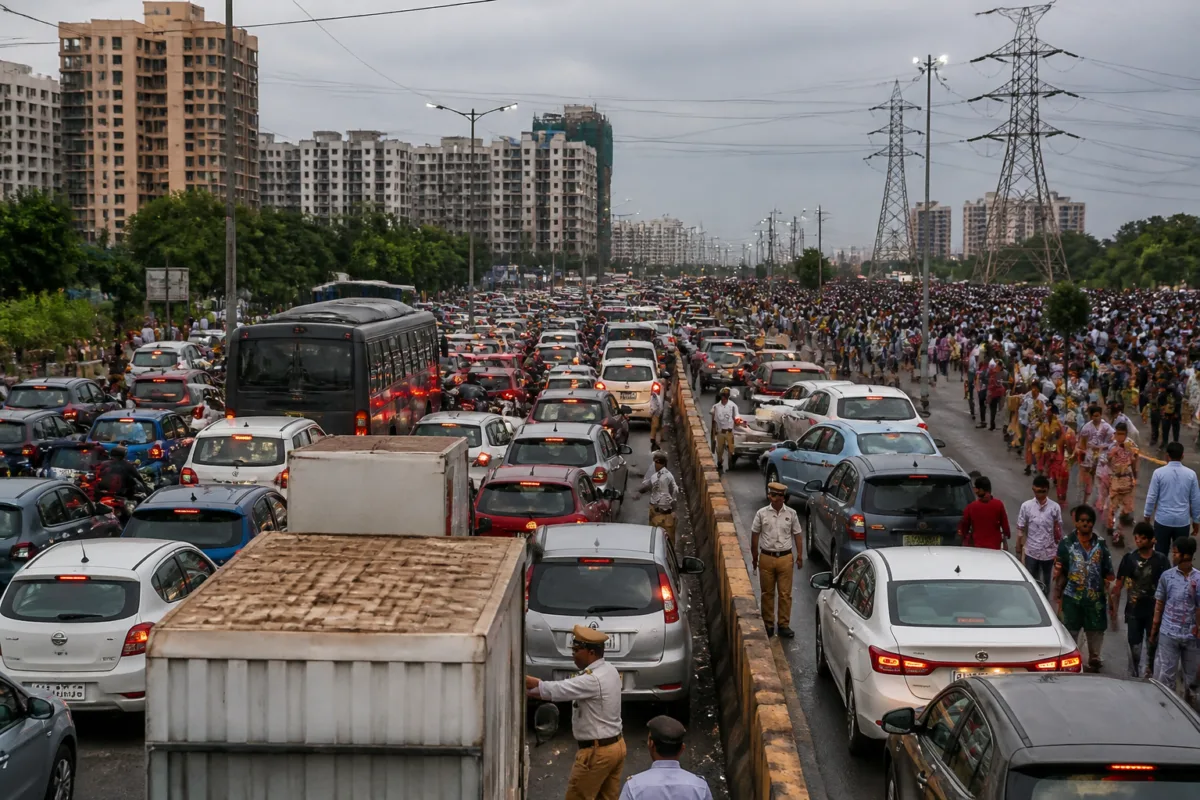
The immediate event took place on October 27, when thousands of people gathered on Ghodbunder Road to protest what they described as a poor investigation into the September murder of Shiv Sena (UBT) functionary Pradeep Purnekar. According to the report by the Times of India, the gathering blocked the road for more than six hours. Commuters returning home were stranded for hours, while some were forced to walk several kilometres to reach their destinations.
The issue before the commission is not whether a protest can take place. It is whether the authorities had made adequate arrangements to protect other residents while allowing it to proceed. That distinction matters in a city where a single arterial route can carry daily commuter traffic, emergency movements and local trips simultaneously. The complaints filed by Thane residents alleged that the disruption affected their right to sleep, health, dignity, free movement, access to emergency services and a peaceful environment.
Justice A M Badar, chairperson of the Maharashtra State Human Rights Commission, said the complainants had made out a prima facie case for immediate interim relief. The commission described the allegations as raising a serious issue of continuing violations of residents’ rights and a failure by the authorities concerned to protect those rights. The language of the interim recommendations places the matter beyond a routine congestion complaint: it treats the response to the disruption as a human-rights and public-administration issue.
That approach brings the city’s emergency-response system into the centre of the case. Residents had called Dial 112 during the protest, and the commission has asked the police to submit a report on the action taken on those calls. It has also directed that a call to Dial 112 and a written complaint should be promptly attended to, with the complainant informed in writing about the action taken. The local senior police inspector has been asked to ensure that complainants are not harassed or intimidated.
These directions identify a basic accountability loop: a resident reports a threat or obstruction, the control room or police unit records the complaint, officers respond, and the complainant receives an explanation of what happened. The commission’s order suggests that this loop must be examined in relation to the October 27 protest. The central question is not simply how many people gathered, but whether calls from affected residents generated a timely and documented response while the road remained blocked.
The commission has separately asked Thane traffic police to prepare and implement a traffic management and diversion plan for the stretch within two days. The plan is to include the deployment of traffic personnel during any gathering. This is important because the reported disruption did not remain confined to one point on Ghodbunder Road. The complainants said the gathering created unprecedented chaos in the Louis Wadi area as well as on Ghodbunder Road, with the blockage producing a cascading effect across Thane city.
The reference to a diversion plan also highlights the difference between traffic control after a road is blocked and mobility planning before a gathering begins. A city’s response cannot depend only on officers arriving after congestion has spread. It requires advance knowledge of the gathering, an assessment of the road’s importance, designated diversion routes, personnel deployment and a system for communicating changes to commuters and emergency services. The commission’s direction does not establish that these arrangements were absent, but it requires the police to address the issue directly.
The question of permission is equally significant. The commission has asked police to check whether permission was obtained for the protest. This is an administrative question with practical consequences. If permission was required, the approval process should ordinarily provide an opportunity to consider location, timing, crowd size, traffic diversion and emergency access. If permission was not obtained, the authorities must explain how they responded to an unplanned gathering that affected an arterial road for several hours.
The report does not establish the final position on whether permission had been granted, nor does it state whether an FIR was registered based on residents’ complaints. Those are among the matters on which the police have been asked to report. The distinction between what residents alleged and what the authorities ultimately establish will therefore be important in assessing responsibility for the disruption.
The case also shows how mobility failures can become rights failures. Being delayed in traffic is not automatically a human-rights violation. However, a prolonged blockage can have wider consequences when residents cannot reach home, emergency vehicles face difficulty moving, or people are left without a workable route to essential services. The complainants specifically referred to access to emergency services and a peaceful environment, while the commission referred to an alleged continuing violation of residents’ rights.
Ghodbunder Road’s role in this episode is central. The reported gathering affected a major road and had consequences beyond the immediate protest location. The account of commuters walking several kilometres indicates that the impact was experienced at street level, not only through traffic-speed data or police records. The disruption altered how residents travelled, how long they remained outside and whether they could rely on the road network to get home.
At the same time, the available report does not provide traffic counts, the number of emergency calls, the response times of police units, the number of diversions attempted or the duration of congestion in different parts of the city. It also does not include the police’s response to the commission. Those missing details limit what can be concluded about the scale of operational failure. The commission’s interim directions create a process for obtaining some of that information, but they are not themselves a final determination of liability.
The institutional responsibilities are nevertheless becoming clearer. The police must account for the handling of Dial 112 calls and written complaints. Thane traffic police must prepare and implement a plan for the affected stretch and deploy personnel during future gatherings. The local senior police inspector must protect complainants from harassment or intimidation. The commission is monitoring whether these authorities provide interim relief and address the alleged rights violations.
This division of responsibility matters because urban disruption is often treated as an unavoidable consequence of large gatherings. The commission’s intervention challenges that assumption without ruling on the legitimacy of the protest itself. Public assembly and residents’ mobility are being considered together. The administrative test is whether authorities can protect both interests through permission checks, advance planning, emergency access and clear communication.
The episode therefore raises a larger urban question: who bears the cost when public space is used without an effective operational plan? In Thane, the reported answer was commuters, residents and potentially people requiring emergency access. The commission’s order shifts part of that cost back towards the institutions responsible for managing the road, responding to complaints and explaining their actions.
What the evidence confirms is that the October 27 gathering caused extensive disruption on Ghodbunder Road and affected movement across parts of Thane. What remains to be established is whether the protest had permission, how police handled the Dial 112 calls, whether residents’ complaints led to an FIR and whether a traffic diversion plan was in place or implemented. The next significant development will be the report sought from Thane police and the implementation of the traffic plan directed by the Maharashtra State Human Rights Commission.

