


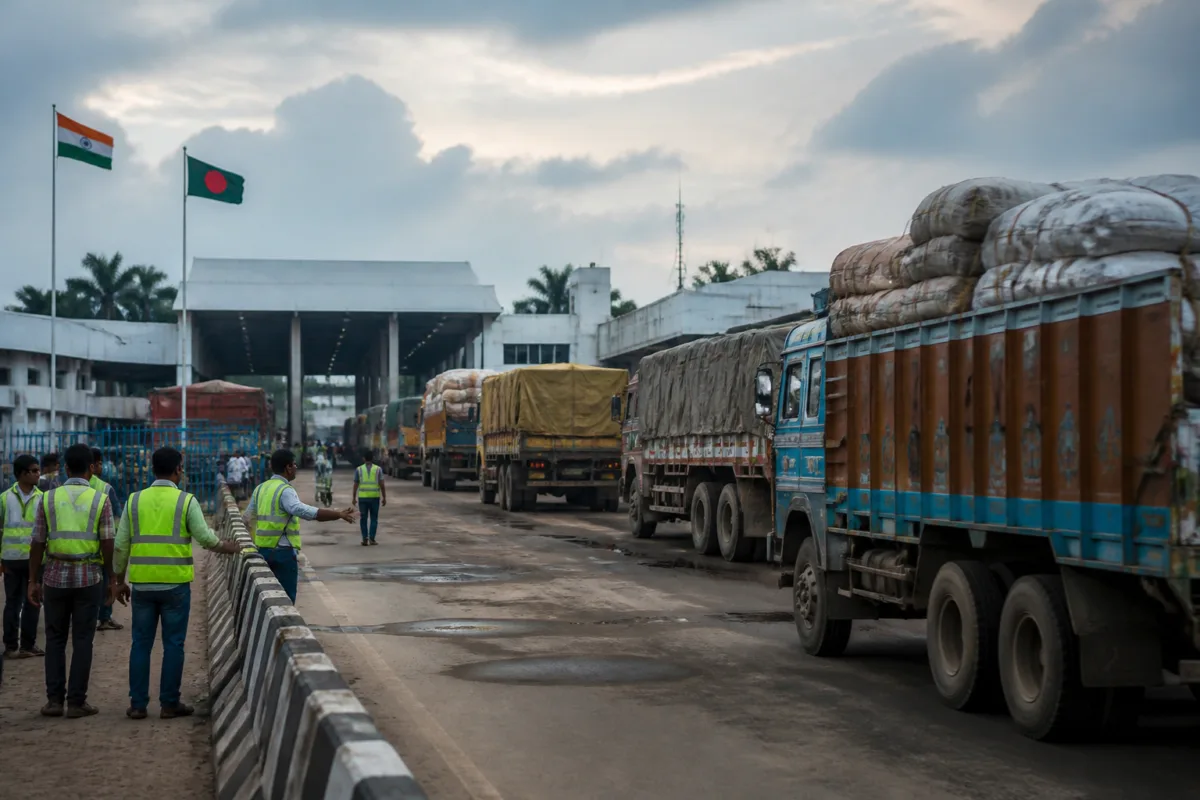
Operations at the Petrapole land port in North 24 Parganas resumed on Wednesday after a three-day stoppage by workers disrupted the loading and unloading of goods from Bangladesh. An interim agreement restored work, but workers continued to demand a permanent arrangement for job allocation and security.
The stoppage had begun on November 1 after competing labour groups disagreed over how work at the international land port would be divided. More than 180 cargo trucks were reportedly held up during the disruption, according to Kartik Chakraborty, secretary of the customs department’s clearing section. At least eight or nine trucks carrying perishable goods such as fish were unloaded following special requests to prevent spoilage.
The dispute centres on the allocation of handling work among labour organisations operating at Petrapole. The source report said the issue has remained politically contested since the change of government in West Bengal, with rival groups linked to Union Minister of State for Ports, Shipping and Waterways Shantanu Thakur and state Food Minister Ashok Kirtania taking different positions on the division of work.
An earlier arrangement had allocated 78% of the work to workers affiliated with the Bharatiya Mazdoor Sangh, or BMS, and 22% to workers from other states and groups. The arrangement was discussed during a meeting involving the state minister, the Land Ports Authority manager and BMS representatives, according to the report.
The BMS subsequently split into two groups, leading to a fresh dispute over the distribution of work. Thakur later met the manager of the Petrapole land port and proposed a different formula: 70% for BMS and 30% for the Centre of Indian Trade Unions, or CITU. Within the BMS allocation, one group was to receive 50% and another 20%.
Workers associated with the state minister’s side opposed that revised arrangement. After discussions on Wednesday, operations resumed under the earlier 78:22 formula. The immediate settlement has allowed goods movement to restart, but it has not resolved the underlying disagreement over which organisations should control work at the port.
Worker Subrata Das said people who had worked at the port for 20 to 30 years were at risk of being removed. He said five labour organisations had previously operated under a fixed work-sharing arrangement, with BMS receiving 78% and other long-serving workers receiving 22%. Worker Robin Sarkar said the main demand was job security and that the work stoppage had made it difficult for families to manage their household expenses.
The stoppage exposed how labour-allocation disputes at a strategic trade gateway can quickly affect freight movement and international commerce. The port’s immediate next step is the continuation of operations under the interim 78:22 arrangement, while workers are seeking a settlement that provides longer-term certainty over work distribution.

