


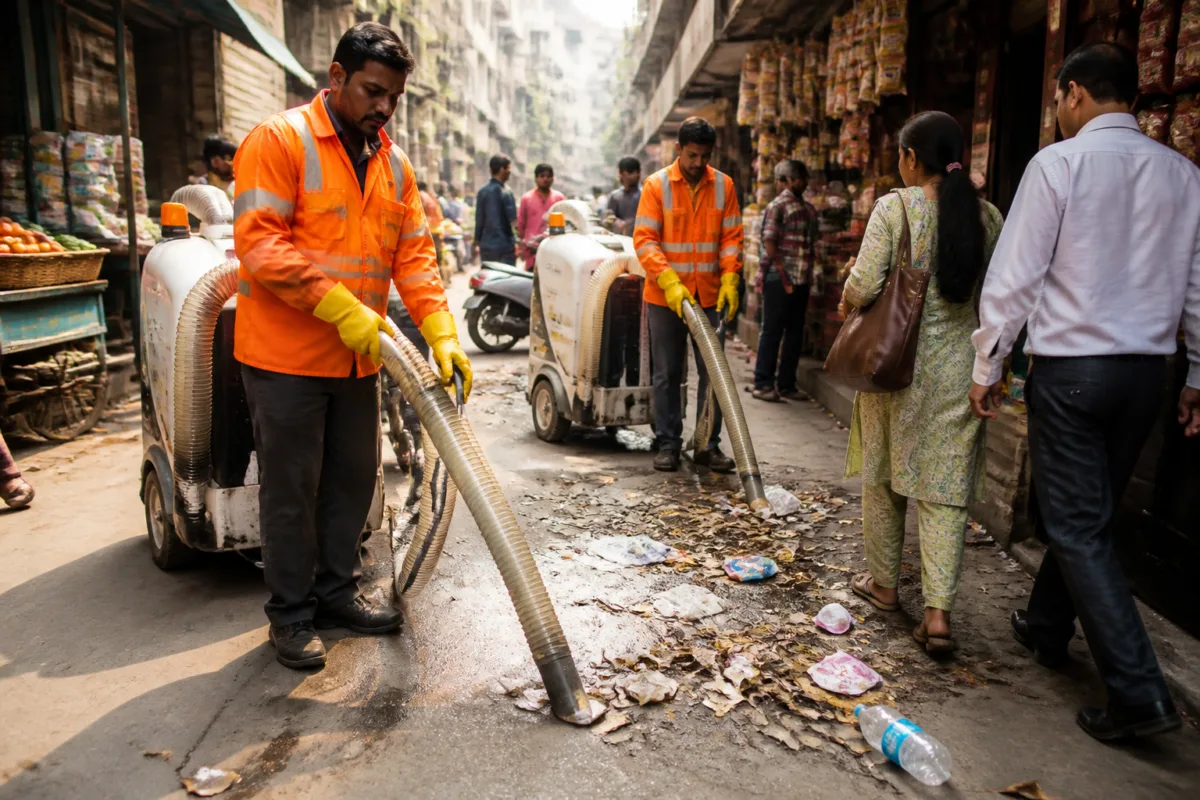
The Municipal Corporation of Delhi has begun trial operations of battery-operated litter picker machines in eight wards of the Keshavpuram zone, as the civic body moves to strengthen waste collection in markets, public spaces, narrow lanes and congested commercial areas.
The trial began on Tuesday and is intended to familiarise sanitation staff with the use of the vacuum-based machines in high-footfall and difficult-to-access locations. The MCD plans to deploy 1,000 machines across Delhi, with four machines allotted to each of the city’s 250 wards.
According to MCD officials, the machines use a suction hose to collect light waste including plastic bottles, paper cups, wrappers, leaves and other litter. Their smaller format is intended to help sanitation workers operate in spaces that are not easily accessible to large mechanised road-sweeping machines.
The equipment was inaugurated by Delhi chief minister Rekha Gupta on October 17. The current trial in Keshavpuram is focused on operational familiarisation, including the use of the machines in markets, busy public areas and congested locations.
The MCD said the machines would supplement existing cleanliness drives rather than replace conventional sanitation systems. Their stated purpose is to improve litter collection in areas where large mechanical equipment cannot operate efficiently, while supporting workers engaged in street-level cleaning.
The deployment plan places four machines in every ward if the proposed allocation is implemented across the city. With 250 wards, the plan would create a ward-level network of compact litter-collection equipment covering local markets, public spaces and narrow lanes. The source report does not specify the total procurement cost, the operating range of the batteries, the number of sanitation workers assigned to each machine or the timeline for completing the citywide rollout.
The trial also places emphasis on how mechanised equipment is integrated into routine municipal work. Its effectiveness will depend on the locations selected, the frequency of use, the handling of collected waste and the continued operation of existing cleaning arrangements. The MCD has not, in the supplied information, announced performance targets or a schedule for evaluating the trial.
For residents, the immediate focus is on litter collection in heavily used areas where waste can accumulate and where conventional road sweepers have limited access. The civic body said the machines are intended to improve cleaning in such locations and assist sanitation staff during ongoing cleanliness operations.
The MCD’s next stated step is to use the Keshavpuram trial to familiarise staff with the machines before the planned deployment of 1,000 units across Delhi’s 250 wards.

