


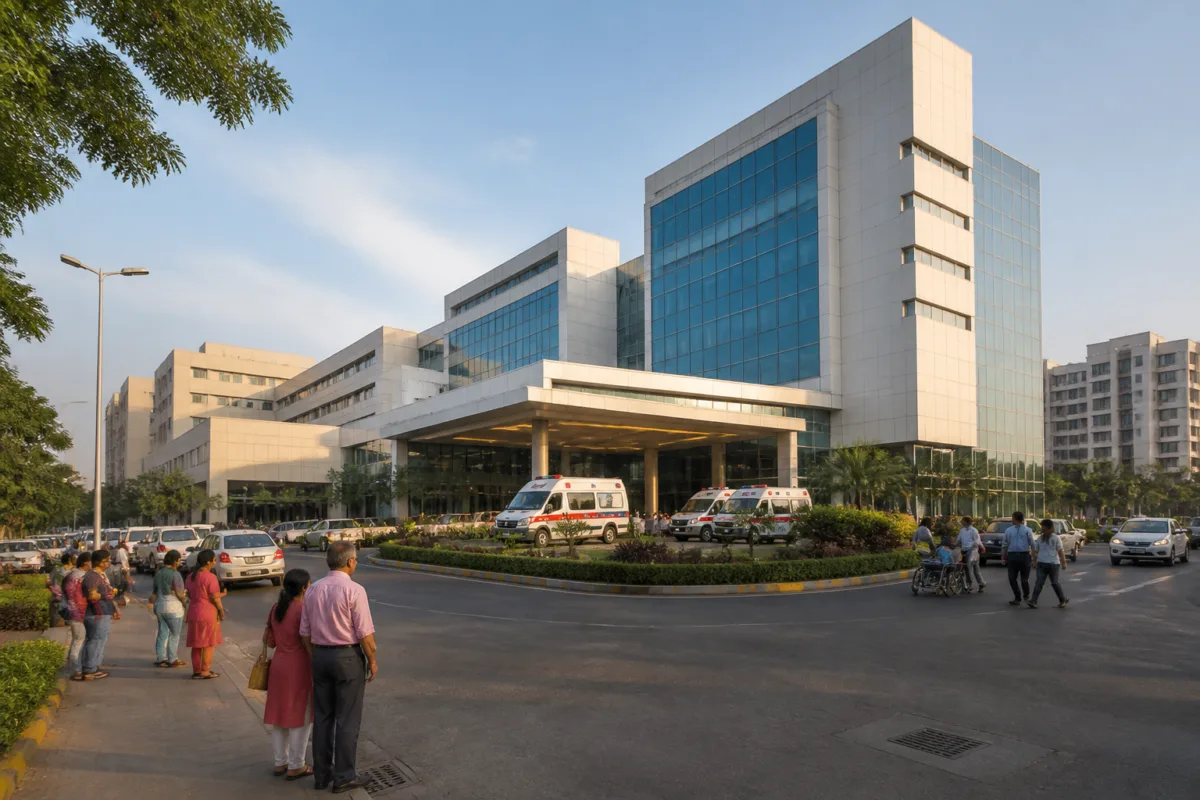
Kauvery Hospitals’ plan to double its capacity from around 2,500 beds to 5,000 in three to four years is more than a private healthcare growth story. It is also a test of whether hospital networks can build a stronger urban healthcare geography in which patients in tier-2 cities do not have to travel to large metropolitan centres for specialised treatment.
The Chennai-headquartered group plans to add capacity at existing facilities in Tamil Nadu and Bengaluru while entering more cities, including Madurai and Coimbatore. It is also adding a large hospital in North Chennai. The expansion, described by founder and managing director Dr. Manivannan Selvaraj as the group’s fastest growth phase, will extend a network that currently has 12 hospitals across Tiruchi, Chennai, Salem, Hosur, Tirunelveli and Bengaluru.
That proposed footprint matters because healthcare access is shaped not only by the number of doctors or hospital beds available nationally, but also by where facilities are located. A hospital in a regional city performs a different urban function from a hospital concentrated in a major capital. It can reduce the need for patients and families to relocate temporarily, travel long distances or depend on a single metropolitan healthcare cluster. Kauvery’s stated objective is to provide what it describes as tier-1 quality in tier-2 towns, rooted in the group’s origins in Tiruchi.
The group began in 1999 with a 30-bed hospital in Tiruchi. It acquired listed entity KMC Speciality Hospital in 2009, a transaction that helped it secure private equity funding, and entered Chennai in 2012. According to Selvaraj, the Chennai operation broke even within two years, giving the chain confidence to replicate the model in other locations. The current expansion therefore follows a regional-to-metropolitan path rather than a strategy built solely around a single large city.
This history also shows why hospital expansion is an urban infrastructure problem. New capacity requires land, construction, utilities, clinical equipment, trained staff, digital systems and a local patient base capable of supporting specialised services. A hospital may be physically completed before it becomes operationally mature. The group’s stated approach is to combine new facilities with additions to existing hospitals, allowing growth to take place across different stages of the network rather than through one large project alone.
The financial scale of the proposed growth is significant within the group’s current operations. Kauvery reports overall revenue of about ₹2,600 crore and nearly 18,000 employees. Most of its hospitals, Selvaraj said, have matured into cash-generating units, while the group has built internal accruals. It is consequently not in a hurry to launch an initial public offering, although it has spoken to bankers about market conditions and has not evaluated specific steps such as pre-IPO funding.
That funding position is important because hospital construction is capital-intensive and exposed to cost escalation. Selvaraj said construction costs had risen by around 20 per cent, while the cost of consumables and several imported high-end medical equipment had increased by nearly 30 per cent over the previous year. These figures were provided by the company’s management and describe the cost pressures facing its expansion plans; they do not by themselves establish a broader industry-wide trend.
The cost problem makes operational design as important as physical expansion. Kauvery has centralised several non-clinical functions, including human resources and finance, in Tiruchi. The rationale is to create efficiencies across a distributed network while keeping hospitals focused on clinical delivery. This is a familiar institutional challenge for multi-city healthcare systems: a group must standardise selected functions without losing the local capacity needed to serve different markets.
The group is also using digitally connected intensive care units so that critical care physicians can monitor patients across locations. It spends around 3 to 3.5 per cent of turnover on technology covering enterprise resource planning, hospital management systems and cybersecurity. The technology investment suggests that the hospital network is being built as a connected operating system, not simply as a collection of independent buildings.
The distinction is relevant to the future shape of regional healthcare. A digitally linked network can allow expertise to be shared between established hospitals and newer facilities, at least in the areas where the model is operationally suitable. However, the material supplied does not establish how many patients are covered by the connected ICUs, what clinical outcomes have resulted, or whether the model will be extended uniformly across the planned 5,000-bed network. Those remain questions for implementation rather than settled outcomes.
The same caution applies to artificial intelligence. Selvaraj sees near-term applications in back-end operations and clinical documentation and said AI would assist doctors rather than replace them. This places the group’s technology strategy in an incremental category: improving administration and documentation before attempting to redesign clinical decision-making. The company has not disclosed a detailed AI deployment plan, investment figure or implementation timeline in the supplied material.
The expansion also sits within a wider debate over the price of hospital care. Selvaraj argued that discussions about hospital pricing should first account for the cost of delivering care. He cited higher equipment, consumable and construction costs, while also acknowledging the need to manage the expectations of patients, governments and regulators. His comments point to a tension that will become more visible as private hospital networks expand: increasing capacity does not automatically make treatment affordable, particularly when the underlying cost base is rising.
The group believes that expanding the insurance base would improve the economics of healthcare delivery. The statement identifies insurance coverage as an important part of the financing system, but the supplied material does not provide data on the share of Kauvery’s patients covered by insurance, the mix of public and private payers, or the effect of insurance on treatment prices. Without those details, the relationship between capacity expansion and affordability cannot be measured from this announcement alone.
The proposed locations reveal the planning logic behind the company’s growth. Chennai and Bengaluru provide major metropolitan markets, while Tiruchi, Salem, Hosur and Tirunelveli represent a wider network of regional urban centres. Madurai and Coimbatore would add further reach within Tamil Nadu. The stated aim is not simply to move into the largest available cities, but to create a chain in which healthcare capacity is distributed across a hierarchy of urban markets.
That model can produce benefits beyond patient access. The group already employs nearly 18,000 people, and additional hospitals will require clinical, technical, administrative and support staff. Yet employment growth alone does not demonstrate that all future facilities will meet their planned timelines or staffing requirements. The central execution challenge will be to scale buildings and equipment while maintaining the clinical capability and operating standards on which the network’s regional proposition depends.
Kauvery’s expansion therefore raises three linked urban questions. First, can regional hospital networks make specialised care more geographically accessible without reproducing the cost pressures of metropolitan healthcare? Second, can centralised systems and digital connectivity help newer facilities reach operational maturity faster? Third, can private expansion align with the expectations of patients, regulators and governments on pricing and quality?
The evidence currently confirms an ambitious capacity target, a defined group of existing and proposed locations, a financing preference based on internal accruals, and an operating strategy that combines centralisation with digital connectivity. It does not yet establish the construction schedule for each hospital, the capital required for the full 2,500-bed addition, the staffing plan, or the final pricing and insurance model. Those details will determine whether Kauvery’s next phase becomes a durable tier-2 healthcare network or remains primarily an expansion promise. For now, the company’s stated plan places regional hospital infrastructure at the centre of its growth strategy.

