


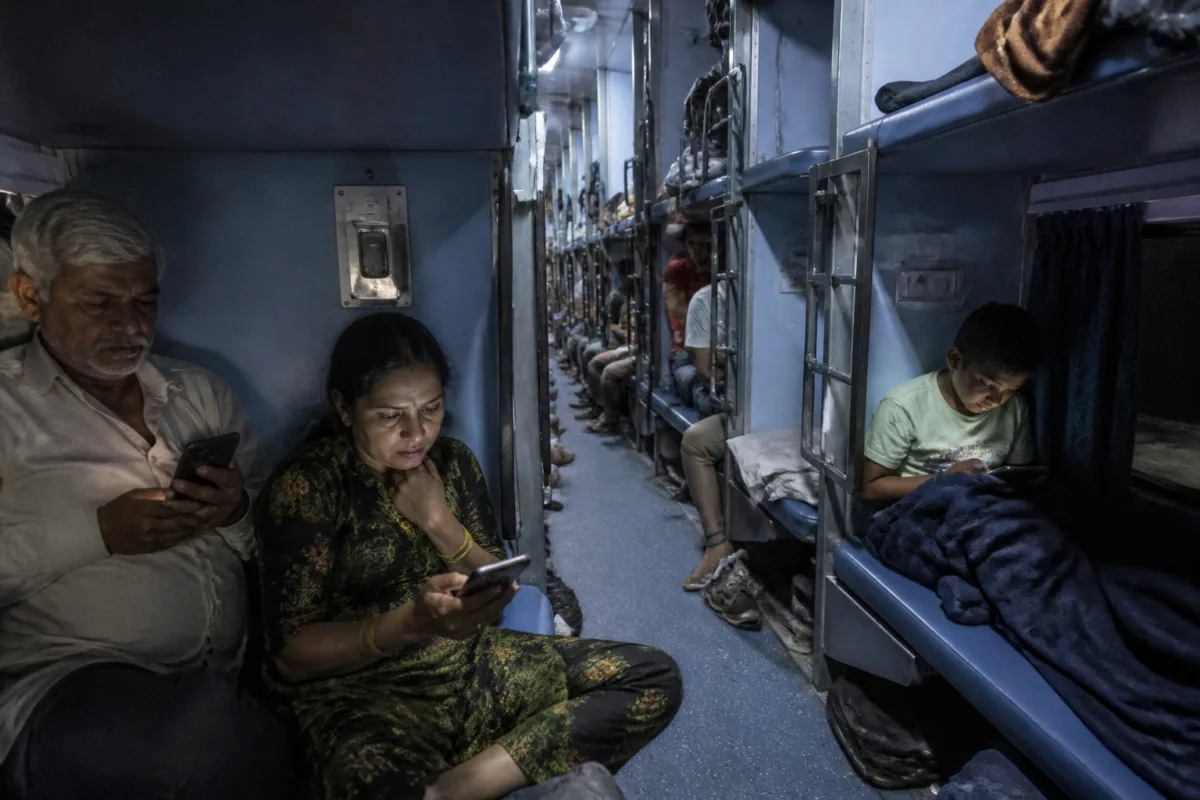
The Railways’ decision to switch off train charging points between 11pm and 5am has turned a routine coach facility into a question about how dependent modern train travel has become on charged mobile phones. The ministry says the six-hour shutdown is intended to prevent fires and other safety hazards, while passengers in Jharkhand argue that it removes access to a service increasingly needed for tickets, payments, travel information and communication during overnight journeys.
The directive was issued in a letter dated October 26 to the principal chief electrical engineers of all railway zones. It instructed railway authorities to ensure that mobile charging points in all coaches remain switched off during the specified overnight period. According to the report, passengers travelling in Jharkhand began questioning the measure after attendants informed them that charging facilities would not be available at night.
The immediate dispute is therefore not only about electricity access inside a train. It is about the gap between the way railway safety is being managed and the way passengers now navigate journeys. A mobile phone can function as an e-ticket, a travel-information device, a payment instrument, a connection to family members and a channel for reporting problems through railway applications or helplines. When a charging facility is withdrawn for six hours, the operational assumption is that passengers can plan around the restriction. The passengers quoted in the report say that assumption does not reflect the conditions of long-distance travel.
Prem Kataruka, secretary of the Jharkhand Passengers’ Association, said phones had become essential to train travel because passengers use them to display e-tickets, access information, make digital payments, book cabs and contact their families. He described the overnight shutdown as inconvenient, particularly for people travelling long distances, and argued that the ministry should consider alternative safety safeguards rather than disabling charging facilities across coaches.
The report also provides a ground-level account of how the order is being experienced. Dhanbad resident Sanjay Chatterjee said he travelled to Jaipur on October 28 and was informed by attendants in his third AC coach that charging would not be available between 11pm and 5am. He had carried a power bank, but said several passengers had to wait until morning to charge their phones. That detail matters because it shows how a centrally issued instruction is translated into a passenger-level rule: the facility becomes unavailable uniformly, regardless of an individual passenger’s battery level, destination or need to remain connected.
Dinesh Singh, who was travelling from Ranchi to Delhi, linked the issue to the period after passengers leave the train. He said a charged phone is needed to book cabs, contact family members, make online payments and use railway applications or helplines to report problems such as dirty coaches and faulty facilities. His concern expands the question beyond convenience. A passenger may complete most of a journey safely but still need a working phone to navigate the last mile, make a payment or seek assistance after arrival.
The directive also highlights an institutional choice in managing infrastructure risk. The ministry’s stated objective is prevention: charging points are to be switched off during a fixed period to reduce the possibility of fires and other hazards. Passengers’ response is focused on control: they want safer charging systems, regular inspections and stricter action against faulty equipment instead of a blanket shutdown. These are different approaches to the same facility. One reduces exposure by limiting use; the other attempts to retain the service while improving the equipment, monitoring and accountability around it.
The supplied report does not establish what specific incidents, technical findings or inspection records led to the ministry’s decision. It also does not state whether the order is temporary, whether it applies to every type of coach and train in the same way, or whether railway zones have been given a timetable for installing safer charging systems. Those unanswered questions are central to assessing the proportionality and effectiveness of the measure. Without them, passengers are being asked to accept a significant service restriction without a publicly described account of the risk it is intended to address.
This is a familiar governance problem in transport systems: a passenger-facing service can be treated as a minor amenity even after it becomes part of the journey’s practical infrastructure. Charging points may appear secondary when compared with tracks, signalling, rolling stock or station facilities. Yet their use is connected to several other parts of the travel system. Digital tickets depend on phone access, online payments depend on battery power, app-based information depends on connectivity and last-mile travel increasingly depends on digital booking. The facility’s importance has grown without necessarily changing how it is classified or managed.
That dependence is particularly visible on overnight routes. Passengers may board before the shutdown period and remain on the train until after it ends. Unlike a station, a coach does not offer easy access to another charging point while moving between cities. A passenger who begins the night with a partially charged phone has limited ability to find an alternative. Those travelling with power banks have a workaround, but the report indicates that not all passengers have one and that carrying backup equipment cannot be assumed to be a universal solution.
The issue also raises questions about the division of responsibility between the railway administration and passengers. The ministry’s letter places the operational responsibility on railway authorities and their electrical wings. Passengers, meanwhile, are expected to adapt by charging earlier, carrying power banks or waiting until morning. The report does not indicate whether the Railways has issued alternative instructions, displayed the restriction before boarding or provided emergency charging access elsewhere on trains. These details would determine whether the shutdown is merely a controlled safety measure or a service change transferred almost entirely to passengers.
The controversy is therefore not evidence that the safety concern is unjustified. Nor does the supplied material establish that switching off charging points will create a specific danger for passengers. What it does show is a mismatch between a broad restriction and the limited explanation available to users. A safety order affecting every coach during a predictable six-hour window requires more than implementation; it requires clarity about the hazard, the technical alternative and the conditions under which the restriction will be reviewed.
The demand from passengers for regular inspections and stricter action against faulty equipment points to the underlying maintenance question. If defective charging points or electrical systems are the concern, the quality of inspections, fault detection and repair becomes as important as the hours during which the points are powered. The report does not provide data on faults, fires, inspection frequency or enforcement action, so it cannot establish whether the main weakness lies in equipment design, maintenance, passenger behaviour or monitoring. Those are distinct problems requiring different responses.
For the Railways, the practical challenge is to reconcile two systems that passengers experience as one: physical railway infrastructure and digital travel services. The ministry’s directive addresses the first through a restriction on electrical access. Passengers’ objections emphasise the second, where a dead phone can affect ticket presentation, payment, communication and onward travel. The dispute will remain unresolved unless the administration explains how the safety objective is being balanced against these increasingly integrated travel needs.
The immediate facts are clear: a railway ministry letter dated October 26 directed zones to keep coach charging points switched off from 11pm to 5am; passengers in Jharkhand have objected; and the ministry has cited fire and safety concerns. What remains unclear from the supplied report is the technical evidence behind the order, its duration, the precise scope of its application and the alternatives available to passengers. Those are the details that will determine whether the shutdown is a proportionate safety intervention or a temporary substitute for safer, better-monitored charging infrastructure.

