


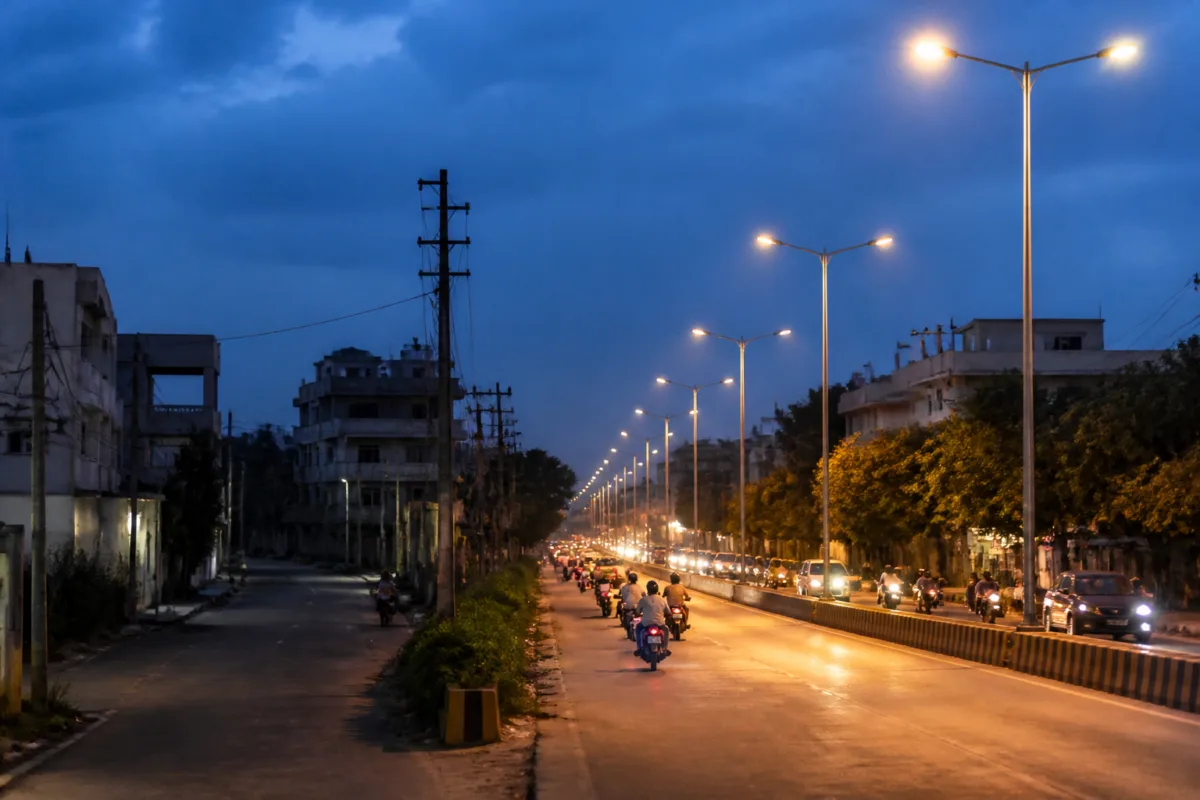
Raipur’s streetlight problem is no longer only about how many fixtures the municipal corporation has procured. It is about whether the city can convert budgeted equipment, administrative directions and ward-level distribution into reliable illumination on the roads and in the public spaces where residents actually move. The Raipur Municipal Corporation has distributed 1,978 streetlight sets across its 10 zones and 70 wards, yet dark stretches continue to be reported in residential areas and on roads developed under the Smart City project.
That gap between supply and service is the central fact emerging from the corporation’s latest review. Officials told the mayor on November 2 that streetlight sets had been supplied to all 10 zones, but installation was progressing slowly in some areas. Manpower shortages were cited, prompting directions to zonal officers to form teams and undertake ward-wise installation drives before Diwali. Officials were also instructed to repair existing non-functional lights.
The details matter because distribution is only one stage in the streetlight system. A civic body must identify dark locations, procure or allocate equipment, install the sets, connect and test them, maintain the network and respond to faults. The report indicates that Raipur has moved forward on supply but remains uneven on installation and repair. The corporation has not specified how many streetlights have been installed across the city, how many are currently non-functional or how many of the newly supplied sets are operational.
This missing operational picture makes it difficult to judge the success of the latest allocation. A number of distributed sets cannot be treated as a number of functioning streetlights. Until the corporation reports installation and performance figures, the public can know that equipment has reached the zones but not whether the intervention has improved lighting at street level.
The latest review followed several earlier warnings. On September 18, the mayor directed zonal electrical teams to conduct night inspections and repair defective lights, particularly on major roads, market areas and public spaces. An October 7 report cited complaints of inadequate lighting in more than 12 localities, including Anupam Nagar, Daldal Seoni and Devendra Nagar. In Anupam Nagar, police reportedly used mobile phone flashlights during an initial search after a body was found.
The reported incident does not establish that poor lighting caused the underlying event. It does, however, show the practical consequences of an unreliable public-lighting network: residents and public agencies may have to operate in conditions where visibility is reduced and ordinary civic functions become more difficult. Lighting is therefore not merely an amenity or a beautification feature. It is part of the basic operating environment of a city after dark.
The corporation has communicated an allocation of Rs 50 lakh for streetlight repairs. The availability of a repair budget is important, but expenditure alone will not resolve the service gap. The administration still needs to translate the allocation into a system that records faults, assigns responsibility, completes repairs and confirms that the repaired lights remain functional. The supplied report does not establish whether such a citywide performance system is in place.
The problem is also visible on roads built under the Smart City project. An October 18 report identified non-functional lights on the Jaistambh Chowk-Fafadih stretch, inadequate illumination between the Collectorate and Khalsa School, and a non-functional memorial lighting installation on the Mahila Thana-OCM Chowk stretch towards Rajiv Gandhi Marg. Six roads covered in that report were developed at a reported cost of around Rs 32 crore.
These locations raise a specific implementation question. Road development and street lighting are often treated as connected elements of the same urban project, but the functioning of the road after completion depends on maintenance arrangements that continue beyond construction. A capital project can be completed, photographed and recorded as an asset while the public experience deteriorates if lights fail and repairs are slow. In Raipur, the reported condition of Smart City roads suggests that the operational phase deserves as much attention as the construction phase.
The geographic distribution of the latest streetlight sets also shows the corporation using a zone-based administrative structure. Zones 1, 3 and 10 were each allocated 212 sets; zone 2 received 140; zone 4 received 202; zones 5 and 7 received 200 each; zone 6 received 215; zone 8 received 197; and zone 9 received 188. The sets were provided under the infrastructure fund and the corporation’s general fund.
Those figures indicate that the corporation has attempted to distribute equipment across the city rather than concentrate it in a single project area. They do not, by themselves, show whether the allocation corresponds to the number of defective lights, road length, population, complaint volume or the condition of public spaces in each zone. The report does not provide that comparison. As a result, the administrative allocation is visible, but the service rationale behind the zone-wise numbers remains unclear.
The mayor’s response has been to order ward-wise installation drives and ask zonal officers to resolve manpower constraints through teams. This places execution responsibility at the zone level. It also exposes a recurring challenge in municipal administration: a city may have funds and equipment, but the final delivery depends on the capacity of local teams to inspect, install and maintain assets across a large number of streets.
The same review revealed delays in nine playground development projects for which Rs 589.91 lakh, or about Rs 5.9 crore, had been sanctioned. Work had progressed at only four grounds, while five were held up by disputes and procedural hurdles. The mayor directed officials to resolve these issues within a stipulated timeframe.
Streetlights and playgrounds are different civic assets, but their appearance in the same review is significant. Both cases involve public infrastructure that has moved through an approval or funding process but has not reached complete, usable delivery. In the streetlight case, the gap is between distribution, installation and operation. In the playground case, the gap is between sanction and physical progress. Together, they show how municipal performance is shaped by the last mile of implementation rather than by announcements or allocations alone.
The numbers also reveal the limits of judging urban governance through sanctioned amounts. The streetlight repair allocation is Rs 50 lakh, while the playground projects carry a sanction of Rs 589.91 lakh. Yet neither amount indicates the quality or speed of delivery without information on work completed, assets functioning and unresolved obstacles. The corporation’s own review has therefore moved attention from approval to execution, even if the available public information remains incomplete.
For residents, the immediate concern is not the institutional source of a streetlight set or the fund from which it was purchased. It is whether a road, market area, residential lane or public space is adequately lit when people use it. The report identifies more than 12 localities where complaints were recorded and several prominent road stretches where lighting was reported to be inadequate or non-functional. That spread suggests the issue is not confined to one isolated fault.
The next stage will be measurable only if the corporation publishes or communicates clearer operating data: how many of the 1,978 sets have been installed, how many existing lights have been repaired, which wards remain pending and whether the reported dark stretches have been addressed. Without those figures, repeated reviews may continue to record directions without establishing outcomes.
Raipur’s streetlight experience ultimately highlights a basic urban governance question: can municipal systems track an asset from allocation to reliable public service? The evidence supplied in the report confirms that equipment has been distributed, repair funds have been identified and ward-level installation drives have been ordered. It also confirms that dark stretches persist, installation is slow in some areas and the corporation has not disclosed the citywide count of working and non-working lights.
The immediate milestone is the ward-wise installation and repair drive ordered before Diwali. Its significance will depend not on the number of teams formed, but on whether the corporation can demonstrate that the streets and public spaces previously identified as poorly lit have become functional, consistently illuminated parts of the city’s everyday network.

