


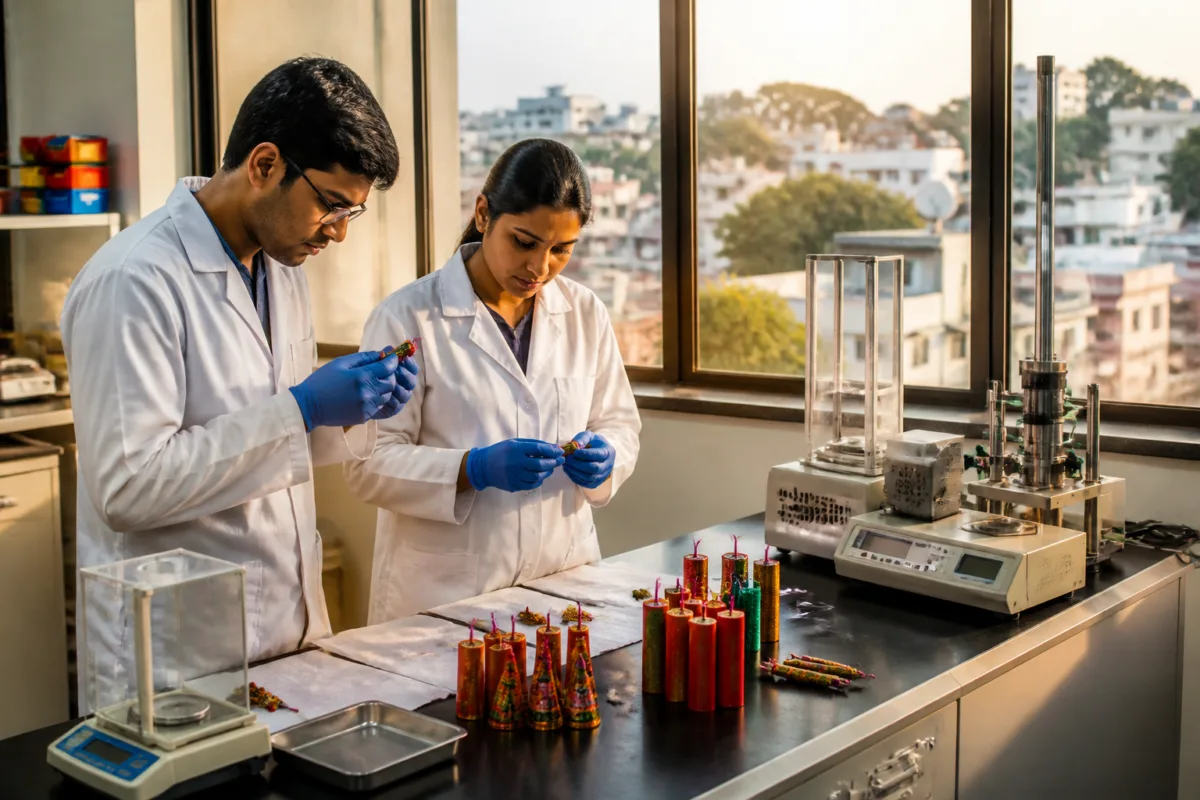
CSIR-National Environmental Engineering Research Institute’s newer green cracker formulations could reduce emissions by 45% to 60% compared with conventional firecrackers, according to the institute. The research is significant because it addresses two urban problems at once: the deterioration of air quality during periods of concentrated firecracker use and the difficulty of regulating a fragmented manufacturing and retail network.
The development also exposes the limits of the phrase “green crackers”. Joshua Krupadam, coordinator of the National Centre of Excellence for Green Firecrackers at NEERI, told the Times of India that the term does not mean zero pollution. It refers to products with lower emissions than conventional firecrackers. That distinction is central to how the technology will be understood, regulated and used in cities.
NEERI’s work is reportedly moving beyond the earlier generation of formulations transferred to manufacturers. Those products resulted in emission reductions of about 25% to 30%, while the newer formulations have achieved reductions of 45% to 60%, Krupadam said. The institute is also developing 12 to 13 variants that produce little or no visible smoke. These products are expected to reach the market by the next Diwali, according to the report.
The numbers indicate a technological improvement, but they do not by themselves establish how much urban pollution will fall. The eventual effect will depend on how widely the new products are manufactured, whether consumers can distinguish authorised products from unauthorised ones, how compliance is checked and how much total firecracker use takes place. A lower-emission product can reduce pollution per unit, but the city-level outcome also depends on the number of units used and the conditions in which they are burst.
That makes the transition from laboratory formulation to market availability the most important part of the story. NEERI’s research can establish the performance of particular formulations, but manufacturers, regulators and enforcement agencies will determine whether those formulations become a meaningful part of the festival economy. The institute’s stated objective is to ensure that only authorised products enter the market. That objective places product identification and supply-chain control at the centre of the environmental question.
### The noise problem is separate from the smoke problem
The research also highlights why air pollution cannot be the only measure used to assess firecrackers. NEERI has examined the noise generated by joint firecrackers, including garlands or “ladis”, which consist of numerous individual shells detonating in quick succession. Krupadam said a garland containing 1,000 shells produced noise levels of around 130 to 140 decibels, compared with a prescribed limit of 125 decibels.
This distinction matters for urban management. Emission reductions do not automatically resolve the public-health and liveability concerns associated with intense, concentrated noise. A formulation may produce less smoke while still creating a sound burden if large numbers of shells are detonated within a short period. Air-quality regulation and noise regulation therefore address different impacts, even when they involve the same product.
The figures supplied by NEERI also show why joint firecrackers are a particularly difficult category to govern. Their impact is created not only by the chemical composition of an individual unit but by the way many units are connected and released together. Regulation must therefore cover the product, its assembly, its testing, its labelling and its use. A simple shift from conventional to lower-emission formulations would not settle the question of cumulative noise.
The source material does not establish how many products currently comply with the prescribed limits, how enforcement is carried out across different markets or whether the proposed new variants have already completed all steps required for commercial sale. Those details will determine how much practical protection the new technology can provide to urban residents.
### A technology question is also a livelihoods question
NEERI’s work is unusual because it connects environmental performance with employment in the joint-firecracker industry. According to Krupadam, joint crackers account for an estimated 20% to 30% of the market and are traditionally made by hand or with small equipment. He said many people involved in their production had lost their jobs over the previous five to seven years.
The institute’s proposal is to permit and regulate the production of joint firecrackers rather than allow the sector to remain outside a controlled framework. Its argument is that scientifically developed products could address environmental concerns while creating employment opportunities for workers who have been displaced.
That approach raises an institutional issue that is often missing from pollution debates. Restrictions can reduce exposure to harmful emissions and noise, but they can also affect workers and small producers whose income is linked to the regulated activity. A policy that recognises only the environmental outcome may overlook the economic consequences of enforcement. Conversely, a livelihood argument cannot replace safety and pollution controls. The challenge is to design a framework in which employment is linked to authorised production, tested formulations and enforceable limits.
The report does not provide figures for the number of workers affected, the geographical distribution of the industry or the scale of investment needed to shift small producers towards compliant manufacturing. It also does not establish whether the proposed regulation has been formally adopted by the relevant authorities. These gaps matter because the employment case will need more than an estimate of market share to become an implementable policy.
### The regulatory chain will decide the outcome
The central urban question is not simply whether NEERI can develop a lower-emission cracker. It is whether multiple institutions can make the product legible and enforceable in the marketplace. The institute is responsible for research and formulation development. Manufacturers must produce according to approved specifications. Retailers must sell authorised products. Consumers must be able to identify them. Enforcement agencies must be able to test and act against non-compliant goods.
Each link presents a possible failure point. If products are poorly labelled, consumers may not know which claims are credible. If unauthorised products enter the market, the presence of compliant variants may not substantially change overall pollution levels. If testing is difficult at the point of sale, enforcement may rely heavily on paperwork rather than actual product performance. If consumers interpret “green” as pollution-free, the term could create unrealistic expectations and weaken public understanding of the remaining impacts.
Krupadam’s clarification that green crackers are not zero-pollution products is therefore more than a technical qualification. It is a communication requirement. Environmental claims have to be precise enough for consumers and authorities to understand what has been reduced and what has not. In this case, the reported reduction concerns emissions relative to conventional crackers; it does not eliminate noise, smoke or the need for regulation.
The expected market availability of the newer variants by the next Diwali creates a defined milestone, but it is not the same as a completed policy transition. Before that point, the relevant questions will include whether the formulations receive the necessary approvals, which manufacturers are equipped to produce them, how products will be authenticated and how compliance will be monitored during periods of high demand.
The available evidence confirms that NEERI has developed formulations with a reported improvement over its earlier products and is investigating near-smokeless variants and regulated joint crackers. It also confirms that the institute is treating pollution and employment as connected parts of the problem. What remains unclear is the scale at which the products will be manufactured, the status of formal regulatory approval and the enforcement mechanism that will govern their sale and use.
For cities, that distinction is decisive. A laboratory reduction becomes an urban intervention only when it is carried through the full chain of production, authorisation, retail, consumer information and enforcement. The next milestone is the proposed market introduction of the new variants by the next Diwali, alongside further clarity on how joint firecrackers will be regulated and how their air and noise impacts will be measured.

