


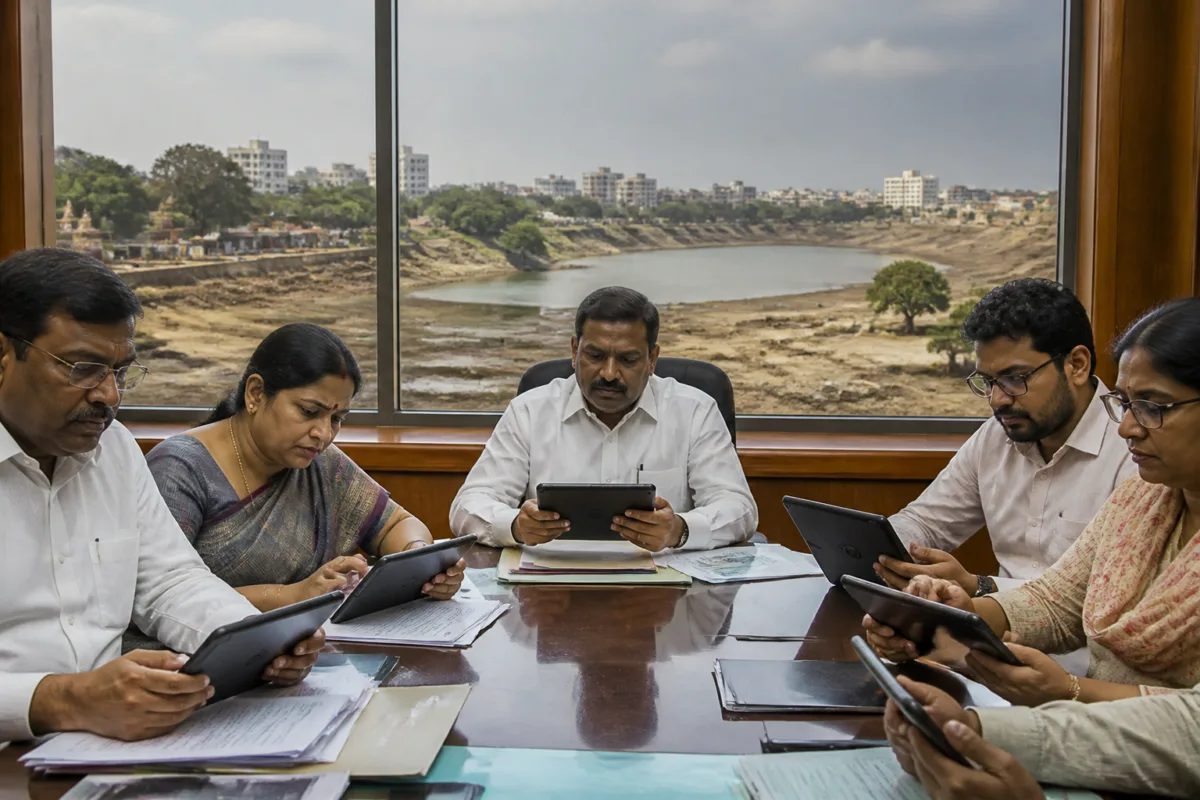
Nagpur Municipal Corporation’s plan to spend Rs 1.48 crore on 365 Android tablets arrives at a difficult moment for the city: Totladoh reservoir, its main water source, was reported to have fallen to 31.34% of live storage capacity on October 31, compared with 92.42% on the same date last year. The immediate controversy is about the price and timing of the tablets. The larger urban question is whether civic bodies can justify technology procurement when the systems, skills and accountability needed to use such devices effectively remain unclear.
According to the Times of India report, the tablets were proposed for elected representatives and municipal officials, including the mayor, deputy mayor, Standing Committee chairperson, ruling and opposition leaders, corporators, department heads, executive engineers and junior engineers. The proposal estimates a total expenditure of Rs 1.48 crore, including taxes, with each tablet costing Rs 38,999. Procurement is to be undertaken through e-tendering, and the devices are to be supplied with digital pens.
The municipal information technology department has justified the purchase by citing the growing use of the work module, the e-office system, the management information system portal, video conferencing and other technical software. The civic body has also referred to the discontinuation of its earlier laptop supply service as a reason for moving to tablets. The municipal commissioner cleared the proposal on October 13, and the municipal house subsequently approved the procurement proposal, as reported.
The stated rationale reflects a broader administrative shift. Municipal work increasingly depends on digital files, online approvals, information dashboards, video meetings and electronic communication. Tablets can make it easier for officials and elected representatives to access documents outside offices, review project information and participate in online processes. In principle, digitisation can reduce dependence on paper files and make administrative workflows faster.
But a device is only one part of a digital governance system. Its value depends on software access, connectivity, training, maintenance, data security, user adoption and clear rules on how information is recorded and acted upon. The reported proposal provides a justification for the hardware, but the available account does not establish how the corporation will measure whether the tablets improve decision-making or service delivery.
That gap matters because the proposal itself reportedly acknowledges an earlier failure. During the tenure of former Standing Committee chairperson Avinash Thakre, tablets were bought and distributed among corporators. Most of those devices later stopped working, while several corporators struggled to use them effectively. The new procurement therefore is not simply a first investment in digital administration. It is a repeat intervention after an earlier programme produced weak results.
The central issue is not whether municipal officials should use digital tools. It is whether the corporation has addressed the causes of the earlier failure before committing another Rs 1.48 crore. The report does not indicate a proposed maintenance contract, replacement policy, training schedule, device usage audit or plan for disposing of obsolete equipment. It also does not clarify whether the new tablets will be linked to individual users, official workflows or measurable performance requirements.
These details are important because public technology procurement often becomes fragmented. A department may purchase equipment to solve an immediate operational requirement, while the organisation lacks a complete lifecycle plan covering procurement, deployment, repair, upgrades and end-of-life replacement. When that happens, public spending produces a visible asset but not necessarily a durable improvement in governance.
Nagpur’s water situation adds a sharper fiscal and administrative context. Totladoh’s live storage level of 31.34% on October 31 was far below the 92.42% recorded on the same date the previous year. The report describes deficient rainfall, falling reservoir levels and efforts by the civic administration to conserve supplies. It also places the tablet proposal alongside urgent needs such as water conservation, leakage control and essential civic infrastructure.
This does not establish that money spent on tablets could automatically be transferred to water management. Municipal budgets are divided across departments, schemes and approved purposes, and the report does not provide a comparison of the corporation’s water-sector allocation with the proposed technology expenditure. However, the timing makes prioritisation a legitimate governance question. In a period of water stress, residents are likely to judge new spending not only by its formal purpose but also by its connection to the most immediate service risks.
The procurement also raises a question about how civic priorities are communicated. If the tablets are necessary for e-office systems, the corporation needs to demonstrate why existing devices, shared facilities or alternative arrangements are inadequate. If the devices are intended to improve access for corporators, it needs to explain how usage will be tracked and how the public will benefit. If the purpose is administrative continuity after the laptop service was discontinued, the transition plan becomes part of the justification.
The reported per-device cost of Rs 38,999 includes a digital pen and forms part of the total estimate that includes taxes. The final cost, however, will depend on the e-tendering process and the terms eventually approved. The procurement method provides a formal route for competition, but tendering alone does not guarantee value for money. The quality of the specifications, warranty provisions, service-level conditions and evaluation criteria will shape the outcome.
For municipal technology, procurement transparency extends beyond publishing a tender. Residents also need to know who receives the devices, what applications are installed, how official data is protected and what happens when an elected representative’s term ends or an official is transferred. Without such controls, equipment can become difficult to account for, particularly when it is distributed across a large group of users.
The proposal covers 365 tablets, a number that includes elected representatives and officials across several levels of the corporation. That distribution makes governance design especially important. A device issued to a department head may support a defined workflow, while one issued to a corporator may be used for accessing agendas, committee papers or civic information. These are different use cases and should not be treated as identical simply because the hardware is the same.
The earlier experience described in the report suggests that user capability is as important as equipment quality. If several corporators struggled to use the previous tablets effectively, a new purchase without structured training may reproduce the same problem. Similarly, if devices stopped working because maintenance was inadequate, a replacement purchase without support arrangements may create a recurring expense rather than a one-time solution.
The episode therefore sits at the intersection of three municipal responsibilities: maintaining essential services, modernising internal administration and protecting public money. None of these responsibilities automatically overrides the others. The governance test is whether the corporation can connect them through transparent planning. Digital systems should support service delivery, but their success must be assessed through the work they enable rather than the number of devices purchased.
The available report confirms the size of the proposed expenditure, the intended users, the stated technology rationale, the earlier tablet programme and the sharp decline in Totladoh’s reported storage level. It does not establish the final tender price, the detailed technical specifications, the maintenance arrangements or the performance indicators attached to the new programme. Those are the next facts needed to assess whether the procurement represents a functional upgrade or another cycle of underused civic equipment.
Nagpur’s tablet proposal is consequently more than a dispute over an item of municipal spending. It is a test of whether urban administrations can move from buying technology to building digital capacity. The corporation’s next steps—through the tender, deployment, training and monitoring process—will determine whether the new devices become working tools for governance or repeat the shortcomings of the earlier initiative.

