


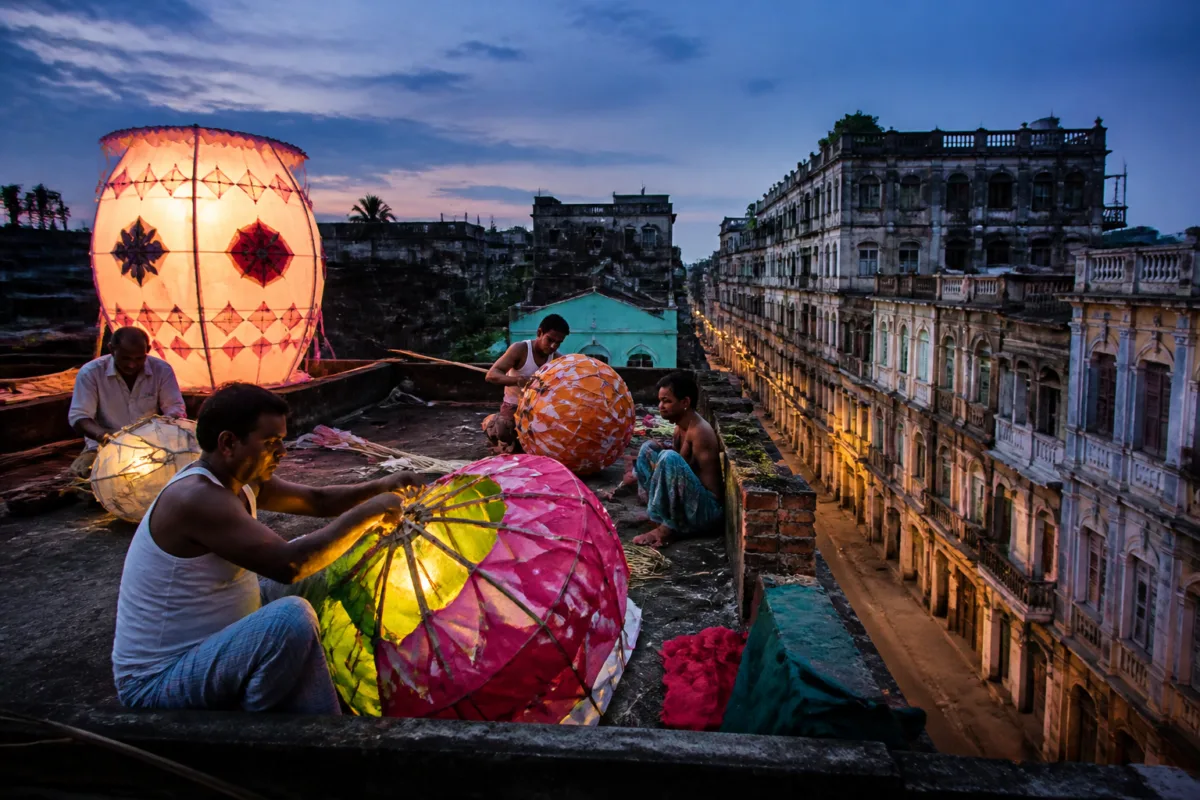
Kolkata’s phanush tradition is facing a problem that is less about the lanterns themselves than about how the city governs practices that sit between culture, public safety and neighbourhood space. Families in north Kolkata have prepared their handmade lanterns for Kali Puja, but say they cannot release them because they have been unable to obtain clear permission from the police and fire departments.
At Bholanath Dham near Scottish Church College, the Dutta family has been making and releasing phanush since 1924. The tradition, started by Maniklal Dutta, is now in its 102nd year. This year, the family prepared 15 handmade lanterns ranging from about five to 15 feet in height. The lanterns are ready, but the family says the release cannot proceed without the required licence.
Ajoy Dutta has approached Lalbazar and was directed to different departments, including the Arms and Ammunition section and the fire department. The family also emailed the police commissioner and the director general of fire services and submitted copies to the local police station. According to the family, officials have not provided a clear route for securing permission. Some officials reportedly said they were unaware of a process for issuing such a licence, while others directed the family back to the police.
The resulting uncertainty exposes an administrative problem common to many urban activities: the requirement for permission may be clear, while responsibility for granting it is not. In this case, the practice involves an open-sky release, combustible materials and a populated neighbourhood. Those factors can reasonably bring several departments into the conversation. But the report indicates that the families have not received a single, intelligible process explaining which authority must decide, what documents are required or what safety conditions must be met.
That gap matters because the phanush is not simply a seasonal product sold in a market. The Duttas say their lanterns are made at home using fuel prepared from jute, cloth and spirit, without paraffin. Their designs have included themes such as the cricket World Cup, the football World Cup and Operation Sindoor. The craft therefore combines household production, local cultural memory and a public display that takes place above densely settled neighbourhoods.
The safety question cannot be dismissed. A large lantern released over a built-up area creates a legitimate need for rules governing materials, launch locations, weather conditions, crowding and the possibility of fire. However, the supplied report does not establish whether the authorities have rejected the releases on safety grounds, imposed new technical conditions or merely announced a licensing requirement without creating an accessible approval mechanism. That distinction is central. A safety framework can reduce risk only when residents know how to comply with it.
The Dutta family’s experience is echoed at Dhar Villa near Hedua. Prodyut Kumar Mallick’s family has released phanush for approximately 60 to 65 years, generally making 10 to 15 lanterns annually. The family produces colourful designs, lattu-shaped forms and topical themes, and considers a Kali phanush essential to its festival programme. Mallick has also written to the local police station, the commissioner and the director general of fire services, but says he has not received clear permission.
The numbers in the report show that this is a small-scale tradition, but not an isolated household event. One family prepared 15 lanterns. Another usually makes 10 to 15 each year. Residents gather on terraces, children watch the lanterns rise and older residents recall a time when the practice was more widespread across old north Kolkata. Its urban footprint is therefore distributed across homes, rooftops and neighbourhood sightlines rather than concentrated in a single officially managed venue.
That distributed character may be one reason the practice falls awkwardly between administrative categories. It is not described as a commercial fair, a formal public event or a conventional fireworks display. Yet it takes place in shared urban airspace and can attract residents to terraces and lanes. The report shows families approaching police and fire officials separately, suggesting that no clearly identified single-window mechanism has been communicated to them.
The problem is also generational. In Belgachhia, 87-year-old Sachin Mukherjee has decided not to release phanush from his family’s five-storeyed home this year. Instead, he plans to hold the programme at Bhadreshwar on November 22. Mukherjee usually releases the lanterns on the Sunday following Jagaddhatri Puja and said this may be his last year making phanush himself. His decision means Belgachhia will miss a display that had become part of its festive calendar.
This detail shifts the issue beyond one year’s festival schedule. A craft tradition depends on practitioners, materials, family knowledge and repeated public practice. When an older maker stops, the city may lose more than a single event. The report does not establish that licensing uncertainty alone will end the tradition, but it does show how unclear permissions can add pressure at a moment when some practitioners are already ageing and considering whether they can continue.
The reported history reaches back roughly 110 years, when Gouri Shankar Dey of Hatkhola-Darjipara is believed to have begun the practice. It later became associated with old north Kolkata’s festive landscape and was described by practitioners as a quieter alternative to loud crackers. The lanterns require balance, patience and timing, making the release the visible end of a longer process of domestic craft work.
The administrative issue, then, is not whether cultural tradition should automatically override safety. The evidence supports a narrower question: can a city protect residents while also giving legitimate community practices a clear and workable regulatory pathway? The answer depends on whether authorities identify the responsible office, publish requirements, assess the activity on consistent safety criteria and communicate the decision before families invest time and materials.
The supplied report records contact with the police commissioner, the director general of fire services, Lalbazar, the Arms and Ammunition section and local police stations. It does not provide an official explanation from any of these authorities about the licensing requirement, the legal basis for it, the number of applications received or the safety standards being applied. Those missing details prevent a conclusion about whether the new requirement is a formal policy change, an enforcement decision or an administrative instruction whose implementation has not yet been clarified.
That uncertainty is significant for urban governance. Rules that affect activities in public-facing neighbourhood spaces must be understandable not only to large organisers but also to households and community groups. A process that requires residents to move between departments can create delay even when the underlying safety objective is legitimate. It can also produce inconsistent outcomes, with some families cancelling, others considering unauthorised releases and still others shifting programmes to different locations.
For north Kolkata, the immediate consequence may be an empty sky over Hedua and Belgachhia during a festival when families have traditionally gathered on terraces. The longer-term question is whether the city can document, regulate and safely accommodate a small but distinctive cultural practice before its remaining practitioners disappear. The evidence currently confirms that families have prepared lanterns, sought permission and encountered uncertainty. It does not yet confirm the final administrative decision or the precise safety rules that will govern future releases.

