


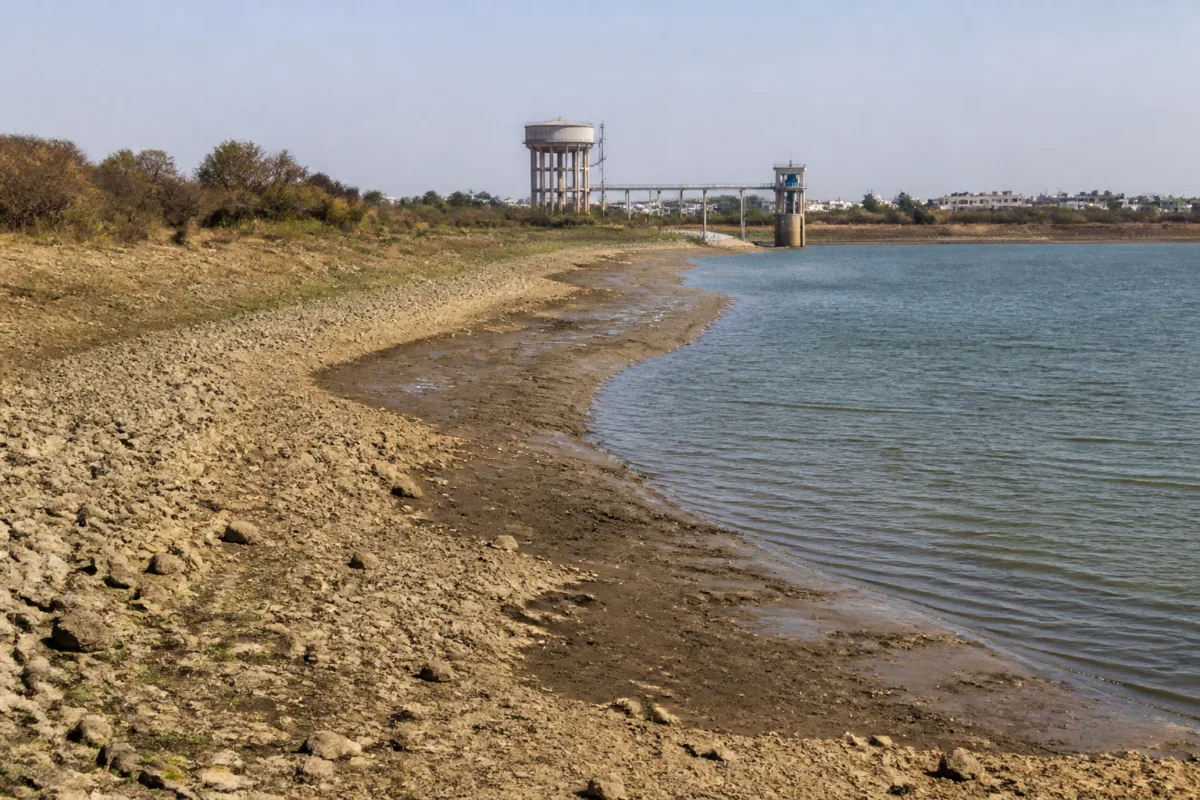
Gujarat’s water crisis is becoming visible not through a single failed reservoir, but through a broad deterioration in storage across the state. A report by Gujarat Samachar – Ahmedabad says water held in 206 reservoirs fell by 5,181.37 million cubic metres compared with November 2025, even as the Sardar Sarovar reservoir recorded a marginal increase. The contrast highlights both the scale of the state’s water stress and the importance of one major reservoir in cushioning it.
According to the report, Gujarat’s 206 reservoirs held 15,284.37 million cubic metres in November 2025. That figure had fallen to 10,103 million cubic metres in the corresponding period of 2026. The decline amounts to roughly one-third of the previous year’s storage. In the state’s 17 major reservoirs, storage dropped from 12,783.78 million cubic metres to 8,840.65 million cubic metres, a reduction of 3,943.13 million cubic metres.
These figures matter because reservoir storage is the bridge between the monsoon and the rest of the year. Once rainfall ends, reservoirs support drinking water supply, irrigation and other uses. A weaker starting position leaves less room to absorb delays in the next rainfall cycle or increased demand during dry months. The supplied report does not provide a statewide urban consumption forecast, but the storage numbers establish that the buffer available to the state is substantially smaller than it was a year earlier.
The rainfall comparison explains part of the change. Gujarat recorded 811.96 millimetres of rain in 2026 up to November, or 89.34 per cent of the average, compared with 1,061.80 millimetres, or 119.13 per cent of the average, during the same period in 2025. Rainfall was therefore 249.84 millimetres lower, while the share of the average fell by 29.79 percentage points. The report attributes the weaker monsoon to the impact of El Niño. That attribution is presented by the source and is not independently assessed in the supplied material.
The distribution of storage is as important as the total. In November 2025, 151 reservoirs reportedly held more than 90 per cent of their capacity. In 2026, that number had fallen to 35. At the other end of the scale, reservoirs holding less than 70 per cent of capacity increased from 30 to 147. This is not merely a decline in the statewide total; it is a shift in the number of reservoirs operating with a reduced cushion.
That unevenness is particularly important for a state in which water availability varies considerably between districts. The report identifies Devbhoomi Dwarka, Porbandar, Jamnagar and Kutch as the districts where rainfall conditions were especially poor. It says drought was declared in these four districts after the low rainfall created drought-like conditions, and attributes the declaration to Chief Minister Bhupendra Patel. The reported impact is expected to be felt directly in agriculture and water availability.
For cities and towns, the condition of individual reservoirs can be more consequential than a statewide average. The report uses Ajwa Lake to illustrate this point. In 2025, after strong rainfall, Ajwa’s level reached 212.95 feet in September, and all 62 gates were opened as inflows increased. In 2026, the lake did not reach a comparable danger level even once. Its level was reported at 208.57 feet on the morning of the report, a level the source says is normally seen around February.
Ajwa’s example shows how a reservoir can move into a late-season stress position before the calendar reaches the months usually associated with scarcity. The supplied material does not state how long the present storage will last, what restrictions may follow, or whether municipal supply schedules have changed. It does, however, indicate that the timing of water stress is moving earlier in at least one important local water system.
The Sardar Sarovar reservoir provides the principal counterpoint. Its storage was reported at 9,369.82 million cubic metres in November 2025 and 9,440.68 million cubic metres in 2026, an increase of 70.86 million cubic metres. While that rise is modest relative to the decline recorded across the wider reservoir network, it gives Gujarat a major source of relief at a time when many other reservoirs are carrying less water.
This concentration of relief also reveals an institutional vulnerability. A strong position in one major reservoir can soften the effect of weak storage elsewhere, but it does not erase local distribution problems. The report does not provide details of the state’s allocation rules, inter-reservoir transfers, municipal supply arrangements or irrigation priorities. Without those details, it is not possible to determine how far Sardar Sarovar’s additional storage can compensate for depleted reservoirs in other regions.
The state’s water system is therefore facing two connected questions. The first is quantitative: how much water remains in storage compared with the previous year? The second is administrative: how will that water be distributed among districts, cities, agriculture and other users if the next rainfall cycle is also weak? The available figures answer the first question clearly but do not establish the state’s response to the second.
The report also places Gujarat’s current position in a wider cycle of volatility. A wet year in 2025 produced high reservoir levels in several locations, including Ajwa, while a weaker 2026 monsoon left most reservoirs in a poorer position. The movement from 151 reservoirs above 90 per cent capacity to only 35 in one year demonstrates how quickly storage conditions can change. It also shows why a single year’s water abundance cannot be treated as a permanent improvement in water security.
For urban administrations, the immediate significance is the need to read reservoir data as an operating signal rather than only as a seasonal statistic. Lower storage can affect the margin available for maintaining regular supply, especially in locations that depend on specific local reservoirs. Yet the supplied report does not document any new municipal measures, rationing decisions, emergency works or formal urban water-management plan. Those remain matters for further reporting and verification.
The evidence currently supports a clear conclusion: Gujarat entered the post-monsoon period of 2026 with considerably less water stored across its reservoir network than it had a year earlier. The Sardar Sarovar reservoir is providing some relief, but the sharp fall in storage elsewhere, the increase in reservoirs below 70 per cent capacity and the early-season weakness reported at Ajwa indicate a more distributed water-security problem. The developments that warrant monitoring are district-level supply decisions, agricultural impacts, reservoir levels through the dry months and the state’s next formal assessment of water availability.

