


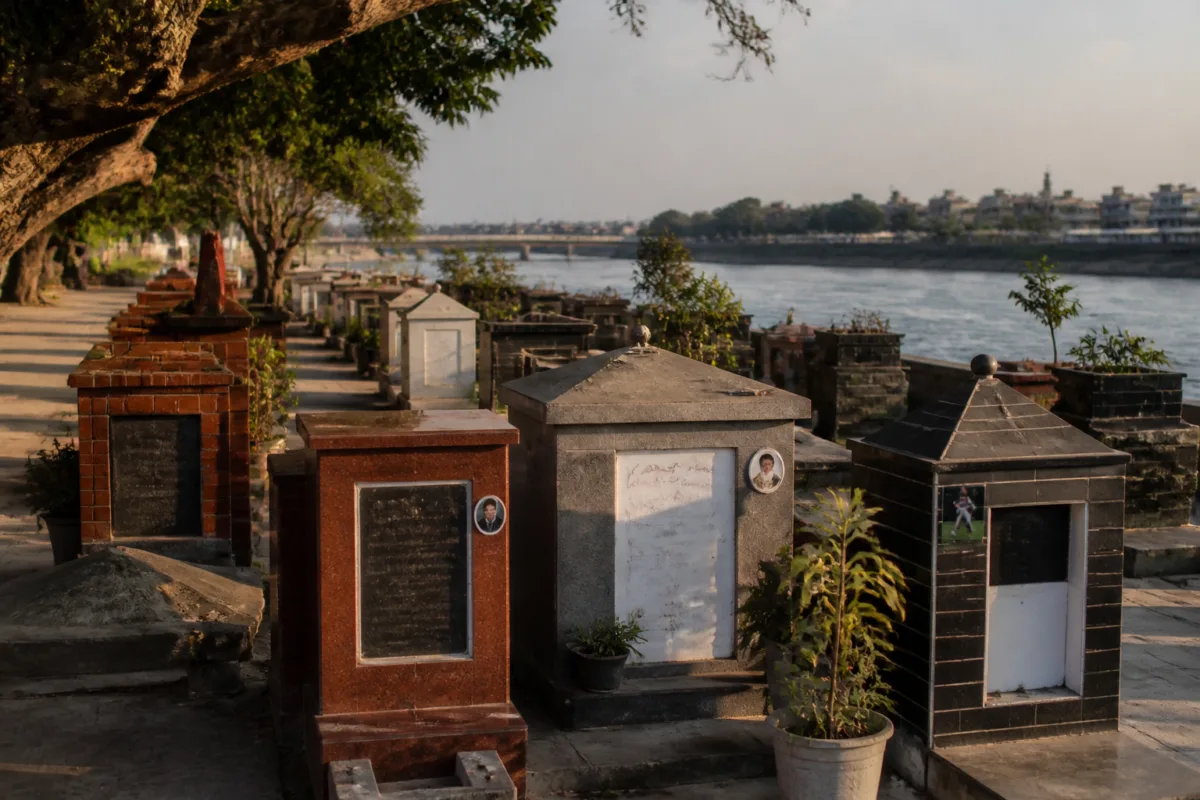
Ahmedabad’s Hansol crematorium is more than a place for funeral rites. Along the Sabarmati river, the Chhara community has created an estimated 1,500 or more small memorial structures, known as deris, where poems, shayari and symbols of personal identity preserve the memory of those who have died. The tradition offers a rare view of how an urban community uses a crematorium not only to mark death, but also to retain family histories in a rapidly changing city.
The memorials stand on the road connecting Hansol and Noblenagar, according to a report by Gujarat Samachar – Ahmedabad. Their plaques contain verses about mothers, family attachment and loss. Some are intensely personal. One inscription describes a mother as a figure who sacrifices her life for her children, while another says that a home feels empty when a mother is absent. These words transform the site from a collection of funeral structures into a public record of private grief.
That distinction matters because cities often treat crematoriums as essential but largely invisible infrastructure. They are planned and used for a specific civic function, yet the emotional, cultural and spatial practices that develop around them are rarely part of mainstream conversations about urban land. Hansol’s deris show that such places can also operate as community archives, where families preserve relationships and memories in a physical form.
The reported tradition belongs to the Chhara community and has continued for years. Families visit the memorials during festivals and special occasions, particularly on Diwali. They light lamps, conduct prayers and gather to remember relatives. The practice gives the crematorium a recurring community role beyond the moment of cremation. It also creates a visible connection between the living and the dead, with families returning to a specific place rather than retaining memory only within the home.
The memorials do not record people only through formal names and dates. They also preserve personality. The report cites the example of a young man named Meet, whose memorial carries a cricket sticker and a poem written by his father. The verse describes cricket as Meet’s identity and says that although his life’s match has ended, he will always remain the man of the match. The sticker and the words together represent a form of memorialisation built around an individual’s interest rather than a standard religious or administrative format.
This is the central urban significance of Hansol: the site gives physical space to ordinary lives. The memorials do not commemorate public figures, civic achievements or historic events. They remember family members through affection, habits and shared experiences. A cricket sticker, a line about a mother or a verse written by a parent becomes part of the landscape. In that sense, the crematorium functions as a community-made memory space within the city.
The evidence supplied in the report also points to pressure on this tradition. Riverfront development, limited space within the crematorium and reduced interest among younger generations are cited as reasons why fewer new deris are now being created. The report does not provide a project notification, land measurement, relocation plan or official statement from the agencies responsible for the area. It therefore establishes the existence of these pressures as reported observations, but not the precise extent of their impact or the administrative decisions behind them.
That limitation is important. Urban development can affect memorial practices in several ways, but the Hansol report does not specify whether existing deris have been removed, whether access has changed, or whether new construction has been formally restricted. It also does not identify the authority responsible for managing the crematorium or explain how riverfront works have altered the site. What is clear from the supplied account is that the community sees the physical setting as increasingly constrained and that the creation of new memorials has declined.
The issue is therefore not simply whether a distinctive tradition survives. It is also about who gets to shape the meaning of urban land. A crematorium may be classified primarily as a service facility, but for the families who return to Hansol, it is also a place of ritual, remembrance and collective identity. If planning recognises only the first function, the other uses can be weakened without being formally discussed.
This challenge is common to many forms of informal or community-created heritage, even though the Hansol report does not compare the site with other locations. Such heritage may not have a protected structure, an official plaque or a formal conservation plan. Its value lies in repeated use and shared memory. The 1,500-plus deris reported at Hansol indicate the scale of that collective investment, but the material supplied does not establish when they were built, how many remain intact or whether they are documented in any municipal record.
The site also raises questions about generational continuity. The report says that younger people show less interest in the tradition, but it does not include interviews with young residents or families explaining why. The reason could be changing preferences, mobility, limited space, or a shift in the way families remember the dead; the available evidence does not allow those possibilities to be separated. What can be stated is that the practice depends on both physical room and a willingness to maintain it, and the report identifies pressure on both fronts.
The Diwali visits show why the memorials cannot be understood as abandoned structures. Families return, light lamps and pray. These activities give the site a continuing social life. The memorials are not only markers of past deaths; they remain part of the present-day calendar of the community. Their significance comes from the combination of built form, written language, family ritual and repeated visitation.
For urban administration, this creates a practical question about the treatment of culturally specific spaces. The supplied report does not describe any formal policy for Hansol’s deris, nor does it mention consultation with the Chhara community. It also does not establish whether any preservation or documentation exercise is under way. Those gaps matter because the decline of a tradition can occur gradually, through small changes in access, space and maintenance, without a single dramatic event.
The numbers available are limited but still revealing. The report places the number of deris at more than 1,500 and identifies the site as being along the Sabarmati river, near the Hansol-Noblenagar route. It also identifies a recurring annual practice during Diwali and a decline in the number of new memorials. These facts provide a basic picture of scale, location and continuity, while leaving unanswered questions about the site’s total area, ownership, maintenance, visitor numbers and future land-use plans.
Hansol’s memorials show that the built environment carries meanings that are not always visible in development plans. A riverfront, a road or a crematorium can appear to be a question of land use and infrastructure, but the same space may also hold the emotional geography of a community. The deris make that geography legible through words and symbols: a mother’s memory, a family’s grief and a young man’s love of cricket.
The evidence confirms that Hansol crematorium has become a distinctive community memorial landscape, with more than 1,500 reported deris and rituals that continue during Diwali. It also indicates that riverfront development, space constraints and changing generational interest are reducing the creation of new memorials. What remains unclear is the formal planning and management position on the site. Any future account of Hansol will need to establish how the crematorium is administered, what development has changed and whether the community’s memorial tradition has been documented or consulted on.

