


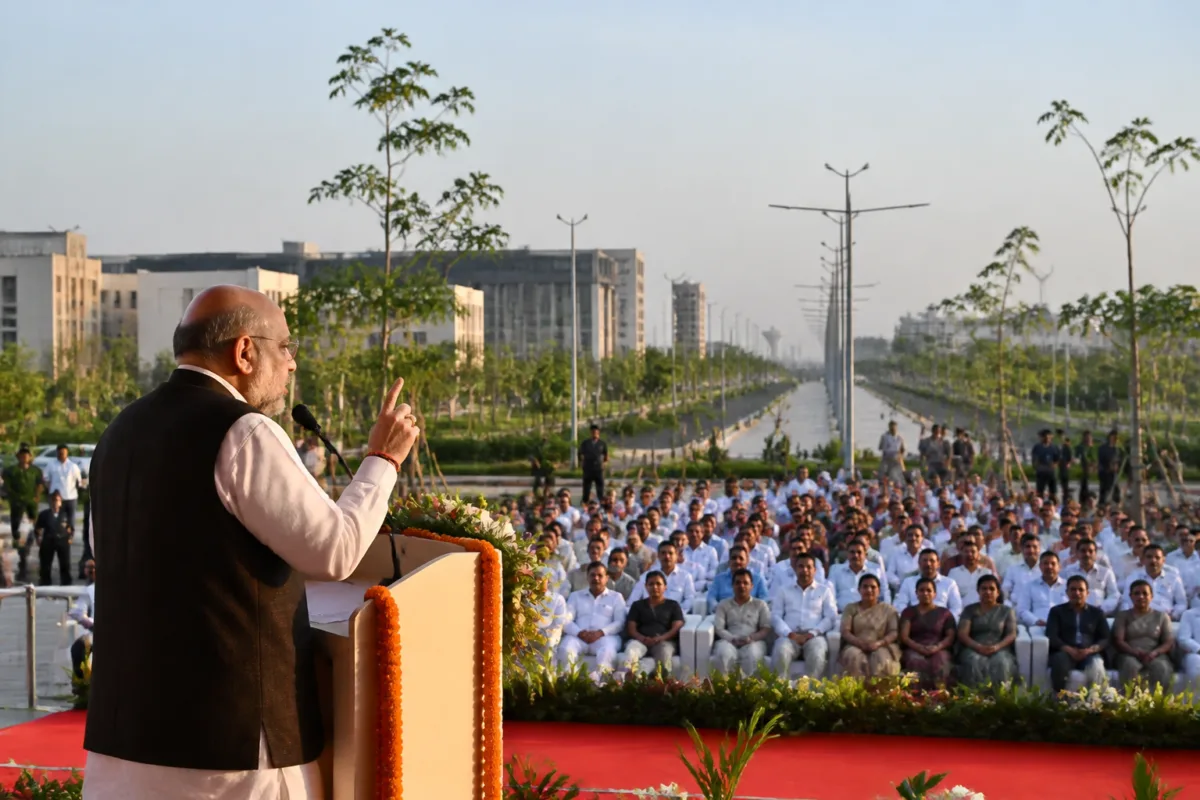
Union home minister Amit Shah has said 90% of people who left the Maoist movement surrendered while 10% were killed in security operations, linking the decline of armed insurgency in Chhattisgarh to renewed development activity in tribal regions. Shah made the claims at the concluding ceremony of Chhattisgarh Rajyotsav in Nava Raipur, while also announcing new plantation and tourism initiatives for the state.
The figures were presented by Shah during a defence of the Centre’s campaign against Maoist insurgency. He did not specify the period covered by the claim or the total number of people to whom it referred. According to the report, he said the government’s policy had been to welcome those who surrendered their weapons and sought to return to mainstream life, while security forces would act against those continuing armed violence.
Shah also directed his criticism at human rights campaigners, asking why concerns about armed Maoists were not accompanied by equal attention to tribal civilians affected by prolonged violence. He described Bastar as a region where landmines, attacks on road workers, destroyed schools and forced recruitment had disrupted basic public services and development.
The home minister said the decline in violence had created conditions for a new phase of growth in the state. He referred to government assistance for people who lost limbs in improvised explosive device blasts, including the provision of artificial limbs. He also invited commentators who had written about human rights to visit Bastar and observe the changes taking place there.
The speech included attacks on previous Congress-led governments and former Union home minister P Chidambaram over their approach to negotiations with Maoists. Shah said the present government had insisted that those seeking to join the mainstream must first lay down their weapons. He also accused Maoists of operating parallel administrative structures, described as Janatana Sarkar, in areas under their influence.
Shah’s comments placed roads, schools and local administration at the centre of the security-to-development transition. His remarks suggested that infrastructure construction in Bastar had previously been constrained by attacks on workers and explosive devices, although the speech did not provide project-wise figures or an independent assessment of completed works. The report also did not include a response from Congress or human rights organisations to his allegations.
The event extended beyond security policy. Shah said Chhattisgarh could become one of India’s top three tourism destinations, citing Chitrakote and Tirathgarh waterfalls, Kanger Valley National Park, the Maa Bamleshwari and Maa Danteshwari temples, and Bastar Dussehra. He also mentioned Bastar Pandum and Bastar Olympics as initiatives intended to promote tribal traditions and participation among young people.
In Nava Raipur, Shah inaugurated the Viksit Bharat Sankalp Park at Peepal Van. He said 2,500 saplings had already been planted at the site and announced a plan to plant five lakh peepal trees across Nava Raipur, with the stated aim of developing the city as a Peepal City and an environmentally friendly urban centre. The report did not specify the project’s land area, funding, planting schedule or maintenance arrangements.
Shah further claimed that Chhattisgarh’s gross state domestic product had increased 25-fold since the state’s formation, per capita income had risen 17 times and literacy had improved from 55% to around 80%. He also referred to an increase of about 30% in the annual budget, without identifying the comparison period. During the ceremony, he released the 33rd instalment of the Mahtari Vandan Yojana, which provides financial assistance to eligible women.
The next phase of the state’s development will now be tied by the government to the consolidation of security gains, the expansion of roads and public services in Bastar, and the implementation of tourism and plantation plans announced in Nava Raipur. The specific timelines and monitoring arrangements for the five-lakh-tree initiative and other development commitments were not detailed in the report.

