


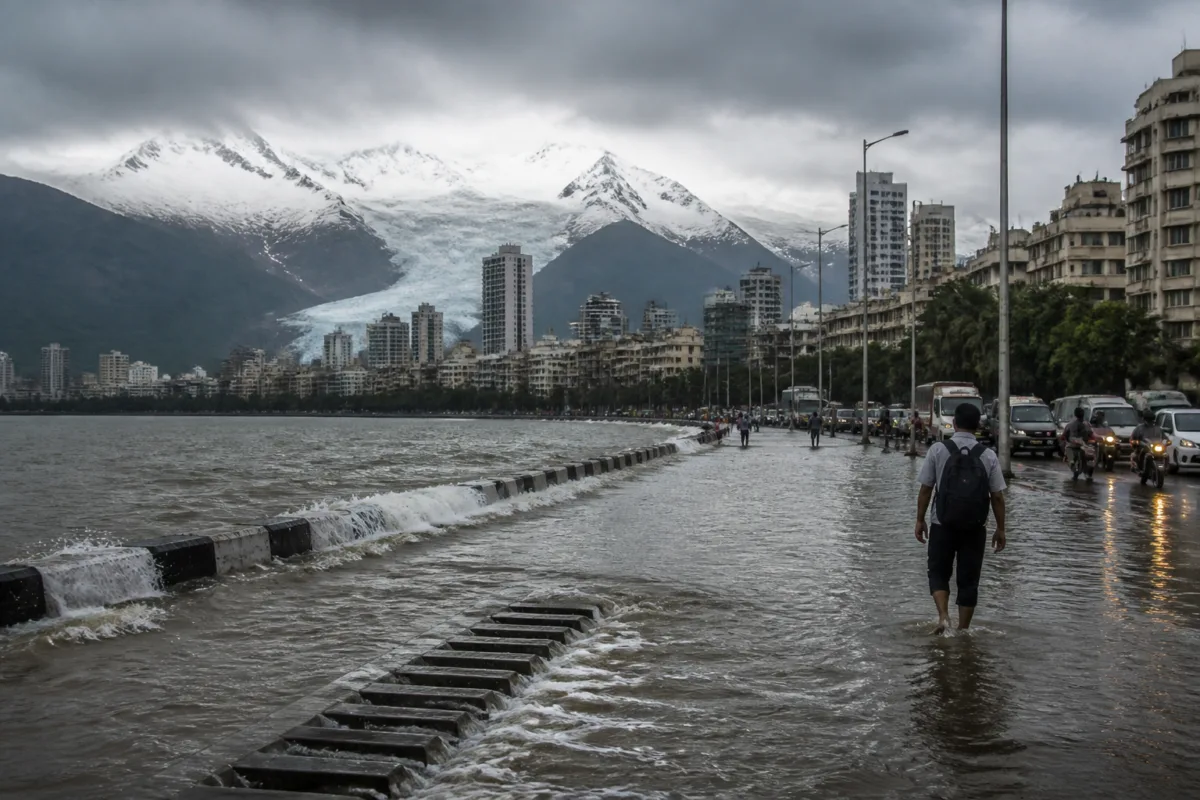
The International Cryosphere Climate Initiative’s 2026 report says the world is likely to cross the 1.5°C global warming threshold, shifting the climate debate from whether the limit can be avoided to how high warming rises and how long it remains above it. For cities, the warning is not only about hotter days. It is about rising seas, unstable water supplies, shrinking natural defences and infrastructure designed for a climate that is disappearing.
The report, titled “State of the Cryosphere 2026, The Cost of Overshoot”, focuses on the frozen parts of the Earth: the Greenland and Antarctic ice sheets, mountain glaciers, snow, sea ice, permafrost and cold polar oceans. These systems may appear distant from most urban residents, but they influence the conditions under which coastal settlements, river basins and mountain-dependent communities function.
The central concept is overshoot. Under the 2015 Paris Agreement, countries committed to holding global warming well below 2°C above pre-industrial levels while pursuing efforts to limit it to 1.5°C. The supplied report explains that the planet is already about 1.4°C warmer than the pre-industrial period and says the world will pass 1.5°C. The threshold is a global average across oceans, deserts, ice and cities; a seemingly small change in that average can produce much larger shifts in particular places.
That distinction matters for urban planning. A global temperature average does not translate into one uniform experience. It can mean longer heatwaves in cities, heavier rainfall in some locations, pressure on water systems and increased exposure to coastal flooding elsewhere. The report’s analysis places ice at the centre of this chain because its loss affects sea levels, freshwater storage, solar reflection and the release of carbon from thawing frozen ground.
The report outlines two broad overshoot pathways. In a limited overshoot scenario, ambitious efforts to reach net-zero emissions by the middle of the century, followed by the removal of carbon dioxide from the atmosphere, could see warming peak at about 1.7°C before returning below 1.5°C by 2100. If that effort does not occur, the report says warming could peak at about 3°C, with the world not returning below 1.5°C until around 2250.
Those pathways are not interchangeable from an infrastructure perspective. A return to a lower air-temperature average would not immediately restore the ice systems already lost. The report says glaciers that disappear do not return within a human lifetime, while the major ice sheets respond over centuries. It also says that even if temperatures return to 1.5°C, substantial ice loss is already committed and sea levels will continue rising for centuries.
This creates a difficult planning problem for cities. Infrastructure has long operating lives, while climate conditions can change faster than roads, drainage systems, coastal protections, water networks and buildings can be replaced. Decisions made today therefore have to account for risks that may extend well beyond a project’s construction period. The supplied report does not set out a city-by-city adaptation plan, but its findings show why short-term weather records alone cannot capture the full planning challenge.
Sea-level rise is the clearest urban connection. The report says that around one billion people live within 10 metres of current sea level, including an estimated 230 million within one metre. It states that Greenland is losing ice about five times faster than in the 1990s, while Antarctica’s contribution to sea-level rise is about six times greater than 30 years ago. Together, the two ice sheets lost more than 11 trillion tonnes of ice between 1979 and 2023, adding more than 3 centimetres to global sea level.
At present, sea level is rising by about 0.45 centimetres a year, according to the report. Under high overshoot, instability in the ice sheets could push that rate as high as 5 centimetres a year by 2150. The report places the limit for many natural defences, including mangroves and salt marshes, at about 0.7 centimetres a year. The comparison points to a structural vulnerability: natural coastal systems can provide protection, but their ability to keep pace with accelerating sea-level rise is not unlimited.
For coastal cities, the issue is therefore larger than the height of a seawall. Ports, roads, rail lines, drainage networks, housing and public utilities are connected systems. A rise in the background sea level can reduce the safety margin available during storms or high tides, while the loss of mangroves and salt marshes can remove natural buffers. The supplied report does not quantify the exposure of individual Indian cities, but its global figures establish the scale of the population and infrastructure challenge facing low-lying settlements.
The other major urban connection runs through mountain water systems. Between 2000 and 2023, glaciers outside Greenland and Antarctica lost an average of 273 gigatonnes of ice a year, with the loss rate 36% higher in the second half of that period than in the first. The report says at least three billion people depend seasonally on a healthy mountain cryosphere.
That dependence is especially relevant to the Hindu Kush Himalaya. The report says the region could lose about one-third of its ice at a stable 1.5°C level of warming and at least two-thirds at 3°C. Mountain ice functions as seasonal water storage. Its decline can therefore affect not just mountain settlements but also downstream towns and cities whose water systems, agriculture and economies depend on river flows.
The report also says that even stable warming at 1.5°C would threaten more than half of the world’s glaciers, measured by number, with extinction. It estimates that capping warming at 1.5°C could preserve almost half of today’s glaciers by 2100, compared with about one-fifth at 2.7°C and less than one-tenth at 4°C. These figures show why each additional fraction of a degree changes the infrastructure and water-planning problem rather than simply adding to an already fixed risk.
The policy challenge has two linked parts. The first is emissions reduction: the report’s limited-overshoot pathway depends on reaching net-zero emissions by mid-century and subsequently removing carbon dioxide from the atmosphere. The second is adaptation to changes that are already underway. The report says large amounts of irreversible ice loss are committed at today’s warming of about 1.4°C, meaning that mitigation cannot eliminate the need for coastal, water and disaster-resilience planning.
This combination complicates the responsibilities of urban institutions. Municipal bodies typically manage local drainage, roads, land-use decisions and public services, while larger questions involving emissions, river basins, coastal regulation and national climate policy sit across multiple levels of government. The cryosphere report does not propose a specific administrative model, but its evidence reinforces the need to connect climate policy with everyday infrastructure decisions.
It also challenges the way urban risk is measured. A city may appear protected when its current flood defences cope with existing conditions, yet the same system may become inadequate as sea-level rise accelerates. A water network may function under present seasonal flows but face greater stress as glaciers shrink. The time horizons of ice sheets and glaciers are much longer than election cycles, annual budgets or typical infrastructure project timelines, creating a gap between the pace of environmental change and the pace of public decision-making.
The report’s most important message for cities is that returning below 1.5°C, even if achieved, would not restore all the conditions that existed before overshoot. Air temperatures can respond relatively quickly when atmospheric carbon falls, but ice loss and sea-level rise continue on much longer timescales. That makes the duration of overshoot as important as the peak temperature reached.
The evidence supplied with the report confirms three connected pressures: coastal populations face a rising baseline of sea levels, mountain-dependent regions face the loss of seasonal water storage, and natural systems that protect settlements have physical limits. What remains uncertain in the supplied material is how these global findings will translate into specific risks for individual cities and infrastructure systems. Those local assessments, along with the speed of emissions reduction and the future stability of the major ice sheets, will determine how much room urban planners have to respond.

