


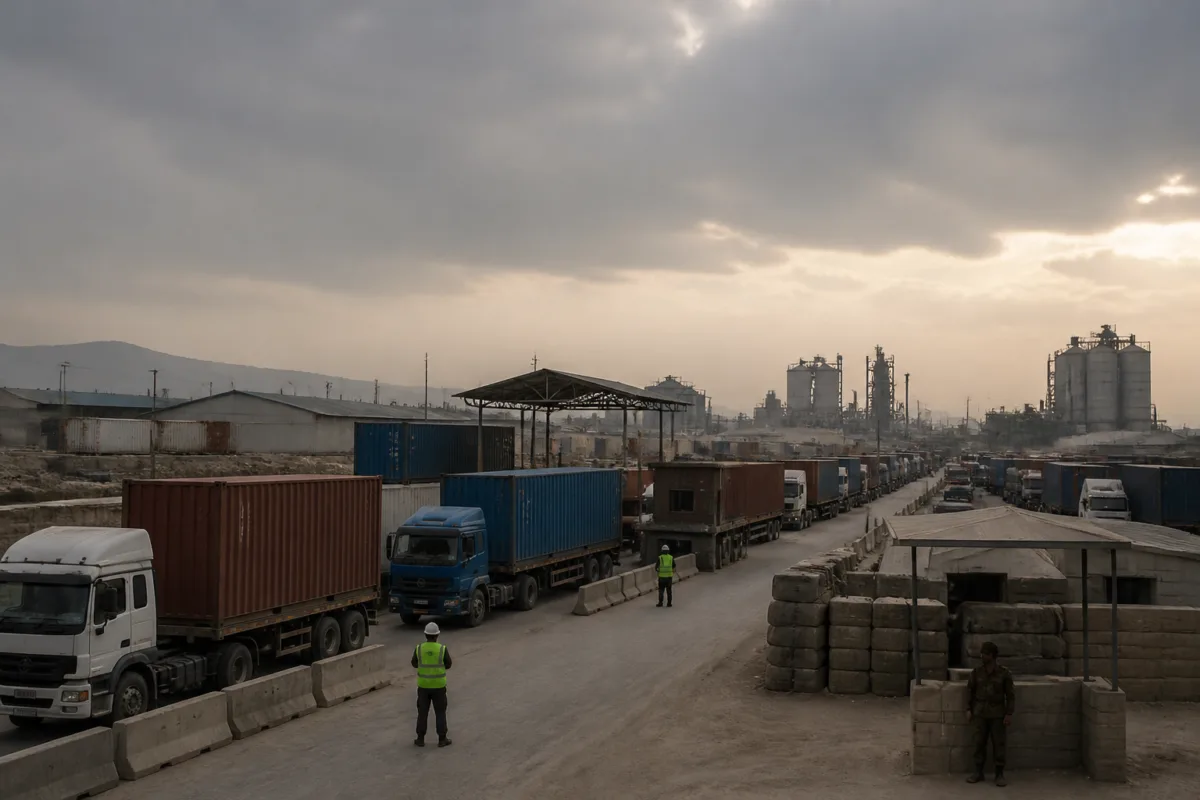
Pakistan’s reported $40 billion economic loss since trade with India was suspended in 2019 is more than a bilateral commerce dispute. It shows how political restrictions can reshape the cost, distance and reliability of industrial supply chains, forcing manufacturers to source essential inputs from markets that are farther away and potentially more expensive.
The estimate has been cited by Pakistan’s business representatives, who are now urging the Shehbaz Sharif government to restore commercial relations with India. According to the report, Pakistan-India trade was halted after the Pulwama terror attack and the subsequent rise in tensions between the two countries. The business community says the prolonged disruption has increased import costs, extended delivery timelines and placed pressure on domestic industries.
The claim comes from a business advocacy group and was reported by Aaj Tak Business, citing PTI. Noor Muhammad Kasuri, identified as the council’s chairman, said Pakistani companies have had to purchase raw materials and industrial products from distant countries. That shift has raised freight expenses and lengthened the time required to receive supplies. The report does not provide an independent calculation of the total $40 billion loss, so the figure remains an attributed estimate rather than an established national-account measure.
The wider significance lies in the geography of production. India and Pakistan share a land border, but the suspension of trade has pushed Pakistani firms towards suppliers in countries such as Brazil, Egypt, China and the United States. For commodities with high transport costs or time-sensitive delivery requirements, replacing a nearby supplier with a distant one can affect not only the price of imports but also inventory planning, working capital and production continuity.
That effect is especially visible in pharmaceuticals. Kasuri said Pakistani pharmaceutical companies could save about $3 billion annually if access to Indian raw materials were restored. The report does not specify the precise products, quantities or calculation method behind that estimate. It does, however, identify the mechanism: access to Indian inputs could reduce production costs and improve supply-chain efficiency for drug manufacturers.
This matters because pharmaceutical production depends on the predictable availability of active ingredients, chemical inputs, packaging materials and other industrial supplies. When inputs must travel longer distances, manufacturers face greater exposure to freight charges and delivery delays. The supplied report establishes the business community’s claim about these pressures but does not provide data on factory closures, medicine prices, shortages or changes in production volumes. Those outcomes therefore cannot be inferred from the $3 billion estimate alone.
Textiles provide another example of how a trade restriction can spread through an industrial ecosystem. Pakistan’s textile sector has reportedly faced an additional burden of about $5 billion after importing cotton from Brazil, Egypt, China and the United States. Kasuri linked this cost to declining domestic cotton production and increased dependence on imports. The report does not state whether the $5 billion refers solely to freight and procurement costs or includes wider effects such as price differences, production losses and financing costs.
The distinction is important. A country may continue to obtain a commodity from alternative suppliers while still losing competitiveness because the replacement supply is slower or more expensive. For textile mills, cotton availability affects spinning, weaving, garment production and export schedules. The reported burden therefore points to a supply-chain problem extending beyond one transaction between two countries, although the supplied material does not quantify the impact on employment, exports or individual firms.
The list of affected goods also includes sugar, fertiliser, cement, petroleum products, iron and steel, vegetables and heavy machinery. These are not confined to a single industrial sector. Fertiliser and agricultural products influence food supply chains; petroleum affects transport and manufacturing; iron, steel, cement and heavy machinery are basic inputs for construction, infrastructure and industrial expansion.
That gives the issue a built-environment dimension. Construction costs are shaped not only by land, labour and finance but also by the availability and delivered price of materials such as cement, steel, fuel and machinery. The report does not claim that Pakistan’s building sector has suffered a quantified loss because of the trade suspension. It does indicate that business representatives see restricted access to geographically close industrial suppliers as a reason for higher input costs across several sectors.
The logic advanced by Pakistan’s business community is based on proximity. Kasuri said India’s geographical closeness could make it a cheaper supplier for goods where transportation accounts for a significant share of the final cost. He specifically cited petroleum delivery, arguing that Indian refineries are closer to Pakistan than several existing international suppliers. The report provides no route-level freight comparison or transaction data, but the argument highlights the role of distance in determining whether a nominally available product is commercially viable.
For urban economies, supply-chain distance is a structural variable. Manufacturers, wholesalers and construction companies depend on predictable flows of materials into cities and industrial centres. When sourcing routes become longer, businesses may need more storage, larger inventories and greater financial protection against delays. These costs can eventually pass through to manufacturers, contractors and consumers. The supplied report does not measure that pass-through in Pakistan, but it identifies the industrial inputs and sectors where the business community believes the pressure is concentrated.
The political decision to suspend trade also demonstrates that commercial connectivity depends on institutions beyond the market. Even when companies on both sides may have economic reasons to trade, formal restrictions, security concerns and diplomatic tensions can interrupt established supply chains. Businesses then have to reorganise procurement around the available regulatory environment rather than the most geographically efficient option.
The report does not describe any government decision to reopen trade, nor does it identify a formal negotiation, policy notification or implementation timetable. The immediate development is a demand from Pakistani industry representatives for broad economic cooperation with India. Their request covers pharmaceuticals, textiles, agriculture and petroleum, alongside industrial and construction-related goods.
The economic estimates should consequently be read as advocacy claims that explain what Pakistani businesses want the government to consider. The reported $40 billion figure, the $3 billion annual pharmaceutical saving and the $5 billion textile burden require access to the underlying methodology before they can be treated as independently verified measures. The article does not provide a breakdown by year, product category, company or national-account indicator.
Even with those limitations, the reported claims reveal the central policy tension. Restricting trade may serve immediate strategic or political objectives, but it can also force domestic industry to replace nearby supply with costlier and slower alternatives. The longer such a disruption continues, the more businesses may redesign contracts, procurement networks and production plans around those alternatives.
The larger urban question is how much economic resilience depends on the ability of cities and industrial regions to access affordable inputs. A pharmaceutical cluster, textile centre, refinery-linked market or construction economy is not sustained by local production alone. It also relies on transport links, border procedures, energy supplies, material markets and predictable trade rules. When one of those connections is removed, the consequences can appear as higher costs across several sectors rather than as a single visible infrastructure failure.
For now, the supplied evidence confirms a renewed appeal from Pakistan’s business community and identifies the sectors it says have been affected by the India trade suspension. It does not establish that trade will resume, quantify the independent national loss or show how the claimed costs have been distributed among firms and consumers. The developments to monitor are any formal government response, the publication of supporting calculations and evidence of whether commercial ties are restored in specific sectors or remain suspended across the board.

