


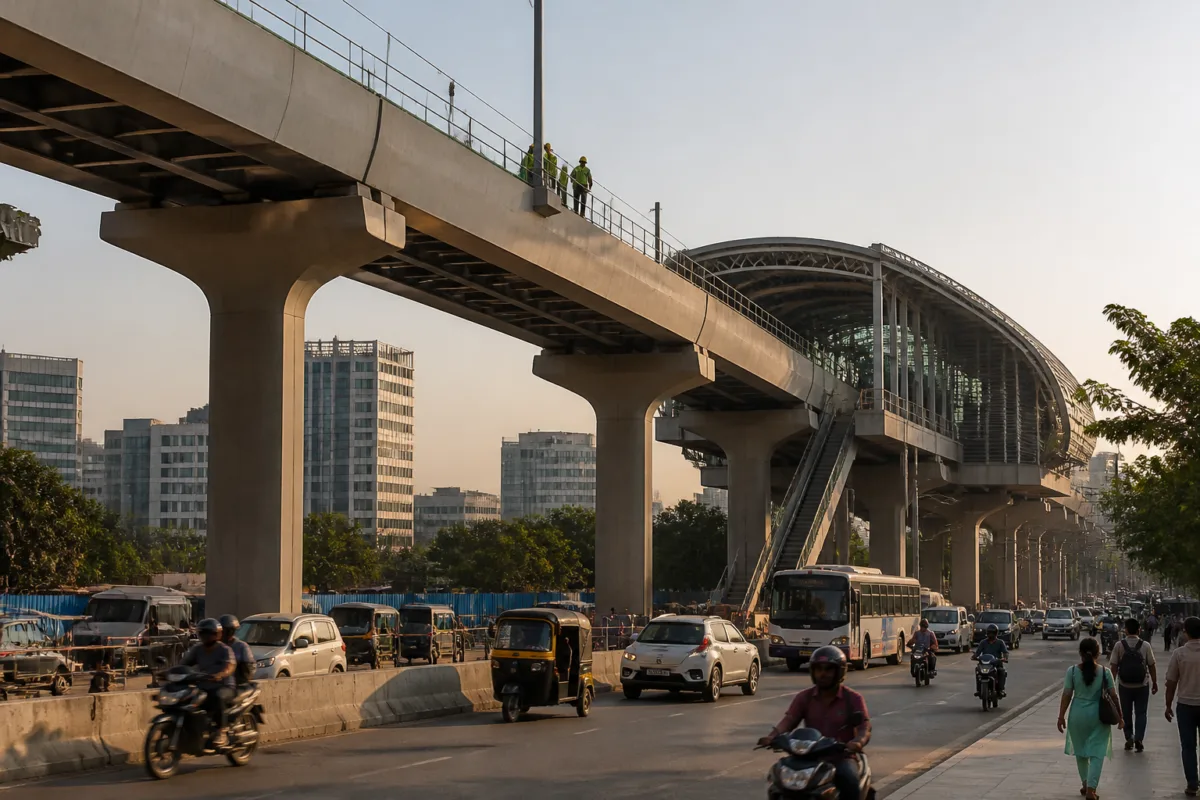
Pune Metro Line 3 is finally scheduled to open after six missed inauguration milestones, but the uncertainty surrounding its launch has exposed a deeper problem in urban infrastructure delivery: a project can be technically close to operation while still remaining administratively dependent on land, approvals, unfinished stations, safety certification and the availability of a high-profile inauguration. The Hinjewadi-Shivajinagar corridor is scheduled for inauguration on 3 November 2026, with passenger services expected to begin the following day.
The latest account, published by Civic Mirror – Pune, is based on remarks made by Pune District Collector Jitendra Dudi during a meeting with residents and citizens from the Hinjewadi area on 2 November. Dudi reportedly said that considerable effort had gone into ensuring that the inauguration took place on 3 November, while declining to disclose further details. He also indicated that the opening had remained uncertain until the final stage and that the prevailing expectation had been that it would take place only after Diwali.
That account is significant because the corridor had already moved through several proposed launch dates. According to the report, the project was originally expected to be completed by March 2025. Proposed inauguration milestones in March, September and December 2025, followed by March, May and 15 June 2026, were not achieved. A further assurance of starting services in July also did not materialise. The 15 July proposal was reportedly deferred because safety certificates and some works were still incomplete, while a target for the first half of September was also missed.
The result was not simply a delay in opening a transport line. Each revised date created a new public expectation for a corridor intended to connect Hinjewadi, Pune’s major information-technology hub, with Shivajinagar. The report describes growing confusion and resentment among residents as the dates changed. For commuters and employees, the uncertainty affected the credibility of a project that has been presented as an important response to traffic congestion and the daily difficulties faced by workers travelling to and from the IT district.
The project’s immediate operational position is more limited than the full corridor’s promise. The report states that passenger services are expected to begin from 17 of the line’s 23 stations. It also says that four or five important stations between Balewadi and Shivajinagar had still been incomplete shortly before the inauguration. This distinction matters: an inauguration date can be fixed even when the complete network, all stations or every associated facility is not yet ready for public use.
### A project caught between construction and ceremony
The repeated postponements point to several layers of project readiness rather than one isolated failure. Civic Mirror attributes the delays to land acquisition, permissions, possession of sites and incomplete station works. Safety certification also affected the proposed July opening. These are different administrative and technical processes, involving different responsibilities and timelines, but they converge at the point at which a line is allowed to carry passengers.
The report also links the final uncertainty to the scheduling of Prime Minister Narendra Modi’s proposed visit to Baramati. The visit was reportedly cancelled 10 to 12 days before it was due to take place, disrupting the earlier plan under which the metro inauguration was expected to be held during the visit. This left the Prime Minister’s Office and local administration facing a fresh scheduling problem, according to the report.
That sequence shows how public infrastructure can become tied to two parallel calendars. One is the delivery calendar: construction, land access, permissions, testing and safety approvals. The other is the political and ceremonial calendar: the availability of senior leaders and the planning of public events. When the second calendar changes, the public announcement may move even if the physical project remains at the same stage. In Pune’s case, the collector’s remarks suggest that the two calendars remained closely connected until the last moment.
The report says the Pune district administration and the Prime Minister’s Office maintained continuous coordination and follow-up before the 3 November date was finalised. The administrative effort described by the collector therefore concerned not only the project’s physical completion but also the alignment of multiple institutions. The available account does not establish which agency was responsible for each unresolved item, or whether all 23 stations will open on the same timetable. It does establish that the launch depended on coordination extending beyond the implementing authority.
### Why the missed dates matter
The six missed milestones provide a measurable record of the project’s uncertain delivery. They span March 2025 to June 2026 and were followed by further postponements in July and September. Although the supplied report does not provide the project’s total cost, construction length or detailed work schedules, the sequence of dates reveals a sustained gap between expected completion and actual readiness.
The gap is especially important for a mass-transit project because its value is not created by a single structure. A metro line must function as a chain: land must be available, stations must be usable, safety requirements must be met, access routes must work and passengers must be able to rely on a published service. If one part of that chain remains incomplete, the opening may have to be restricted or postponed. The stated plan to begin operations from 17 of 23 stations illustrates how readiness can be partial rather than all-or-nothing.
For Hinjewadi, the urban stakes are substantial even though the supplied material does not quantify current traffic volumes or expected passenger numbers. The area is described as an IT hub whose employees face daily travel difficulties, while the wider city is dealing with rising congestion. A transport project serving this corridor is therefore expected to influence commuting patterns, but the article does not provide evidence to calculate how much traffic it will remove or how quickly that effect will be felt.
The available numbers nevertheless make the administrative problem visible. Six missed inauguration dates, 23 planned stations and an initial operating plan covering 17 stations are more informative than a general statement that the project was delayed. They show a corridor that has moved closer to service but has not yet reached the condition implied by a fully completed line. They also underline why announcing dates before every dependency is secured can damage public confidence.
### The governance question behind the launch
The Hinjewadi-Shivajinagar experience raises a question about how infrastructure milestones are communicated. A project may have an engineering target, a service-readiness target and an inauguration target, each with different conditions. When these are presented to citizens as one date, any change can appear to be a failure of the entire project, even when some components have progressed.
The report indicates that incomplete works and safety certificates were among the reasons behind earlier postponements. It also refers to land acquisition, permissions and site possession as factors that delayed completion. These are not last-minute event-management issues. They are foundational requirements that should ordinarily be tracked through the project’s implementation framework. The uncertainty described by the collector suggests that the public-facing launch schedule remained vulnerable because these requirements and the inauguration programme were not fully insulated from one another.
The institutional picture is also fragmented. The district administration was involved in coordination and land- and site-related issues; the Prime Minister’s Office was involved in the inauguration schedule; and the report refers to the Pune Metropolitan Region Development Authority in connection with efforts to understand the project’s background. Safety certification and station completion introduced further operational requirements. The supplied material does not identify every agency’s precise legal responsibility, but it shows that the line’s opening could not be decided by one office alone.
For citizens, this fragmentation is experienced as a simple question: when can the train be used? For administrators, the answer depends on a series of approvals and physical conditions. The difference between these two perspectives is where communication becomes critical. Repeated date changes without a clear public explanation can turn ordinary project uncertainty into distrust, particularly when the corridor is already associated with years of waiting.
### What remains unresolved
The scheduled inauguration on 3 November and proposed passenger service from 4 November represent a clear milestone, but the supplied report leaves several operational questions open. It does not state when the remaining six stations will begin service, whether all incomplete works have been closed, or which safety certifications apply to the initial 17-station operation. It also does not provide a revised completion timetable for the full corridor.
Those details will determine whether the latest date marks the end of the project’s uncertainty or only the beginning of a phased opening. The distinction is important for commuters planning regular journeys, employers in Hinjewadi assessing staff access and residents living around the stations. A partial opening may provide an immediate service, but its usefulness will depend on station access, interchange arrangements and the completion of the remaining sections—issues not established in the supplied material.
The evidence currently confirms three things. First, the corridor missed multiple earlier targets because of a combination of land, permissions, site possession, incomplete works and safety requirements. Second, the final inauguration date was affected by changes to a planned high-level visit and required coordination between local administration and the Prime Minister’s Office. Third, the initial service plan covers 17 of 23 stations rather than the entire line.
The next test is therefore operational rather than ceremonial: whether the announced passenger service begins as scheduled, how the 17 stations function in practice, and when the remaining stations and works are completed. Those milestones will show whether Pune Metro Line 3 has moved from a repeatedly revised inauguration schedule to a dependable urban transport service.

