


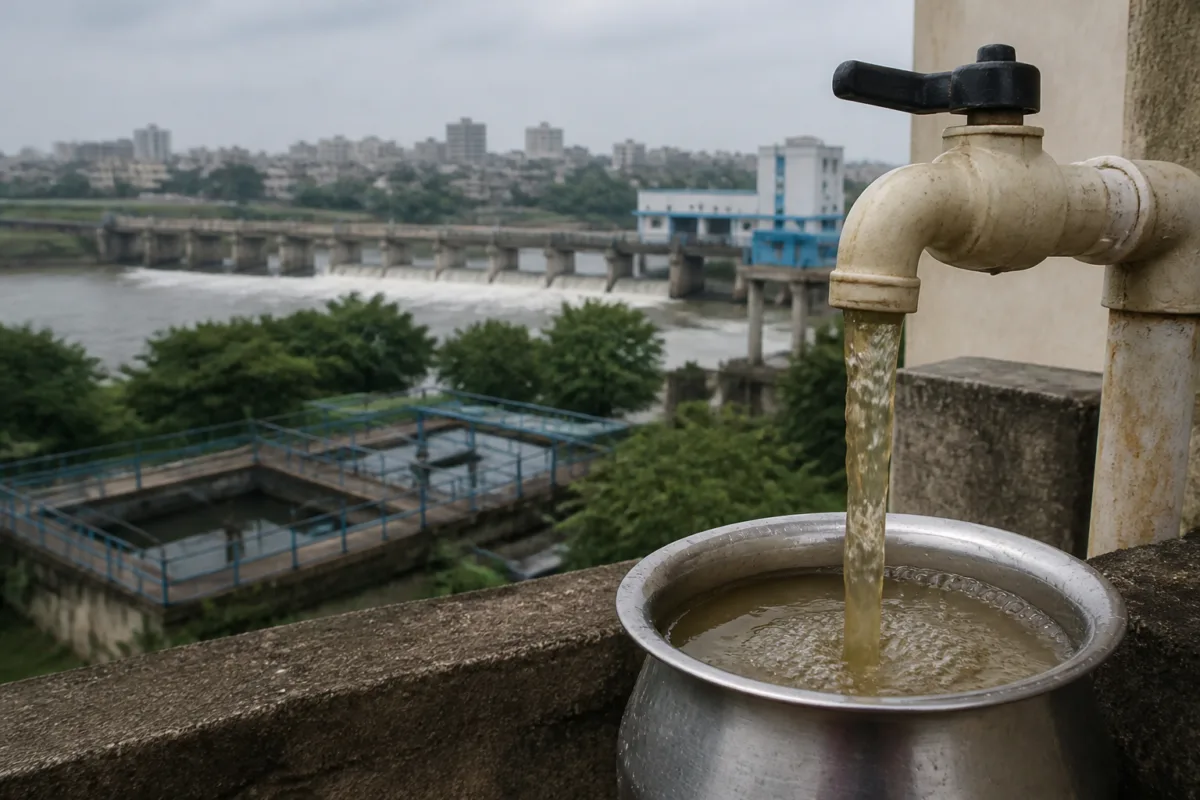
Surat’s recent water-quality disruption was not a one-day contamination incident. For nearly 20 days, residents in areas including Rander, City Light and Bhestan reported discoloured, foul-smelling water, while some also reported stomach-related health problems. Although the Surat Municipal Corporation (SMC) said conditions had improved after water was released from the Ukai dam, the episode has exposed a deeper weakness in the city’s water-supply system: a recurring dependence on natural or emergency flushing to protect the quality of water stored at its main source.
The immediate explanation offered by the civic body is linked to the condition of the weir-cum-causeway from which Surat’s water is drawn before treatment at purification plants. According to SMC officials cited by the Times of India, impurities and polluted water enter the weir over the year. This encourages vegetation growth and increases the density of the stored water. The resulting deterioration becomes more visible after the monsoon, particularly as temperatures rise during the transition to winter.
That sequence matters because it places the problem between the source and the household tap. Surat’s water is not supplied directly from the weir. It is treated at water purification plants before distribution. Yet treatment does not remove the need for effective source-water management. When the waterbody accumulates impurities, the treatment system has to manage a more difficult and variable input. The report does not provide laboratory results, details of the treatment process or data on whether treated-water standards were breached. It does, however, establish that residents experienced visible and odorous changes in supply for an unusually long period and that the civic body connected the episode to conditions at the weir.
The SMC’s explanation also points to an institutional arrangement in which seasonal river and reservoir conditions are central to urban water management. Water-quality complaints typically emerge every year after the monsoon, officials said. The corporation generally requests the state government to release water from the Ukai dam so that the weir can be flushed. This year, around 1,500 cusecs were discharged after the SMC sought the release.
The problem was that the intervention did not produce a quick resolution. The SMC attributed the slower improvement to limited rainfall and the absence of heavy discharge from Ukai during the monsoon. In previous years, officials said, monsoon flows naturally flushed accumulated impurities from the weir. That natural flushing did not occur this year, leaving contaminants in the waterbody for longer. The subsequent release from Ukai improved water quality to a large extent, according to the civic official quoted in the report.
This is more than a question of whether a single remedial measure worked. It reveals how a city’s water reliability can depend on a chain of conditions that extends beyond its municipal boundary. Surat’s civic administration operates the local water-supply and treatment system, but the availability and timing of water released from the Ukai dam are part of the response when the weir’s condition deteriorates. The episode therefore involves municipal operations, source-water quality, state-level water release decisions and seasonal hydrology.
The available account does not establish the exact administrative protocol governing such releases, the time required to approve them or whether a fixed contingency arrangement exists for years with limited rainfall. It also does not state whether the 1,500-cusec release was planned as part of a routine annual protocol or arranged specifically in response to the complaints. Those details are important because the difference between a predictable operating procedure and an emergency request determines how quickly a city can respond to deterioration in source-water conditions.
The duration of the disruption is the clearest signal in the report. Residents described nearly 20 days of poor-quality water and said they had not previously experienced such a prolonged period. That duration creates practical burdens even when water remains available through the network. Households may need to store or purchase alternative water, avoid using tap water for drinking and cooking, or spend additional time assessing whether the supply has returned to normal. The report does not quantify these costs, but the complaints indicate that the issue was experienced as a service failure rather than a minor change in appearance.
Public-health concern is also central, although the evidence supplied does not establish a causal link between the water and reported illnesses. Some residents said they experienced stomach-related health problems. Their accounts warrant attention, but they should remain distinct from a confirmed medical or laboratory finding. The report does not include test results, hospital data or an official health department assessment linking the symptoms to the water supply. That gap does not make the complaints irrelevant; it shows why timely water testing, public disclosure and clear health guidance are important during a prolonged quality incident.
The same distinction applies to the phrase “water quality improved”. The SMC official said the Ukai discharge resolved the problem to a large extent, but the supplied report does not provide before-and-after test results, the parameters measured, the locations sampled or the date on which the water was declared safe. Residents may therefore judge improvement through colour and odour while the authority relies on technical measurements. A durable public response requires both: transparent test-based communication and an explanation residents can understand at neighbourhood level.
Surat’s case also highlights the limits of treating recurring seasonal deterioration as an exceptional event. If complaints typically emerge after the monsoon and the response usually involves flushing the weir, then the city already has evidence of a recurring risk pattern. This year’s limited rainfall made the vulnerability more visible, but the underlying issue described by the SMC is the annual accumulation of impurities and vegetation in the source waterbody. A system that performs well only when monsoon flows provide natural cleaning has limited resilience when rainfall patterns change.
The report does not identify a permanent engineering or management solution. Residents have asked the civic body and councillors to find one rather than relying on temporary measures each year. Their demand raises a basic governance question: whether the city’s water system is being managed through preventive source protection and planned monitoring, or mainly through corrective action after households begin reporting changes.
Answering that question would require information not included in the report, including the frequency of water-quality testing at the weir and treatment plants, the pollutants or impurities detected, the operational changes made during the 20-day period, and the standards used to decide that supply had returned to normal. It would also require clarity on whether the SMC has assessed alternative flushing methods, source protection measures or upgrades to treatment and monitoring systems.
The immediate episode appears to have eased after the Ukai release, but the evidence points to an unresolved seasonal vulnerability. Surat’s water system depends on the condition of a shared source, treatment capacity and coordination between municipal and state authorities. When rainfall is insufficient to provide the usual flushing, the city’s ability to maintain consistent water quality becomes dependent on how quickly that vulnerability is detected and how rapidly additional water can be secured.
What the report confirms is limited but significant: multiple Surat neighbourhoods faced discoloured and foul-smelling water for nearly 20 days; the SMC linked the deterioration to impurities in the weir and inadequate monsoon flushing; around 1,500 cusecs were released from Ukai; and residents reported health concerns and demanded a longer-term solution. What remains unclear is the technical quality of the water during the disruption, the precise health impact and whether the civic response will change before the next post-monsoon cycle. Those are the facts that will determine whether this was a prolonged seasonal disturbance or a warning of a larger weakness in Surat’s urban water resilience.

