


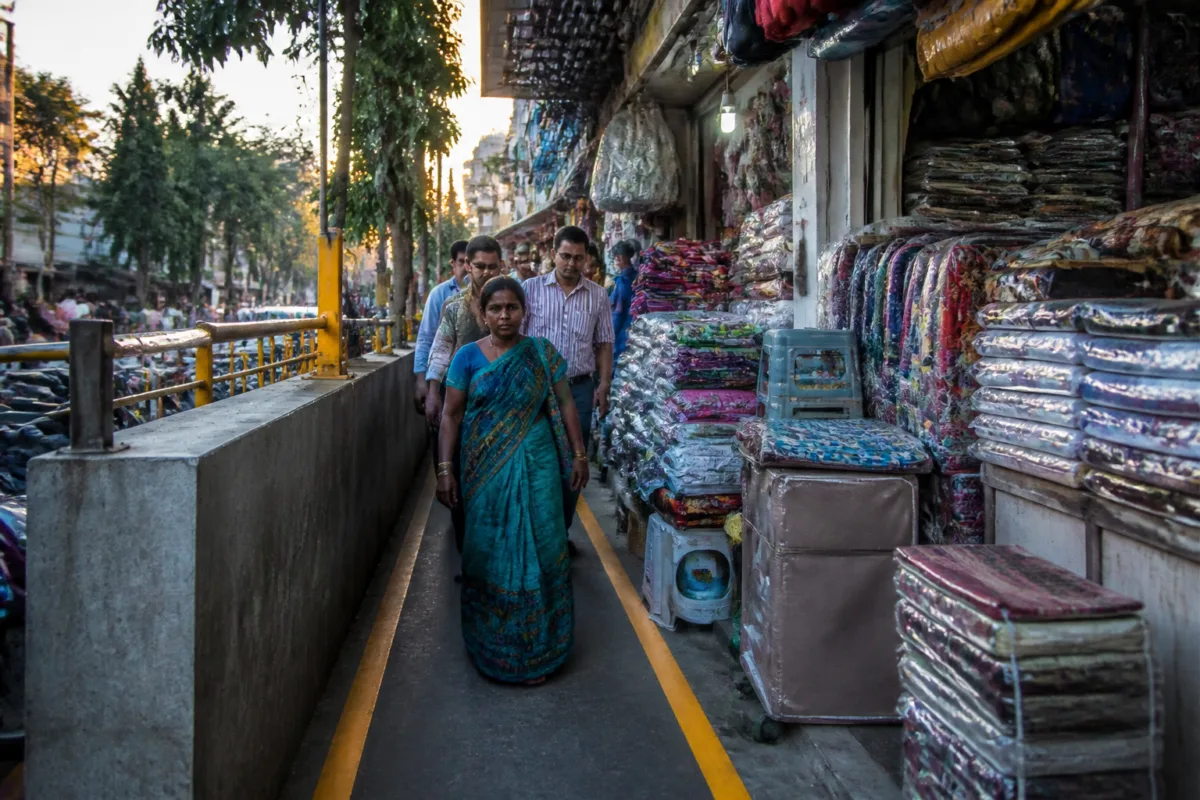
Bhopal New Market’s yellow lines were meant to restore pedestrian space, but fresh markings extending beyond the designated limits have exposed a deeper problem: the municipal boundary exists on the pavement, while enforcement remains uncertain in the market that uses it. The episode matters not simply because shoppers are being forced to squeeze past merchandise, but because the same narrowed pathways could affect evacuation and emergency access during a fire or other crisis.
The immediate sequence is clear. A recent fire at New Market raised concerns about congestion and inadequate access. The Bhopal Municipal Corporation then inspected the market, and the civic body’s commissioner visited the area the following week. After that inspection, the corporation ordered yellow lines to mark the space allotted to shops and prevent merchandise from spilling onto pedestrian pathways.
Yet the marking exercise produced a visible contradiction. Barely a day after the order, additional yellow markings appeared in some stretches three to five feet beyond the designated limits, according to the report. The area being absorbed was the space intended for pedestrians. In effect, the market acquired a physical line, but the line did not yet function as an enforceable limit.
That distinction is central to understanding what has happened at New Market. A painted boundary can communicate a rule, but it cannot by itself create compliance. The report indicates that shopkeepers continued to extend their merchandise beyond the allotted space, while the new markings appeared to formalise or enable that extension in places. The result is an enforcement problem made visible through paint.
The gap between the civic body’s stated action and the market’s functioning is also significant. The BMC’s press release after the inspection presented a reassuring picture, but the ground-level situation remained difficult even when the market was closed on Monday. Pedestrians still struggled to find space to walk. If the pathways are constrained when shops are inactive, the report notes that congestion is likely to become more pronounced when businesses open and festive shoppers arrive.
This is why the question cannot be reduced to whether individual shopkeepers have crossed a line. The available evidence points to a larger administrative test: can the municipal corporation define, monitor and protect a public pathway in a commercially active market? New Market is not merely a row of private shops. Its circulation space is shared by shoppers, workers, residents and emergency responders. When that space is occupied by merchandise, the cost is transferred to everyone using the market.
The timing of inspections is therefore important. BMC officials have been visiting the market, but the report says these inspections typically take place in the morning, before shops open and before the main bustle begins. That schedule may allow officials to observe the physical layout, but it does not necessarily reveal how the market functions during its busiest hours. Merchandise can move outward, pedestrian flows can intensify and access routes can narrow after the inspection has ended.
This creates a basic mismatch between the administrative moment and the public experience. The corporation is checking conditions when the market is relatively inactive, while residents encounter the consequences when commercial activity is at its peak. An inspection that does not capture operating-hour conditions may confirm that space exists in principle without establishing that it remains available in practice.
The recent fire gives the issue a direct safety dimension. The report does not provide details about the fire’s cause, damage or response, but it says the incident exposed risks associated with congestion and inadequate access. That makes the condition of the pathways more than a question of convenience. Narrow passages can affect how quickly people leave an area and how easily emergency responders enter it. The report’s central concern is not that a fire will necessarily occur again, but that the market’s current layout raises questions about movement during an emergency.
Public-space enforcement is often treated as a periodic clearance exercise: officials inspect, mark a boundary, issue a warning and move on. New Market shows why that cycle may be insufficient. The boundary has to remain visible, respected and monitored after the inspection. If merchandise returns to the pathway or the limit itself is shifted, the formal order loses operational meaning. The issue is therefore not the absence of a municipal instruction. It is the absence of evidence, in the supplied report, that the instruction is being sustained during the hours when it matters most.
The yellow lines also reveal an institutional communication problem. They are intended to make the permitted shop area legible to traders and enforcement staff. But when markings appear three to five feet beyond the designated limits, different actors may be operating with different interpretations of where commercial space ends and pedestrian space begins. Without consistent enforcement, a line can become a negotiation rather than a rule.
The report records no response from BMC Commissioner Ramprakash Ahirwar despite attempts to contact him. That leaves several operational questions unanswered. It is not clear from the supplied material who authorised the additional markings, whether they were official, what action the corporation plans to take against extensions, or whether inspections will be conducted during business hours. It is also not clear whether the civic body has identified a specific emergency access route through the market or set out a timetable for restoring the pathways.
Those unanswered questions matter because the corporation’s responsibility extends beyond issuing a warning. A functioning enforcement system would need to establish the approved shop boundary, ensure that the boundary is applied consistently and verify conditions when the market is open. It would also need to communicate what traders can display, where pedestrians are expected to walk and how emergency access will be protected. The supplied report does not establish whether such a system is in place.
The market’s festive-season context adds pressure to the existing arrangement. More shoppers mean greater demand for movement through the same constrained space. The report specifically links the expected festive crowd with the possibility of heavier congestion. That does not require a prediction about an incident; it is a straightforward capacity question. If pedestrians already struggle to find space when shops are closed, additional footfall will put further pressure on the available pathway.
This is also why the issue has relevance beyond New Market. The pattern described here—inspection, marking, warning and continued encroachment—raises a recurring urban governance question: who protects the space between private commerce and public movement? The pathway may sit physically beside shops, but its function is public. When it is progressively occupied, the city’s rules remain visible while the public benefit they are meant to secure disappears.
The evidence currently confirms three things. First, the BMC responded to a fire and safety concern with an inspection and an order to mark shop limits. Second, pedestrians continued to face constrained movement, with additional markings appearing beyond the designated boundaries in some stretches. Third, inspections conducted before business hours may not be capturing the market’s most congested conditions. Together, these facts show a gap between formal intervention and lived urban conditions.
What remains unclear is equally important. The report does not establish who made the additional markings, whether enforcement action followed, how the BMC defines emergency access at New Market or whether the commissioner will respond to the concerns raised. The next meaningful test will come during active trading hours, when the corporation’s boundary is no longer simply painted on the ground but challenged by the demands of commerce and crowds. Until then, New Market’s yellow lines remain a sign of municipal intent rather than proof that pedestrians have regained their space.

